Thursday, January 8, 2026

An Interview With Dana King, Author of the Nick Forte Novels

 One Bite at a Time: Criminal Econ 101 is your seventh Nick Forte novel. How long do you think you’ll continue to write this character?

Dana King: I have another in progress now. After that he’ll appear in at least one of the upcoming Penns River novels. Beyond that, we’ll see. A few years ago I didn’t know I’d write as many Fortes as I have already. It all depends on what ideas I get that are best suited for him and how long I continue to write. I am seventy years old, you know.


OBAAT: Forte is a throwback, tough guy private investigator. Why not make him more in line with the recent zeitgeist of more woke, less violent detectives?

DK: Because the PIs I read that made me want to write these stories were in the classic mold. Sam Spade, Philip Marlowe, The Continental Op, Spenser, Patrick Kenzie, Elvis Cole. They all have unique personalities and handle many things differently from each other, but they’re all guys who will talk a problem out for only so long. It should also be pointed out that Forte is not insensitive. He’s just willing to tune up those who need it.


OBAAT: You didn’t mention Mike Hammer.

DK: Mickey Spillane had a lot to do with me starting into writing, but as I developed novels I found Hammer’s approach and Spillane’s style had become stereotypical and hard to write around without sounding derivative. I haven’t read a Hammer novel in a long time. The last one I read seemed stylistically dated, but that’s the fault of all the imitators since. I also tried to watch Hill Street Blues and Moonlighting a few years ago and couldn’t get into them. Other shows have taken what they did and refined it to the point where some things in the originals seem almost primitive. That doesn’t mean I love and respect those shows any less. Same with Spillane and Hammer.


OBAAT: You said Mickey Spillane had a lot to do with you starting to write. Where did the idea for Nick Forte come from and how did Mickey Spillane influence that?

DK: I used to be a professional musician. Trumpet player. My career, such as it was, ended and I was looking for a creative outlet when a good friend complained about an audition being rigged. Understand, that doesn’t mean anything underhanded went on. Mostly it meant some people thought the orchestra already knew who they wanted and went through the motions of holding auditions, which meant a hundred fifty trumpet players had to pay to fly in from wherever to audition for a job they had no chance of getting.


Looking at such things from the outside as I was after quitting, I thought of an idea for a private eye who was knowledgeable about the ins and outs of the instrumental music business, called in to investigate a shady audition; my closest friends got thinly disguised characters based on them.


For the detective’s name, ‘Forte’ was an obvious choice. It means ‘loud’ in music, but is literally ‘strong’ in Italian. I chose ‘Nick’ because I needed a name that worked with an Italian surname and had the punch to it a hard consonant provides.


I spent a weekend binging the first three Mike Hammer novels and wrote the story in a week as both an homage and a satire. It was so well received by my friends I wrote another for the job I was working at the time, then another for the job I went to from there. A few people encouraged me to try my hand at a novel. As almost all writers do, I wrote a couple that will never see the light of day, though one was able to garner me an agent. The third was A Small Sacrifice, which earned a Shamus nomination, so I figured I knew what I was doing.


OBAAT: Readers tend to give Forte a pass for some of his more egregious transgressions thanks to the relationship he has with his daughter, Caroline. Was that something you deliberately set out to do?

DK: It’s a funny thing, how writing works sometimes. I didn’t set out to do that, but as I revised the book I saw how a close relationship with his daughter leavened Forte’s character. I’, a divorced father myself and used that to add some depth and occasional lessening of tension. Almost everything Nick and Caroline do in the books is drawn from things I’ve done with my own daughter, Rachel. I chose the name ‘Caroline’ for Nick’s daughter because it was first runner-up for a middle name for Rachel.


OBAAT: I asked Nick Forte in a recent interview how he “reconciled the loving father [Caroline] knows with the violent man others may see and she’s learning about through the Internet?” He told me I should ask you. Okay, I will. How does he do it?

DK: Forte doesn’t need to reconcile a thing. He is who and what he is. Like anyone else, he conducts himself differently in different situations and he takes those situations, and the people in them, as he finds them. When he’s with Caroline, he’s a loving father. When he’s with someone who needs sorted out, he’s more than capable. We all have multiple sides to our personalities.


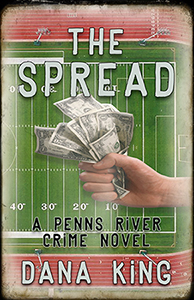
OBAAT: Forte ‘guest stars’ in a couple of your Penns River novels. (Grind Joint and The Spread.) How did that come about and what makes it work, in your opinion?

DK: In Grind Joint I needed a character to color outside the lines a little so that the lead detective in Penns River, Ben ‘Doc’ Dougherty, could remain true to himself and still get the book to come out right. I’d written four Forte novels by that time, and Nick was perfect, so I made him Doc’s first cousin to make the relationship closer and explain how this Chicago PI comes to a little town in Western Pennsylvania precisely when they need him most..


OBAAT: You’ve twice been nominated for Shamus Awards by the Private Eye Writers of America, and this year you’re on one of the awards committees. What does PWA mean to you?

DK: Private eye fiction may be the most uniquely American literary genre. The Irish author Declan Hughes – creator of the Ed Loy books – gave an impassioned speech at Bouchercon in 2008 about how, when done right, the PI novel is the highest form of crime fiction. Declan made me proud to write PI stories.


What Bob Randisi began with the intent of keeping the genre vital is, to me, a noble thing. The annual banquets were special, and I miss them since they were discontinued after COVID. They were opportunities for the True Believers to get together and celebrate what their peers were doing to keep the genre alive. I hope someday they’ll start up again.


As for the awards, Bob was open to self- and independently published writers submitting when no one else was. MWA wouldn’t consider me for membership and I had two Shamus nominations.


The Shamuses are also among the few awards that are not popularity contests, as they are decided by an author’s peers. It’s an honor to have been asked to serve on an awards committee. It allows me an opportunity to give back to the genrewhile acknowledging I have been a worthy contributor to it. That’s something sales alone cannot deliver.

An Interview With Private Investigator Nick Forte

One Bite at a Time: Let’s get the elephant in the room out of the way right off the bat: you’ve killed several men. How do you feel about that?

Nick Forte: I don’t feel good about it, but I’m not losing sleep, either. Remember, I wouldn’t be here to answer that question if I hadn’t taken care of those guys.


OBAAT: You’re a throwback to an earlier age of detectives; some might call you a dinosaur. How do you justify your methods?

NF: I don’t need to justify myself to anyone except as the law may require. I do what I feel has to be done at the time. If there are repercussions, I’ll deal with them as they come up.


OBAAT: Your daughter Caroline figures prominently in these novels. How has your relationship with her evolved as she grows, and how do you reconcile the loving father she knows with the violent man others may see and she’s learning about through the Internet?

NF: What’s between Caroline and me is between Caroline and me. Next question.


OBAAT: But she’s a key element of your books.

NF: I don’t write the books. King does. You want to know why he writes them the way he does, ask him.


OBAAT: Are you a violent man?

NF: Do you mean do I go out looking for opportunities to be violent? No. I will say I have the potential for violence and people would do well not to provoke me beyond a certain point. A friend once said I am the poster child for ‘fuck around and find out.’ I can’t argue with that.


OBAAT: It’s safe to say your closest friend and confidant is Timothy “Goose” Satterwhite, a collector and enforcer for various crime entities on the South Side of Chicago. You were a police officer and consider yourself to be working on the side of the angels. How do you reconcile the close association with such a known violent criminal?

NF: Tim Satterwhite has pulled me out of more scrapes than I have fingers to count. I know there are people who wonder how we can be friends, but the kind of work I do doesn’t bring me into contact with a lot of priests or schoolteachers or caregivers. I take my friends where I find them.


OBAAT: You seem to be more inclined to take the law into your own hands as the series goes on. How do you justify that?

NF: The law tells what’s legal, not what’s just. Among the things that frustrated me as a cop was that I was constrained to work on what followed the law and not what the end result would be. As a private operator I can do a little more to see to it that people who need a better deal get one. And, sometimes, that those who were planning to escape justice have it applied to them.

Monday, January 5, 2026

From (Criminal) Econ 101, Chapter 3

 The aspect of the Nick Forte novels I am most often complimented on is the relationship between Nick and his daughter, Caroline. Caroline is growing up – she’s in high school now, playing in the marching band – but Nick isn’t any less protective. He struggles with it, knowing she has to learn how to take care of herself, but the Cone of Protection still exists.


From Chapter 3:


I met up with Caroline and her buds outside the band room. The plan was for me to drive Tyler and Joanna home before Caroline and I made the 45-minute trek to Bolingbrook.

Caroline had a better idea. Even I thought so.

“Can we get ice cream?”

We’d made this improvisation before. “You girls know the drill,” I said to her friends. “Send your mom or dad a text to ask, then show me they said it was okay.”

Apparently they had me pegged as a soft touch; the requests were already approved. Both girls nearly broke my nose shoving cell phones in my face

Sundae School was busy, not packed. I bought sundaes for all three girls – typical, and a primary reason I’m so popular when it comes to giving rides – and a milkshake for myself. I always got milkshakes when playing chauffeur, on the off chance we’d have to leave before I was ready. It’s hell to eat a sundae and drive at the same time.

I took my shake far enough away for them to be sure no eavesdropping took place. Tyler’s father got himself busted six months earlier and had yet to redeem his reputation. I maintained a line of sight so they wouldn’t have to find me when it was time to go.

Twenty minutes later two boys/young men I’d noticed sitting in a far corner made a detour on their way out to pass near my charges. No big deal. The boys looked like high school seniors or college freshmen. For all I knew they were friends or relatives of one of the girls.

A couple of minutes later Tyler’s and Joanna’s body language stiffened. Caroline was still cool, but she knew I was close and would handle anything too uncomfortable. The other girls had no such assurance.

These were always awkward situations. My first impulse was to go over and sort these boys out, but the girls needed to learn how to deal with social dilemmas; my best role was safety net. I finished my shake and was watching the situation play out when Caroline peeked over her shoulder in my direction.

I moved with an unhurried stride. Tossed my empty cup in a trash bin on the way over. Took each boy by an elbow to steer them past the girls’ table and toward the door.

This produced the expected reaction.

“Hey! What the fuck, man?”

“Who the hell are you?”

I didn’t speak until we cleared the door. Kept my voice in the register Caroline calls menacing. “I’m conducting a survey and want to ask you a couple of questions.”

These were Arlington Heights toughs, which meant South Side ten-year-olds would steal their lunch money before pantsing them. The taller one said, “You’re not going to like the answers if you don’t turn us loose, asshole.”

“First question: do either of you know what it’s like to eat soup through a straw for…I don’t know. Six to eight weeks? However long it takes a broken jaw to heal.”?”

Not the question they’d expected. “Uh…no.”

“Second and last question: would you like to find out?”

For sure not what they expected. All I got were head shakes.

“Then fuck off.”

            And off they fucked.

Friday, January 2, 2026

My Favorite Reads, Fall 2025

 My favorite reads from the fourth quarter of 2025.

 Notice I don’t say the “best” books I read over the past three months; these are my favorites. My ego is not such that I am willing to pronounce anything as “best,” which is a consensus thing.

 At best.

 The Black Echo, Michael Connelly. The first Bosch novel and not as fluidly written as later books would be, The Black Echo still has all the elements Connelly’s loyal readers came to love. If you’re a Harry Bosch fan and wonder how things got started, look this one up.

 Wolf Tickets, Ray Banks. A re-read I enjoyed just as much as the first time. Banks is one of those writers who makes you forget you’re reading; the book flows as if these two guys are telling you their stories. Using multiple first-person POVs can seem gimmicky, but Banks makes it seem like you’re coming across each of them in a bar on alternate nights. This is the book that set the Ray Banks hook in me.

 True Target, Austin Camacho. I don’t typically care for hit man protagonists but I’m a devotee of Camacho’s Hannibal Jones series, so I gave this one a try. I think I still prefer Jones – after all, he’s a PI and I’m a PI guy – but Skye is a protagonist who can carry a series. The story is never predictable but always makes sense, and Skye has aspects to her character – including her pronoun – that makes this not just another hit man novel.

 Winter’s Bone, Daniel Woodrell. I re-read this a couple of weeks before we lost Woodrell, so how great was out loss was fresh in my mind. A beautifully written book where the writing never draws attention to itself to interfere with the story or characterization, by which I mean Woodrell never succumbed to striving for the ‘sentence beautiful;’ telling stories in a gripping and evocative manner was how he naturally wrote. I think I’ve read all his novels now and I’ll continue to come back every year or so to remind me of his extraordinary talent.

 Not Born of Woman, Teel James Glenn. Frankenstein’s creature returns from the Arctic to work as a private investigator in pre-World War Two New York. Glenn’s writing evokes Mary Shelley’s voice while still giving Adam Paradise license to tell the story in his own way. Paradise has both gifts and limitations mere humans lack but none strain credulity once you accept the initial premise. This book deserves all the acclaim it has received.

 The Blooding, Joseph Wambaugh. Speaking of extraordinary talents, this non-fiction effort by another giant we lost this year shows his off on multiple levels. Though he was the greatest writer of police procedurals ever – rivaled only by Ed McBain – Wambaugh’s non-fiction is even better. Here he examines in detail two gruesome murders in an English village in the mid-1980s that led to the first instance of identifying a killer through genetic fingerprinting. Alternately funny and painful to read, The Blooding left me sitting quietly for several minutes after I finished it; I took a couple of days off from reading when I was done.