Monday, April 8, 2013

Is Crime Fiction Socially Aware?

Last week’s major topic in several blogs I read had to do with whether crime fiction was socially aware, at least as much as, say, science fiction or fantasy. (Jay Stringer looked at it on Do Some Damage here, after Steve Weddle got the ball rolling in response to multiple posts across the blogosphere; Steve provides the links.) I tend to be a few days late with my responses to the affairs of the day, so it won’t kill me to wait a few minutes while you read what Steve and Jay had to say, even though my two cents’ will probably then be a disappointment.

To me, this breaks down into two questions: Is crime fiction socially aware, and are science fiction and fantasy more so? Based on my reading, crime fiction is well aware of social issues, and discusses them well. I don’t read as broadly in the genre as some, so my perspective may be a result of a skewed perspective, as the writers I tend to come back to definitely have social perspectives they consistently work into their books: Dennis Lehane, George Pelecanos, Richard Price, Adrian McKinty, Tim Hallinan, John McFetridge, and Leighton Gage (among others) all take the time to point out social inequities.

Crime fiction lends itself well to this, as so much crime comes about, directly or indirectly, from unfortunate social circumstances. I’m not apologizing for anyone here. Two guys grow up in almost identical situations. One goes to work every day, pays his taxes, and never ask for anything from anybody; the other robs liquor stores or sells drugs. Choices were made. Good crime fiction can provide insight into how difficult those choices may have been, and what other options may have been available.

The trick is to keep the story satisfying and suspenseful, not slip into melodrama. In one of his Derek Strange books—I forget the title—Pelecanos communicated his views on gun control so plainly I was repeatedly distracted from the story—“enough, already”—even though I agreed with everything he wrote. Moonlight Mile is Lehane’s weakest book, in large part because his politics are so overtly displayed. Both have served their views far better in other books—Pelecanos in the Turnaround and The Night Gardener; Lehane in The Given Day. The points are better made in the latter examples, in large part because the reader was not beaten about the head and shoulders with them.

As I said above, my perception may be skewed because this is the kind of crime fiction I like to read. Still, it’s not like these books aren’t readily available.

Let’s turn now to science fiction and fantasy, and how much better they supposedly deal with social issues. I will begin by stating I can provide no examples. The closest thing I’ve read to science fiction in twenty-five years is Slaughterhouse-Five. Still, having read a reasonable amount of it as a younger man—both good and bad—there is one comment I feel comfortable making: sci-fi and fantasy writers have an easier go if it, because they get to create their own worlds.

If a sci-fi writer wants to talk about child labor, he can create a world where the conditions exist to make exactly the points he wants to make. The rules of this world must still be evenhanded enough to keep from straining the readers’ willingness to suspend disbelief too hard, but it’s a big advantage. Crime fiction writers—to paraphrase Chandler—have a not very fragrant world, but it is the world in which they live, and they must do what they can with it. It won’t do to set a novel in the current day that has draconian penalties for gun ownership. To address the other side of the spectrum, legal heroin is also not an option for the crime writer. True, crime fiction can be written in a dystopian (to the author) future, or in an alternate reality, but then the story becomes borderline sci-fi/fantasy, if it does not cross the line altogether.

There’s nothing wrong with that. Philip K. Dick blended noir and science fiction brilliantly in Do Androids Dream of Electric Sheep. (Made into the film Blade Runner, screenplay by Hamilton Fancher and David peoples, directed by Ridley Scott.) Dan O’Bannon, Ronald Shussett, and director Scott mix sci-fi and horror in Alien. The list is lengthy, and distinguished.

I guess what I’m getting at—you knew there had to be a point sooner or later—is comparing the social awareness of crime and sci-fi/fantasy is like comparing the amount of scoring in baseball and hockey. The contexts are different enough to make meaningful comparison virtually impossible. Add in the added complication of what can get published and read in a certain genre, and it’s safe to say any genre is as socially aware as its readers allow it to be.

Wednesday, April 3, 2013

Vivid and Continuous

The problem with many writing books—and writing teachers—is they tell you How it’s Done, sometimes in stentorian tones of great implied import. The end effect is too often to overwhelm the reader/writer, especially those still looking for their own way. There’s too much to remember, and it’s too hard. Some are deterred. Others decide rules are made to be broken, so I might as well start now.

John McNally’s Vivid and Continuous is an excellent entry point for a startup writer. It combines brevity (147 pages, not counting index and reading list) with a conversational tone to move the reader through key considerations in any type of fiction. Though the professed thrust is for those interested in literary ficiton, the lessons and examples will be useful to anyone.

The book breaks into fifteen chapters, each with its own topic. Ranging from The Ideal Reader, Beginnings, Titles, through Minor Characters, Humor (his “Sure-Fire Formula for Becoming Funnier in Thirty Days” alone is worth the price of the book) and wrapping up with Gestation and Humility. Each chapter describes a little of why it’s important, cites examples, but never becomes pedantic. If ever a writing book read like you were talking to a guy at a bar, this is it.

The examples are deftly used and should incline the reader to want to further explore many of them. The chapter on minor characters details how, in The Catcher in the Rye, Salinger uses a large number of characters who appear for too short a time to require—or even deserve—detailing to characterize Holden Caulfield through his descriptions and reactions to them. Salinger’s gift for putting the character’s image into the reader’s head with a single sentence. (Faith Cavendish, who “wasn’t exactly a whore or anything but that didn’t mind doing it once in a while.” Or Sally Hayes’s mother, who’d do charity work only if “everybody kissed her ass for her when they made a contribution.”) We may not have Holden’s background, but we all know these people.

The two final chapters stick out. In Gestation, McNally discusses the idea of each story needing its own time to be told. Some may flow, while others may need years to come together, left fallow for extended period until the writer’s experience or cultural events reach a point where the story opens itself to the author. The catch with fictional gestation periods is, no one knows how long they are, and they’re different for each story.

The final chapter is titled Humility. Cautioning young writers against hubris, McNally cites giants such as Thomas Pynchon looking back with dismay at some older stories, and John Steinbeck’s despair over how he had failed with The Grapes of Wrath. (“It’s just a run-of-the-mill book. And the awful thing is that it is the absolute best I can do.”) A caution to all fledgling iconoclasts who would break new ground because the world has never seen a talent such as yours: get over yourselves. If Pynchon and Steinbeck harbor doubts about their results, you should at least consider yours could be flawed.

McNally is not above using his own writing for example. This is often a turn-off. Here, it’s done with a difference. Instead of using his work to show How It’s Done, he uses what led to a piece of his to describe how it got there, warts and all. The lessons is not, “Listen to me, for I am great,” but, “You don’t to make some of the same mistakes I did. Take this for what it’s worth.” The engaging writing style and regular dollops of humor make everything do down with a smile.

Vivid and Continuous is an excellent book for fledgling writers, as well as those more experienced who need an occasional reminder of things to be aware of. It would be perfect for an adult education class that included student of various levels of ability, as its lessons apply on multiple levels. I learned a lot, was reminded of more, and had a great time reading it. My only disappointment came when I realized I had come to the end, a feeling that can be easily remedied with another read, if only to cherry pick the bits that most appealed to me.

Monday, April 1, 2013

The Big O Revisited

I recently extolled the virtues of Declan Burke’s The Big O on the occasions of its re-release as an e-book. It occurred to me while writing that blog my original reading of The Big O was five years ago. It might be time to see if I’d still agree with my original assessment.

I read it again. Liked it even more.

Much of that is due to my maturing as a reader and writer myself. (it’s not like the book changed in the interim. It’s the same copy I read in 2008. Any changes must be some Harry Potter shit.) Now I can see how Burke pulled off much of what he did, mainly in how responsibly he sets up things that may seem off-the-wall later. Far from limiting my enjoyment, this understanding enhanced it. Listening to Tower of Power is always a pleasure, but understanding how the horn lines and rhythm sections are put together adds a level of appreciation for whoever wrote the chart, and his ability is take the same musical tools available to everyone else and make something unique from them.

Burke’s work is like that. He operates on multiple levels in what is admittedly a “screwball noir,” using everything in the toolbox to good effect. He knows there are some things he can get away with because the book is, in effect, a comedy, so he weaves the characters’ lives more closely together than might seem plausible in a more “serious” work. The effect created is not unlike classic comedy films, where complication after complication turn out to be related somehow until you have people leaving rooms half a second before someone looking for them enters through another door. Knowing how hard it is to pull off—trust me, I do know—makes it that much more satisfying to see it done successfully.

It is, unfortunately, not uncommon to re-read something and wonder, “Why did I do that?” After giving The Big O a second going-over, I was left thinking, “What took me so long?” Now my task is to work Eightball Boogie and Absolute Zero Cool each into the To Be Read list before too much time passes. I don’t like to make the same mistakes twice.

Thursday, March 28, 2013

The Vegas Knockout

The Vegas Knockout is the second of Tom Schreck’s books I’ve read. I picked up a copy of TKO after hearing him speak at the Indianapolis Bouchercon and liked it enough to give him another try. Nice work, me.

The Vegas Knockout is another tale of never-was fighter Duffy Dombrowski and his basset hound, Max. Duffy’s alleged “real” job is as a social worker. That gig often interferes with his love of boxing. When the two butt heads, boxing wins. So, when Duffy is offered a chance for a couple of weeks’ work as a sparring partner for heavyweight contender Boris Rusakov—in Vegas, no less—he’ll do whatever he has to do to make it look as though he’s in a training class when he’s really in Vegas getting his ass kicked.

Vegas isn’t quite what Duffy expected. First, he has to find a way to get Max on a plane without loading him into baggage. (I’d tell you why, but that ruins a fun elements of the book, so read it and find out for yourself.). His accommodations are also not quite what he expected, though he gets over it. (Details omitted for the same reason as above. I don’t like to risk spoiling anything in a review.) He is able to coax his New York drinking buddies to come out. That has its fair share of surprises, too.

The plot is complex enough to hold your attention without becoming confusing. Some elements require a little more suspension of disbelief than I am accustomed to, but Schreck is aiming for a tone closer to Donald Westlake than to Richard Stark. Duffy is an engaging character. Funny, a loyal friend, not quite as bright as it would pay him to be. Max is a force of nature. Together, they create memorable scenes.

The scenes in the boxing gym are what make The Vegas Knockout stand apart. Schreck works sometimes as a boxing referee and knows how things work. He’s able to show all the warts and still not make Duffy’s love of boxing seem foolish. Duffy knows this sparring gig may be the pinnacle of his career. To many he’d seem a failure. To him, he has rubbed elbows and shared a ring with some of the best in the world. He understands the camaraderie of the gym in a way no one from the outside can fully appreciate, and will have the memories forever. That’s enough.

The Vegas Knockout is a funny book, full of engaging characters that cover the spectrum of human likeability. What makes it more than a piece of fluff is how Schreck uses Duffy’s love of boxing to stand in for any devotion truly held. Duffy is a success because everyone should have an opportunity to love something as much as he loves boxing, and the maturity to understand it’s okay if it doesn’t always love you back. Duffy’s success is in his journey, just as the greatest fun in The Vegas Knockout is in the reading.

Sunday, March 24, 2013

But What’s It About?

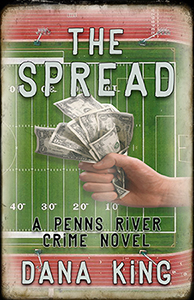
The current work in progress has been, without question, the biggest pain in the ass of any writing project I have ever undertaken. It started in the fall of 2011 as a PI story. By early spring things still weren’t coming together so I re-crafted the plot to become the next installment in my Penns River series and started over from scratch last fall.

I usually knock out a first draft in three, three-and-a-half months; this one took over six. The ending changed three times in the last three weeks. At least half a dozen new chapters will have to be in the second draft—including the final—as the original outline has not held up well to events on the gound.

I read chapters to The Beloved Spouse as they’re ready. She always catches things that need to be fixed, but this go-round has left me with the nagging feeling of having well-written scenes that don’t add up to a book. The end result is—to paraphrase Delroy Lindo in Get Shorty—I can’t wait for this book to be over. I always feel that way, but it’s usually four or five drafts in, and is my indicator things are about as good as they’re going to get. I know that’s not true here.

Enough bitching. All of the above are good things, because I’ve learned a valuable lesson. I gave up on the PI version when I realized the core element of the story—a religious-themed shopping center named Resurrection Mall—didn’t fit well with my PI character. It was better suited to be something built in Penns River, as a counterbalance to the casino introduced in Grind Joint. (Available Spring of 2014 from Stark House. I’ll probably mention that once or twice again.) Writing from that perspective has been easier, but there were still issues. I’ve finally figured out what they are.

The nagging concern that I had a series of good chapters in search of a book got me to thinking a key question for any book: what’s it about? I’d been writing with the idea the book was about Resurrection Mall, and Ben Dougherty was the main character. Uh-uh. It’s about life in a perpetually economically depressed community; the main character is the town. Making sure the narrative thread is continuous should not be my primary concern. The story can be told as a series of small town vignettes, each relevant to the core, but relevant in different ways, and the relevance may not be immediately obvious. It’s still going to be a lot of work, but I know where I’m going now, and it will be fine.

Stephen King says in On Writing that the trick for him is to find out what a book is about. On Page 201 he writes:

Not every book has to be loaded with symbolism, irony, or musical language (they call it prose for a reason, y’know), but it seems to me that every book—at least every one worth reading—is about something. Your job during or just after the first draft is to decide what something or somehtings yours is about. Your job in the second draft—one of them, anyway—is to make that something even more clear. This may necessitate some big changes and revisions.

I usually plunge more or less straight into second drafts.For me, half the reward of finishing the first draft is having an opportunity to fix it. This time, the process is different. I’m taking a week to read the entire first draft with the purpose of re-writing the outline to reflect what’s there, not what was intended. Take some notes and take a look at the forest for a change. Sub-plots will be altered or removed. Some chapters will be added, some cut, and others will be dramatically shifted in focus. It’s going to be as big a pain in the ass as any project I’ve ever tried. It’s also going to make for a better book.

This will end up a my most ambitious project, though it did not start out that way. It might work, or it might not. I’ll stay with it until it’s as good as I can make it, then you can decide whether all the effort was worth it.

Just like always.

Wednesday, March 20, 2013

Yet Another Benefit of E-Books

I’ve said for as long as I’ve been paying serious attention to e-books their greatest benefit to writers and readers is how they remove the demands of length from books. Traditionally published books could most economically be printed in “signatures” of 32 pages. This is why you so often saw blank pages at the beginning and end of books. (Sometimes still do.) They’re trying to get to a multiple of 32. E-books don’t care.

Price points are different, too. Publishers need to recoup the costs of publishing, binding, and shipping. (Including returns.) Those costs aren’t a great deal less whether the book is 160 pages or 320. The catch is, no one wants to pay $28.95 for a 160-page book. (As sales figures show, there may not be all that many people who want to pay $28.95 for a 320-page book, either, but that’s a different discussion.)

The two above points mean authors may be asked to either cut a long book, or more likely, to pad a shorter work. Cutting or adding material due to literary concerns is a good thing. Every story has an optimal length. Part of the writer’s chore is to figure out what that is, and match it. Cutting or padding for marketing or logistical concerns is never a good thing, but sometimes necessary. Even I understand that.

Not with e-books. They can be any length, and the price can be set accordingly, as there are virtually no physical production costs. No printing, no shipping, and—praise God—no returns. If your story requires 153 pages to tell, that’s how long the book is. Instead of charging $12.99 (or whatever the traffic will bear today for a full-length novel), charge $8.99 for it. Or $5.99. There won’t be any more assumed physical costs. E-books remove authors from the tyranny of length, Ray Banks caught this wave before a lot of people. I suspect someone like Scott Phillips will benefit, as well.

I recently discovered another oft-overlooked benefit of e-books, when Declan Burke re-released The Big O. Originally published in paper, the book received about one-tenth the notice it deserved before turmoil in the publishing industry cast it adrift in the stormy seas of unsupported books. Dec retrieved the rights and has recently brought it out as an e-book available for 4.99. (You choose the currency. Depending on where you buy it, it can be dollars, pounds or euros.)

This is good news for everyone. Obviously for Dec, as it gives him a well-deserved second chance for the book. (The final line in my original 2008 review, cut from my recent e-book piece, reads, “It's just as well Harcourt couldn't get it out in time for beach season; too many people would be staring, wondering what the hell you were laughing at.”) The Big O reminds me of a story Elmore Leonard could have written, if Donald Westlake had written the outline. It’s out of print in paper, but now Dec can re-launch on his own.

It’s good news for readers, too. Those of you who missed it—and you had to look hard to find it in the States—can now have Amazon drop one onto your Kindle in seconds. For cheap. You won’t spend a more entertaining 4.99 whatevers this year.

The best news may be for other authors. Publishers are getting hip to the potential and are looking for ways to keep rights from ever reverting back to authors, but books written before they wised up to e-books are fair game for their authors to re-launch. Keep your eyes open. With luck, all those gems noted in Books to Die For that fell out of print will soon be available for a relative pittance. These are books publishers decided had lived their natural lives, leaving serious readers to troll used bookstores and web sites, and less dedicated readers out of luck altogether. No more.

Good luck, Squire Burke. Not just for The Big O—though it deserves it—but for helping to break the path others may follow.

Tuesday, March 12, 2013

How To Query an Agent

The always readworthy blog Do Some Damage has a post today on the ever-popular topic, “How To Query an Agent.” My comment got a little lengthy, enough to make it a blog post of its own:

I'm amazed at how many people are looking for the "secret" to getting an agent. It's as obvious as a tarantula on a slice of angel food. (Apologies to Raymond Chandler.):

· Write a book they'll think they can sell. That means it's the best writing you can do, and has a chance of getting a publisher's attention. The writer may not be the best judge of either.

· Meet them halfway. Follow their guidelines. It will help to place yourself in their position: getting dozens of submissions a day. Everyone has ways they work best. The agent's guidelines reflect theirs. Do what they ask, just as you'd like anyone asking for your attention to do for you.

· Give them respect (they are professionals), but don't kiss ass (so are you). If their guidelines are too arbitrary and stringent for your tastes, don't submit. If they will only reply if they are interested, don’t submit. (That's my pet peeve. Emailing a rejection takes under thirty seconds. They can spare the time.)

· A query is like a job interview. True, if a contract is signed the agent theoretically works for you, but it has to be a mutual thing. If you don't put your best foot forward, you can't get a fair assessment, and it will be your fault.

Last, but most important: Stop whining. It doesn't help, and no one wants to hear it.