Monday, December 30, 2013

You Think I’m Funny? Funny in What Way?

I am a huge fan of Ray Banks. I’m working my way through the Cal Innes stories (read Saturday’s Child earlier this month) and believe him to be the current master at the novella e-books are so well suited for. (Gun and Wolf Tickets are brilliant, if you haven’t read them.)

This is why I sat up fast enough to cause a whiplash headache when I read his essay, “Five Noir Lessons from Charles Williams” on the Mysterious Press blog. Not only because his thoughts on the topic would be of inherent interest to me, but because he and I agreed on so much. The key section had to do with the importance of a GSOH (a Good Sense of Humor):

My favourite writers—or at least those authors who inspire and whose work lingers in the memory—tend to be inherently funny people with something serious to say. And while Williams was apparently something of a melancholic (and ultimately suicidal) in the flesh, he clearly possessed a wit and humour that informed his writing.

If you're under the impression that a sense of humour and a sense of noir are mutually exclusive, think again. A great tragedy relies on the same wicked timing that drives a great joke, and a writer who appreciates wit and wordplay is more likely to turn out sentences that bristle with energy. Williams is one of those writers: a dry, sharp stylist with a gift for stiletto description. And when he ventures into full tilt comedy—as he does in the screwball nonsense of The Wrong Venus—he does so with considerable aplomb.

Life is full of funny things. Even things that aren’t funny—violence, illness, even death—may be funny in retrospect, and may even be funny to some sick bastards as they happen. Even better, funny things happen in the most serious situations. Things happen, or are said, that have to be laughed at, no matter how stressful the time. It may even be the stress that makes them so funny.

Few things are as tedious as a story with no light touches. I’m not talking about jokes, but levity. Elmore Leonard was the master, bringing smiles through inadvertent character comments or actions. (Inadvertent for the character; Leonard knew exactly what he was doing.) A poorly chosen word, a statement made without full knowledge of the facts, someone whose pretentiousness exposes his ignorance; all can lend realism to a character. My favorite example is from—of course—Get Shorty, Bo Catlett talking to Chili Palmer about screenplays:

“You’re asking me,” Catlett said, “do I know how to write down words on a piece of paper? That’s what you do, man, you put down one word after the other as it comes in your head. It isn’t like having to learn how to play the piano, like you have to learn notes. You already learned in school how to write, didn’t you? I hope so. You have the idea and you put down what you want to say. Then you get someone to add in the commas and shit where they belong, if you aren’t positive yourself. Maybe fix up the spelling where you have some tricky words. There people do that for you. Some, I’ve even seen scripts where I know words weren’t spelled right and there was hardly any commas in it. So I don’t think it’s too important. You come to the last page you write in ‘Fade out’ and that’s the end, you’re done.”

Chili said, “That’s all there is to it?”

“That’s all.”

Chili said, “Then what do I need you for?”

Leonard laid out the key traits of both characters in 179 words, and you laughed. He said he wrote dialog heavy novels because he wanted to leave out the parts readers skipped, and they don’t skip dialog. They don’t skip humor, either. No one wants to miss a chance to be entertained. We’ve all read books, six hundred pages of unrelenting dreariness that had us rooting for the protagonist to die, already, put us out of his misery.

Another excellent use of humor is scene reversal. Start a scene off light and let the bad news hit even harder. Finally, something good happens to the character, and—boom!—the hammer drops. Wading through pages of despair, waiting for other shoes to drop, pretty soon it’s just one more tragedy. Give him some hope, a smile, maybe even a laugh, then crush him. That hurts.

That door swings both ways. Why would a character put up with such an unrelentingly dark life? I’ve read books where I thought about killing myself, and I was only reading about it. Who would put up with that? Even better, why? Because every so often something good happens. It might be as simple as watching a pompous ass slip and fall. Probably not funny to the guy who fell, but that’s the thing about humor: everyone sees it in different things.

Friday, December 27, 2013

Twenty Questions With Dan O’Shea

Daniel O’Shea is a Chicago-area writer. His first thriller, Penance, was published by Exhibit A in April; its successor, Greed is due in February 2014. Drawing on Chicago’s settings and history, the novels explore the city’s history of corruption, but with a national, even international flavor. Old School, a collection of short fiction, was published by Snubnose Press. (Editor’s Note: I know of no better writer of flash fiction.)

His Exhibit A bio states, “Dan would be a handsome gent if he could just stop breaking his nose.” His sartorial splendor more than makes up for it.

One Bite at a Time: Tell us about Greed.

Daniel O’Shea: Greed is my second Chicago novel. (Although the good folks at Exhibit A call it my second John Lynch novel, ‘cause I guess a series is supposed to center around a character. But, like Penance – my debut – it’s really a pretty ensemble cast, so I think about them as my Chicago novels.) It starts with a guy named Nick Hardin – former Marine, former French Foreign Legion – who’s been knocking around Africa for a couple decades, has fallen on some hard times and is looking for an exit strategy. So he steals some diamonds from some bad guys and heads home to Chicago to sell them to the one guy he knows with the contacts to move a mess of undocumented rocks.

Things get complicated. The night Hardin hits town, his contact is murdered. The bad guys, some Al Qaeda types, want their diamonds back and put their #1 trigger jockey on Hardin’s tale. A narcissistic movie star who has a real beef with Hardin sees him in town, calls up a mob contact and puts a hit on him. And then there’s this Mexican drug lord. See, the reason Hardin left the Marines for the Foreign Legion in the first place was he’d killed a punk in a street beef, and the Mexican drug lord happens to be the punk’s older brother. Turns out he holds a grudge. So when Hardin turns up back in town, the drug lord joins the party.

Which leads to bodies. Lots of bodies.

John Lynch and the Chicago cops start trying to sort out the bodies and end up with a hairball of conflicting clues that don’t make any sense. Meanwhile, a guy named Munroe, who’s a free-radical intelligence fixer for the powers that be in DC, hears that Al Qaeda has lost better than $100 million in diamonds – which they usually put on the move when they have an operation to finance. He starts wondering what Al Qaeda might be up to that requires that kind of financing, and whether it has anything to do with a former US Army biological weapons expert who had some very scary ideas and who just turned up dead.

Hilarity ensues.

OBAAT: Where did you get this idea, and what made it worth developing for you? (Notice I didn’t ask “Where do you get your ideas?” I was careful to ask where you got this idea.)

DO: Most of it I just made up as I went along. When I write a book, I just need a place to start. Hardin was what I started with this time. I’d read an article about this ex-military type who’s second career was as a fixer for TV news crews. They want to get into the hell-hole of the week and get some film in the can without their reporter getting his throat cut and without having to buy their equipment back from the local warlord for ten bucks on the dollar. So they hire him.

I’d also read an article about the evolution of the blood diamond trade in West Africa. Seems ethnic Lebanese have played a huge role in the West African diamond trade since forever. Seems that, with the Liberian civil war over, bad guys looking to move black market stones needed a new market. Seems that, since diamonds are small, valuable, and portable, Al Qaeda found diamonds to be a handy way to move money. So they used Lebanese contacts to muscle in on the blood diamond business.

That’s what I started with. A character and a situation I found interesting. Just went with it from there.

OBAAT: How long did it take to write Greed, start to finish?

DO: I wrote the first draft over a couple of months a few years ago. The problem being that it was written as the second in a series and I hadn’t sold Penance yet. Came close once, though. A pretty big New York house almost bit, but they had some specific objections. Being new and stupid, I figured hell, I’ll just re-write Penance, we’ll sell it to the big New York house and live happily ever after. The re-write changed the story quite a bit as it turned out. And, of course, the big New York house passed anyway. Problem being I wrote Greed as the follow up to the re-written version of Penance. Exhibit A bought the original version. So I had to reverse engineer the draft to work with that. That took, roughly, forever.

OBAAT: What’s the back story on the main character or characters?

DO: Sort of gave you Hardin’s story above. John Lynch is a second generation Chicago cop, pretty well connected guy, knows lots of people, knows how the city works, doesn’t approve of a lot of it. Munroe’s a guy that started out as a CIA asset back during Viet Nam and has been unofficially coloring outside the lines since the Church Committee decided the CIA needed to actually play by the roles back in the mid-1970s.

OBAAT: In what time and place is Greed set? How important is the setting to the book as a whole?

DO: Present day, mostly in the Chicago area. Chicago plays its role, but is not quite as important to this novel as it was in Penance. I’ve already got an idea working for my third Chicago novel that will be much more influenced by the city and its history.

OBAAT: How did Greed come to be published?

DO: Greed is book #2 in the two-book deal that crime über agent Stacia Decker squeezed out of Exhibit A.

OBAAT: What kinds of stories do you like to read? Who are your favorite authors, in or out of that area?

DO: I read all sorts of stuff, fiction and non-fiction. In the crime genre, on the big-name side, I love James Lee Burke and John Sandford. Also love John Le Carre. But every time I turn around I find somebody new that’s great. Just read Sean Chercover’s Trinity Game and I’ll be wanting more of him. Just read Duane Swierczynski’s Fun And Games and I’ll be wanting more from him. Same with Reed Farrell Coleman and Gun Church. Ask me that any given week and I’d probably throw out some different names.

Outside crime, always have loved Graham Greene, Saul Bellow, Updike, lots of the usual suspects.

OBAAT: Who are your greatest influences?

DO: I’ve never known how to answer that. Everything goes in the hopper and out comes the sausage. Not sure there’s a way to explain it beyond that.

OBAAT: Do you outline or fly by the seat of you pants? Do you even wear pants when you write?

DO: I wish I could work from an outline. It would save a lot of time. But it doesn’t work for me. In fact, any time I’ve tried to plan anything more than a chapter or two in advance, it seems like my characters actively rebel. So I just make it up as I go.

OBAAT: Give us an idea of your process. Do you edit as you go? Throw anything into a first draft knowing the hard work is in the revisions? Something in between?

DO: I try to clean things up as I go. Don’t usually need to do a ton of copy editing after the fact, but, because I’m winging it, whole story lines get tossed out or baked in occasionally. If something like that happens, I tend to go back and get things to line up again before I move forward. Obviously, because of the way Greed evolved, there was a ton of revision work.

OBAAT: If you could give a novice writer a single piece of advice, what would it be?

DO: Write. Just sit down and write. I fucked around for years and didn’t. Really wish I could go back two or three decades and kick myself in the ass for all the wasted time.

OBAAT: Favorite activity when you’re not reading or writing.

DO: *sits here scratching head* Ummm… Jesus, I need a life.

OBAAT: Which do you take to bed at night, the money earned or the good review?

DO: I’ll have to take the reviews at this point. I have more reviews from writing than money. And I don’t have that many reviews.

OBAAT: Would you stop writing if someone paid you enough money so you’d never have to work again, on the condition you could also never write again?

DO: Supposed to say never, right? That I’d die a tortured soul? That my neglected muse would claw its way out of my chest like that alien creature if I didn’t bleed onto the page? In reality? I’d like to think I’d say no, but it might depend on the number.

OBAAT: If you were just starting out, which would you prefer: 1. Form your own indie publishing house and put your work out in paper and e-book yourself? 2. Go with a small or medium traditional house that offers very little or no advance, a royalty that is only a fraction of what you'd get on your own, and also makes no promise of any type of publicity push, keeping in mind that you also will lose the publishing rights for a period, sometimes indefinitely? 3. Go with a Big Six or legacy publisher that offers a larger advance, legitimate review possibilities, entrance to industry literary awards, and exposure on the shelves of brick and mortar stores. Pick one and say why.

DO: This is the kind of stuff I don’t think about. I know myself well enough to know I’d never get around to all the crap I’d have to handle to self-publish effectively, so that’s out. I have a great agent who does think about this stuff, and does so knowledgeably. I’ll do the writing, Stacia can decide what to do with it.

OBAAT: Beer, mixed drinks, or hard liquor?

DO: Yes.

OBAAT: Baseball or football?

DO: Yes.

OBAAT: What question have you always wanted an interviewer to ask, but they never do?

DO: I got nothing.

OBAAT: What’s the answer?

DO: Something verbose and pretentious.

OBAAT: What are you working on now?

DO: Well, there’s this Bartholomew Daniels guy that I’m pretty close to. He also got a two-book deal with Exhibit A for this weird idea about turning William Shakespeare into an unwilling Elizabethan private dick. The first of those, Rotten At the Heart, hits the shelves in March. I’m kind busy helping him with the second one.

After that, as I said, I’ve got a start on Chicago novel #3, but I’m also itching to dive into a very different, much smaller, more intimate story that would be more in line with some of my short fiction.

As you see, ain’t no flies on Dan. Thanks a million for taking time out during the holidays to sit for Twenty Questions.

Tuesday, December 24, 2013

Merry Christmas / 2013 in Review

‘Twas aught thirteen, a hectic year,
Far busier than most,
The family traveled far and wide,
We were both guests and hosts.

As was expected, Rachel made
The most news of our crew,
Her college graduation came
And went with some ado.

To graduate with honors was
Not all of her acclaim,
Phi Beta Kappa had the key
To share its well-earned fame.

She’s done with school (at least a while)
Now working as a scribe,
To write down what the doctor says
So needs and treatments jibe.

Already there’s an interview,
A med school taking note,
She may soon get to cut folks up,
And wear her own white coat.

But Rachel’s not the only one
A milestone to achieve,
My parents, married sixty years,
A present did receive.

My brother, Stu, and I agreed
To make sure they could see
My Rachel in her cap and gown;
Then after which they’d flee

To Colorado, Hailey’s home
To watch her bid adieu
To high school, amidst family,
Her Dad: the beaming Stu.

Twas Stu who drove them mountainward
And I who brought them back
We learned I-70 quite well,
It was our beaten track.

Eclectic taste in music is
A trait we all enjoy,
Stan Kenton’s old alumni band
Returned me to a boy

The three of us saw TOP
(That’s Tower of Power, you know)*
Plus Big Bad Voodoo Daddy and
Dick Dale, who’s quite a show.

Our Corky’s cards and crafts galore
Continue unabated.
There’s paper stashed from roof to floor;
This card, by her created.

She found some time to take a trip,
New Hampshire, in the fall
To visit with some family,
A good time had by all.

Her son from California came
To visit us at home
And showed that family’s always close
However far they roam.

And as for me, my year has been
A lot of peaks, no valleys,
My first real paper book in print
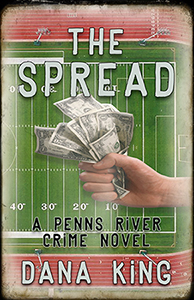
Was added to my tally.

A readers’ conference gave me space
To sit among my peers
And talk about the way we write
Then knock back several beers.

Recounting all we did this year
Has been a humbling task,
Recalling what’s been done for us
Without needing to ask.

Whatever we accomplish here
Cannot be done alone,
We all depend on your support,
Which is so freely shown.

We hope this note finds all you well,
With futures only bright
The Kings now bid a fond adieu
And wish you all, good night.


( * - This line fits when read with the proper Western Pennsylvania accent.)

Grind Joint in the LA Review of Books

Woody Haut, writing in the LA Review of Books, has named Grind Joint among his fifteen favorite reads of 2013. Not in the Top Ten, but that was populated by the likes of Daniel Woodrell, James, Sallis, Max Allan Collins, and Sarah Weinman.

Haut said of Grind Joint: With crisp dialogue and sparse exposition reminiscent of Elmore Leonard and George V. Higgins, it’s an investigation of a town on the edge of a precipice.

Read the entire list. It’s not limited to 2013 books, so there may be a couple you’ve missed along the way.

Monday, December 23, 2013

Audio Interview at The Author’s Show

My radio interview with Don McCauley at The Author’s Show is live all day December 23 (Festivus, how cool is that?) and can be heard here.

Sunday, December 22, 2013

Festivus

Today is Festivus, the holiday for the restofus. As we’re separated by great distances, I’ll leave the feast and Feats of Strength to you to handle individually. The Airing of Grievances commences anon.

Facebook claims to advertisers it knows more about each of us than does the NSA. If their algorithms are so accurate, why have the past couple of weeks brought me suggestions that I might like Justin Bieber, the Winchester Brothers, and my own author page? (There were a couple of even more egregious examples, but I forgot to write them down. Those people were so little known to me I have no hope if recovering the memory.) Who’s next? Kanye West? Miley Cyrus? That black guy with the pick in his hair from the Miller Lite commercials? All I know is, if the Philadelphia Flyers show up as a suggested like, I’m out of there.

I read Walter Mosley’s Devil in a Blue Dress last week. (Loved it and will have more to say in the monthly wrap-up.) A lot of paperback books place excerpts from another of the author’s works at the end of a book; Simon and Schuster saw fit to put an excerpt at the beginning this time, and didn’t make what I’d consider to be a fuss that what came first was not Devil in a Blue Dress. I noticed it and skipped the excerpt—which I always do—but I would have been pissed to have read forty pages—that’s right, four-zero pages—of a book I hadn’t bought before finding out A) this isn’t the book I wanted to read, and 2) I have to buy another book to see what comes next. I also shouldn’t have to hunt for the beginning of the story I paid for, and would guarantee I won’t buy the book they tried to trick me into getting interested in.

I had to add “Festivus” to my spell-check dictionary. Next I’ll find out “Lebowski” isn’t included, either. (Goddamnit, it’s not!!)

The Sole Heir returned from a medical school interview in Colorado at 2:25 am Sunday. The scheduled arrival was 12:55, but still. If airlines are going to schedule flights to come in that late, would it bust their balls to have a few more chairs where people can wait for the arriving passengers in the event of a delay?

I had to sit through a motivational speech the other day, about how at 211 degrees water is just hot, but at 212 it’s steam; with that extra degree, you can accomplish anything. I don’t mean to discourage people, and everyone should have their dreams, but talent and luck are at least as important as hard work. No one ever wanted to be a trumpet player more than I, or worked harder at it; I lack the talent. Facing facts is not defeatism. Tony Roberts and his ilk are full of shit. (Don’t even get me started on the effort required to get to 211, and how much might be left in the tank. Then there’s Celsius, where that extra degree is 80% more difficult to achieve.)

Why is that Duck Dynasty douche nozzle allowed to say whatever heinous shit he wants and hide behind the First Amendment, and I’ll get blasted if I call him out as the inbred redneck sister fucker he (probably) is? Don’t I have a First Amendment right to be offensive, too? (I added “probably” in case someone reads this to him and he decides to sue for libel. Of course, since truth is a valid defense against libel, if he doesn’t sue, I must be right, right?)

Why is there only one Festivus a year? I can live without the pole and Feast and FOS, but I’m just getting warmed up on this grievance business. Lend a hand in the comments. Indulge yourself.

Friday, December 20, 2013

Bouchercon Interviews, Part 10: Conclusion

Today ends the Bouchercon interview series, and I thought it was only fair for me to have to answer the questions I have subjected so many others to these past ten weeks.

One Bite at a Time: What made you decide to come to Albany?

Dana King: Bouchercon was there. Going is now my default mode; it takes a compelling reason for me not to.

OBAAT: What’s the most important aspect of Bouchercon for you? (This year, or any year?)

DK: The atmosphere. That sounds like a cop-out, but I’m jazzed from the minute I get there until well after I’m home again. I never feel more like a writer than when I’m at Bouchercon and during the afterglow.

OBAAT: Were you on any panels?

DK: I lucked into one of Peter Rozovsky’s panels. Peter led Eric Beetner, Mike Dennis, Terrence McCauley, Jonathan Woods and I in a discussion of hard-boiled and noir writing. It was a great experience, from the prep—reading these guys was a treat—to the aftermath.

OBAAT: To you, what makes a good panel, from a panelist’s perspective?

DK: A well-organized moderator who knows what he’s doing, isn’t afraid to steer enough to keep things on track, and does what he can to set the panelists up with discussion provoking questions. You know, Peter Rozovsky.

OBAAT: What do you look for when deciding which panels to attend?

DK: My opinion has evolved there. I used to look for topics where I thought I might learn something. I still do some of that—PI panels will draw me just about every time—but now it’s more which panelists and moderators look like they’d be more entertaining.

OBAAT: What makes a panel good for you when you’re in the audience?

DK: If it’s fun. The panelists should be enjoying themselves, which will convey to the audience. A perfect panel would seem like eavesdropping on a gently guided bull session among bright, witty, and opinionated people.

OBAAT: Would you like to see more or fewer questions from the audience?

DK: Before the series of interviews, I would have said fewer. Too many audience questions are directed to a particular author, and either begin with “Don’t you think…” or end with “Do you Agree?” Somewhere in there is often a rambling manifesto or asking why the author being questioned killed Misery in his last novel. I like Jack Getze’s idea of allowing the audience to submit questions in advance to be chosen by the moderator a lot.

OBAAT: What’s your favorite Bouchercon story, from this year or any past years?

DK: Baltimore, 2008. My first Bouchercon, and I know about three people, and I met them online. Fortunately, Peter Rozovsky was one. He saw me early in the first afternoon, when I’m not having a good time at all, and asked how I liked it so far. We talked and it came up how it’s hard for me to talk to people I don’t know. Peter looked around, and calls over a guy I don’t know. Asked me, “Do you know Scott Phillips? Scott, this is Dana King.” Scott and I shook hands. Peter said, “Okay, now you know Scott Phillips.” Scott made a little small talk and begged off, as he was needed elsewhere. Next year in Indianapolis, I saw him at the bar, said hello. A few minutes later, he leaned over to me and said he and several other people were going to get something to eat; did I want to come? Ever since, Bouchercon introductions have not been an issue for me.

* * *

Before we leave this go altogether, let’s take a look at some of the questions everyone was asked, and see if there is any consensus.

What’s the most important aspect of Bouchercon for you? (This year, or any year?)

People and friends, overwhelmingly. Not panels, not inside industry talk (though both were mentioned); it’s the people. That would have surprised me five years ago; not now. Crime fiction writers and readers are as nice a group of people as you’re going to meet, and are well worth the trip, just to hang with.

What makes a good panel, from a panelist’s perspective?

The consensus wasn’t as clear here, but the moderator is key. The selection of questions to provoke discussion, keeping things moving while not stopping a discussion that’s on a roll, and understanding the audience is not there to hear the moderator promote an agenda; they’re there for the panelists.

What do you look for when deciding which panels to attend?

This was all over the place. It boiled down to the moderator, the topic, the panelists, and the timing. There’s not much else to consider. (Room temperature? Restroom proximity?) Everyone has their own ideas.

What makes a panel good for you when you’re in the audience?

There was no clear consensus here, either. Moderators were mentioned a couple of times. Preparation also came up, for both moderators and panelists. A thread expressed differently by all was getting to know the authors though their comments and demeanor.

Would you like to see more or fewer questions from the audience?

Almost universally “yes,” with a few “it depends.” Audience questions can be risky if someone tries to hijack the panel. (Once again, a good moderator is clutch, even though no one mentioned moderators in their answers to this question.)

So ends the series on Bouchercon. This was a lot more fun—and a lot more informative—than I expected when I got the idea back in September, and I expected a lot. Countless thanks to everyone who participated for their willingness to share their time, and the openness of their opinions. I’m looking forward to seeing everyone in Long Beach in 328 days.