Thursday, June 27, 2024

Spring's Favorite Reads

 As you’ll soon see, the spring that just ended was a good season for reading, at least for me. Two vacations, one of them extended, gave me more time than usual for reading. I did not waste it.


The Monkey’s Raincoat. Robert Crais. A lot of writers tone down the things that made them popular once they become bestsellers; I guess it’s the way of the world. Once you’re on top, the publisher wants to keep you there, which inevitably leads to writing books they hope will attract a wider audience than the core group that launched you; the core will stay, whatever you do. This is not to imply Crais has watered down his writing in recent years, but I decided to go back and read the early Elvis Cole books in order, so I got myself a copy of The Monkey’s Raincoat and had at it. It was a pleasure to be reminded of what attracted me to his writing in the first place; this is as good a first PI novel as has been written since The Big Sleep. No question I’ll stick with the plan and work through these in order now.


All Them Wrong Things, James D.F. Hannah. I began to include as yet unreleased ARCs in these reviews about a year ago, but this is the first time I’ve included a book that is not yet under contract. Hannah is hot right now, with awards and nominations and inclusions in annual anthologies. Best known for his Henry Malone PI stories, All Them Wrong Things  is a departure for Hannah, the story of a decent man caught up in small town corruption and a brother who is an asshole for the ages. All the action and great dialog you’d expect from a Malone book is here, with a story sensibility more in the direction of Elmore Leonard or S.A. Cosby. Let’s hope this one finds a home quickly.


Joey Piss Pot, Charlie Stella. (I read an ARC; the book drops in July.) No one since George V. Higgins has captured the sense and attitudes of organized crime better than Stella, and even though it’s been a while since he wrote in this genre, Joey Piss Pot shows the author hasn’t lost an inch off his fastball. The book abounds with intersecting plot lines, characters who aren’t as smart as they think they are – or need to be – and dialog that reads like you’re at the next table in the bar eavesdropping. Stella’s fans will be delighted, and Joey Piss Pot should also bring him some new ones.


The Outfit, Richard Stark. The fourth Stark/Parker book I’ve read and, for my money, the best of the four. Stark spends more time in other people’s heads than usual here, and the effect is engrossing, as he takes events tangential to the main plot and spends entire chapters on them without making you wonder when he’s going to get back to what the book is ostensibly about; that’s a gift. Stark is on my list of writers I’ll make a point to read at least once a year and I see no reason why he shouldn’t stay there.


The Hot Kid, Elmore Leonard. This is a book that holds special significance for me. It came out in 2005, when I was not only not published, I wasn’t even what could be called a member of the writing community, more like a reader with delusions of writing adequacy. I won a contest with HarperCollins for an ARC of The Hot Kid so long as I wrote a review they could use. I used what I wrote for them as my audition to be a reviewer for the New Mystery Reader website. NMR editor Stephanie Padilla liked it, started assigning books to me, and gave me my first look inside. This exposed me to a lot of books and authors I would not otherwise have discovered, and interviews with several of them – notably Ken Bruen, Declan Hughes, and the aforementioned Charlie Stella – brought me inside the community; the interview with Stella led almost directly to my first contract. It’s been almost twenty years since I read Carlos Webster’s exploits, so I decided to see how well the book held up. The answer is, very. It rambles a little, but the action and dialog are all top-notch Leonard and the book is as much fun to read as anything he wrote, right up there with Get Shorty.


Killer’s Choice, Ed McBain. There isn’t much to recommend this 87th Precinct novel over any of the others. There’s also nothing that makes it not at least as good as most. In short, it’s a solid McBain Eight-Seven story, which means it’s outstanding.


Resurrection Walk, Michael Connelly. I was off Connelly for several years, mostly because his writing doesn’t have the kind of voice and style I like as much as do some others. I picked this up on an impulse because it had both Mickey Haller and harry Bosch, and now I’m back on board. For whatever reason, I picked up on Connelly’s journalistic voice better here than before. Couple that with an exceptional and well-crafted story and he’s now on my list of authors to read at least once a year. I’ll not say more about Resurrection Walk lest I spoil something. Just go and read it.


The Last Few Miles of Road, Eric Beetner. Beetner is an underappreciated gem. Not by other writers, where his reputation was solidified years ago; the general public should be more aware of him, and would be if the big houses weren’t so timid. There are more plot twists here than in any few miles of road. They’re all surprises, and all are prepared so your typical reaction will be “Is should have seen this coming,” even though you didn’t. Much as I like to read for style, Beetner gift for keeping out of the way of the story and characters is so well developed, and works so well, it’s something young writers – and writing teachers – would do well to at least be aware of.


Thursday, June 20, 2024

From the Archives: "But is it Art?"

 I’ve been traveling and unable to come up with a worthy blog post for this week, so I dipped into the archives to see what I thought about things ten years ago. The literary vs. genre debate seems to have lost steam, but it’s always good to look at issues afresh, especially if one is stuck or a new topic.


Will Self got his knickers in a bunch a couple of weeks ago about the death of the novel. Well, the death through lack of sales and public attention of what he considers to be “the novel,” by which he appears to mean “literary novels,” more specifically, “his novels.” I don’t expect you to read the entire diatribe. I couldn’t. If this self-absorbed and condescending essay is any indication of his fiction, then his novels aren’t just dying; they’re committing suicide.


This is, at its core, another self-pitying example of a “literary” writer lamenting a lack of sales and recognition compared to what he considers to be inferior work. As The Beloved Spouse would say, “wah.” To begin such a discussion is to admit defeat. The writers of the past, whose recognition the modern “literary” writer seeks to duplicate, did not, by and large, think of themselves as writing for posterity. They became “literary” after their deaths, because their books outlived them, not because that was the original plan.


Musicians have this debate all the time, though it centers along the lines of, “Why are programs so overloaded with dead composers? Where is the new music?” There is a lot of new (classical) music out there; few want to listen to it, with good reason. Not because it’s bad, but because around a hundred years ago composers started writing for their peers. Not even their peers, really, but those they liked to think of as their peers. A culture grew where an ever-smaller cadre of composers praised music that became ever more obtuse or formulaic in its adherence to arbitrary rules. Music that contained traditional elements (melody, harmony, tonality) was dismissed as “reactionary.”


This is a not uncommon situation in the arts. I was once coerced into a trip to the National Gallery of Art by someone who wished to appear more cultured than she was. (Editor’s Note: I am not claiming to be more cultured than she, just that I make no effort to appear otherwise.) At one point we encountered a painting that looks very much like this (bonus points to anyone who can identify the actual painting; its name escapes me):

A red circle on a white background

Description automatically generated


Our discussion proceeded along these lines:

Her: What do you think?

Me: Huh?

Her: What do you think it means?

Me: You’re shitting me, right?


I’m a believer in art for art’s sake. I don’t consider my writing to be art—an opinion in which I need not stake out a lonely outpost to defend—I do it for the pleasure and satisfaction of the act, much the way a preschooler is more interested in process than results when finger painting. That doesn’t mean I sympathize with authors/musicians/artists who deliberately create for an audience so far to the right of their perceived bell-shaped curve no one else can understand it, let alone “appreciate” it. Too narrowly self-defining one’s audience guarantees its limits; the creator cannot then reasonably complain about a lack of acclimation.


This is not to say current cultural standards are not deplorable. Not enough people read, or listen to music, or, hell, even think about things beyond what’s right in front of them. This is not a new concept. Just as old ballplayers claim the game was better in their day, the erosion of cultural standards has been lamented since the origins of cultural standards. Here’s the thing: if you want to be popular, create things the general population can get into, and not things you think the general population should get into, if they had a clue. By all means, create those things; just don’t bitch when they’re not popular. No society owes any artist a living, not when there are too many people hanging on by their fingernails.


Thursday, June 13, 2024

What Makes a Bestseller?

I’ve written about bestsellers before and I’m not here today to go over the same ground; I’m going over the ground right next to it, so you may have to look closely to see the difference in terrain.


I don’t read a lot of bestsellers and I sure as hell have never written one, so sour grapes is the obvious motive for these posts. I also make a concerted effort to continue to learn and today I’m primarily concerned with what makes a bestseller, or doesn’t. (Yes, my name on the cover places it into the “doesn’t” category. I’m talking about more general things.)


First, and most important, a bestseller has to have a good story. It doesn’t much matter what the story is about. Could be boy wizards, vampires, hobbits, doctors, war, childhood, parenthood, anything. Whatever the story is, it must make it easy for the average reader to continuously suspend disbelief, allowing them to reside in a place where they can imagine themselves somehow involved in the story. To use John Gardner’s phrase, to create a “vivid and continuous dream.”


This is aided greatly by having relatable characters. Not necessarily likeable characters, though those are best for large volumes of sales. The characters need to be people – or animals or aliens – the average reader can relate to in some way so they will care what happens to them. How the author does this is far less important – if important at all – than being successful at it.


Another thing most bestsellers have in common is they were written by people who have published other bestsellers. The single most important determining factor as to which book a reader will buy is author name recognition, especially if they have read this author in the past and liked the book.


I hate to bring up this next one because publishers try to do everything they can to avoid it, but good marketing certainly helps. Authors are more responsible for this all the time, and those with existing platforms are the most likely to get the big advances, but it’s safe to say a book cannot sell a hundred thousand copies if fewer than a hundred thousand people know about it.


Last, and far from least, is luck. Any bestselling author who tells you luck did not play a significant role in her or his success is lying to at least one of you. No less an authority than Dennis Lehane makes no bones about the fact his career took off when a clip of Bill Clinton carrying a copy of Mystic River was shown repeatedly as part of an ad for 60 Minutes.


Capturing the zeitgeist is part of this. Some books, and authors, barely miss blowing up because they’re either a year too early, a year too late; or the timing is right but the mix of ingredients is half a bubble off the sweet spot. No one can predict this. Hitting that sweet spot is akin to winning the lottery. Yes, you have to buy the ticket, but a lot of people bought tickets. The author’s unique and unmatched talent is not likely to be the determining factor.


What a bestseller does not need is to be particularly well written. We’ve all read bestsellers where the dialog is wooden, the similes are execrable, the description overflows with adjectives and adverbs, and the plot has more holes than St. Andrews. How does this happen?


Because the average reader doesn’t care about that shit.


Notice how I’ve been talking about the “average reader?” That’s because they are who buys books in sufficient quantities to create a bestseller. I venture a guess that at least 90% of those who read this blog are writers. Make peace with this right now: writers are, by definition, outliers. What we look for and care about in a book makes as much difference to the average reader as the weather in Poland does to a raccoon in North Carolina. These people don’t give a shit what we think of a book; they know what they like.


And they’re right to do so.


Life is short, and too many things compete to see which can make us the unhappiest. Everyone chooses books based on the qualities they enjoy most when reading. Writers may care more about the writing than the story; that’s okay. It’s also okay for someone who has worked an eight-to-ten-hour day, taken care of urgent household chores, and helped the kids with their homework before getting them off to bed to pick up a book solely to escape for half an hour before falling asleep.


I still don’t read many bestsellers for all the reasons I have expressed over the years. I have also learned that I am an outlier and take pains not to ruin anyone else’s enjoyment of any book, no matter what I might think of it. Entertainment is subjective and I can read with no one’s eyes except my own. Whatever you read, enjoy it. Life is too short not to.

Thursday, June 6, 2024

Goddess Fish Promotions

 I recently did a twenty-day blog tour though the auspices of Goddess Fish Promotions. Having (tried to) put together blog tours myself in the past, I was not looking forward to the process. A good friend pointed me in Goddess Fish’s direction and the process turned into not only being easy, but a lot of fun.


Indie writers are always looking for ways to promote their books that won’t break either their banks or their backs. Below is my conversation with the two woman who run Goddess Fish for your information, should you be so inclined. For even more information, check out their website.


One Bite at a Time: Let’s start with the obvious question and work from there: Where did the name Goddess Fish come from?


Judy: I’m the extrovert and B-type personality (well… we actually say I’m type Z, because I’m SO laid back) … and very much a “yes” person (as in, Marianne says, “I have an idea … let’s do this thing.” and I say, “Okay, yes. We can do that thing.”).  All of those associated with the sites started saying that I would wave my wand and get it done … and my nickname became “The Goddess”. 


Marianne: I, on the other hand, am more Type A, driven, more introverted and less a people person (despite somehow always ended up in customer service for work).  I’m always polite, but it takes a while for me to be authentically friendly.  And one of the folks who works on the site said she was reminded of Abe Vigoda’s character on Barney Miller (yes, we are dating ourselves here), “Fish”.  And the nickname stuck.  Don't know who he is?  Here’s is a tidbit: https://youtu.be/I0OznXFBt8s?si=HjYojhDKCBrePfYm


Both:  When the time came to create Goddess Fish Promotions, we combined the two.  And Marianne (“Fish”) said to Judy (“Goddess”), “Can we make the logo a fish with big pink lips, a wand and a crown?” and Judy said (of course), “Yes.” and she made it so.  Because that’s what a goddess does.


We love the fish …


OBAAT: Now that folks can concentrate on why you’re really here, what does Goddess Fish do?

Judy: We started out just doing virtual book tours.  At the time we started, there was only one company doing them and they were breathtakingly expensive.


Marianne: I’d just published my first novel, and wanted to promote it, but I couldn’t afford the price of that company, so I organized my own virtual tour.  I hated every minute of it, lol.  It was an incredibly difficult task and took hours and hours to book it, to promote it and to follow up with hosts. I understood why that company was charging so much. However, I realized then there were likely other small press authors like me who couldn’t afford the only other company in town, so we decided to dip our toe into the virtual tour business.  That was fifteen years ago. As far as I am aware, we are the second ever virtual book tour company in existence and we’ve expanded since then.


Judy: When we started the company, we were both editors for a publisher.  We ended up having to leave that as the business got busier, but we decided a few years back to offer editing as another service we provide, and we’ve had well over a hundred satisfied editing clients since (most repeat with us, which is the highest compliment.)


OBAAT: I know there’s a Marianne and a Judy. What are your backgrounds and how did you get together to form Goddess Fish?

Judy:  My background, as it pertains to the work we do is that I have published a novel, worked as an editor for a new defunct online eZine as well as the publisher we mentioned before, and I have a Bachelor’s Degree in English.


Marianne:  My background isn’t quite as illustrious as Judy’s.  But I am multi-published, worked as an editor and have been a grammar nerd since birth. 


Judy: A funny story is that we only met IRL a few years ago (2021) even though we’ve been business partners for nearly 20 years—and how is that possible?  We “met” virtually in 1999, when we were in an online writer’s group together at Writer’s Village University and magic was born!  


Marianne: We actually started out in business by creating an online review site (Long and Short Reviews) that focused on small press stories and books because, at the time, it was difficult to get anyone to review them.  Once we started Goddess Fish Promotions, we really handed over the day-to-day running of LASR to our volunteers there, and they do an amazing job with it.


OBAAT: What’s the division of labor and how do you coordinate?

Judy: Every morning, we made a to do list with each item on a piece of paper and throw them in the air.  Whoever’s desk they land on does the job.


Marianne: *I* was going to say that I get all the best clients and since you worked primarily with me, clearly you are an all right person.  LOL…


Okay, in truth, mostly Judy handles initial requests and processes the tours when they first come in.  Marianne makes the banners, and posts the tours on the blog, as well as creating the sign-up form. Then Judy makes the media kits for each tour. At that point, we split them up by tour type and fill them up. 


Every week day we’re up at the crack of dawn checking every scheduled tour stop and promoting them on social media. That’s a job we share.  Otherwise, we try to make sure all business is conducted via email (instead of phone or zoom, etc) so there’s a record of everything for every tour in case something happens where one of us needs to take over. We’ve had family emergencies, illnesses, etc. that have kept us from working now and then… though we try to work through it all.  Judy brought her laptop into her husband’s hospital room and worked after he’d had a stroke.  She wouldn’t leave his side, but she did what work she could.  Our clients depend on us, so we don’t like to use any excuse. If we CAN work, we DO work.


And we are very good at helping the other whenever necessary.  We’re more than business partners.  We’re also BFFS. 


OBAAT: You recently organized a twenty-stop blog tour for me. I once put together a tour of five blogs and can honestly say it was a pain in the ass. How do you pull it off so seamlessly?

Judy: Well…. I waved my wand… seriously, we are a lot like that duck who appears to be swimming effortlessly on the lake. But, below the surface (and behind the scenes) there's an awful lot of pedaling going on!


Marianne: Also, keep in mind we have a pretty good process set up after all these years, as well as a strong rapport with our tour hosts, who we adore and couldn’t do what we do without. 


OBAAT: Are there genres you work with more easily than others?

Judy: As far as us working with them, not really.  We have a great group of hosts, most of whom work with a wide range of genres. Romance, Young Adult, and mystery/thrillers are among the genres that are most popular with the hosts.


Marianne: To be fair, we work largely with the top three genres: romance, mystery and Sci-Fi/Fantasy.  Not because we choose to, but because it’s what’s most popular and numerous.


OBAAT: Full disclosure: When I got my list of eighteen blogs to respond to – two were review only, no input needed from me – and saw what I had on my plate, I was a little intimidated. Once I got into the process, I had a lot more fun than I anticipated. What advice do you have for authors who are considering a blog tour, especially along the lines of what to expect and what attitude to bring with them?

GF: It CAN be fun. Writers write, so enjoy the process when you are doing guest blogs and interviews… don't think of it as a chore. Part of the reason for the interviews and guest blogs, in addition to getting to know you as a person, is to give the readers a look at the writing style. We have both bought books that we've toured simply because the guest blogs were so entertaining--- if you can interest a reader that way, the chances are good they will enjoy your writing. And, conversely, unfortunately, the opposite is also true. 


We send out pretty comprehensive instructions when you start a tour with us, and one line says this: “Please make sure that each post is unique, verbose and entertaining.”


We don’t say that to make it harder for you. We say it because engaging potential readers is really important and short one-line (or one word, ugh) responses are worse than useless.


Thank you so much for having us! This was fun J


Thursday, May 30, 2024

An Interview With G. Miki Hayden, Author of Dry Bones

 G. Miki Hayden started her working life as a computer programmer before beginning her true career as a business journalist writing on subjects from computers to factory automation and robotics to health care. Her first novel, Pacific Empire, was on the NYTimes Summer Reading List the year it came out. She has published several novels since; one of her short stories won an Edgar Award. She taught classes online at Writer's Digest for many years and currently works as a free-lance editor.


Her new book is Dry Bones. I have things to say about it, but who better to tell you about it than Miki?


One Bite at a Time: Welcome to the blog, Miki. To begin with, as I started to read your police procedural, I did a little digging into the setting, Holder, Oklahoma, and found it to be a riddle wrapped in a mystery inside an enigma. I’ll allow you the pleasure of describing the place and how you came to set Dry Bones in it.


G. Miki Hayden: A while back, I read that crime fiction editors thought too many novels were set in New York City. Certainly, a lot of crime novels have been set here—as well as California and Florida—and I have a suspense adventure set in Florida coming out from the same publisher, Down & Out Books—next year.


So, I took that comment to heart and decided to work on a regional. Why Oklahoma? Everyplace is interesting, and as I looked into Oklahoma, I found a number of points of special interest—the sizable Native American population, a Black populace that crossed the country after the Civil War and created Black towns and areas in Oklahoma, the oil drilling industry, and the intense climate, to mention a few.


Then, I followed the example of Ed McBain (Evan Hunter), the author of the 87th Precinct police procedurals, and went into not one but several distinct crimes. And just like McBain’s Isola, Holder, Oklahoma, too, is a made-up place—though Isola is largely based on New York City. Holder is thus not a place I actually know, but I continue to research Oklahoma as a wider location, and I will write another procedural set in Holder and with my same protagonist.


OBAAT: Speaking of which, Aaron Clement is not your typical Oklahoma lawman. Tell us a little about him and what makes him unique.


GMH: To begin with, Clement is smart, and he has his own ideas as to how to do the job. He’s a decent guy and wants justice, real justice for all, whatever that takes. And because he has been in this department for a number of years, he knows the people and he knows how to get around the way things are. He knows who to take to lunch for information. And he’s very aware of what the old regime was like, since his father was something of a dishonest cop in this very department. Clement doesn’t want to be the casual, suit-yourself, kind of officer that his father was, but on the other hand, he might not care to do everything by the book. If following the preferences of, say the prosecuting class, seems wrong, he might skirt around their demands.


OBAAT: As someone who writes procedurals set in a small city, I appreciate how well you create a rural police department. What did you draw upon to build such a vivid entity?


GMH: Thank you!

I actually feel that I developed a knowledge base over many years from three great sources.

Firstly, I had the real pleasure of attending the NYPD Citizens Academy, which I don’t know if they offer anymore. At the time I attended, this series of classes was given in Manhattan at the actual police academy near where I lived. Our instructors and the structure of the class really made this a lot of fun. For instance, we had some acting out of scenarios, such as dealing with a couple fighting to the degree that the police had to be called in. How would a trained officer handle that situation—we or our fellow students were helped to act that out on stage. Also, how would officers perform a traffic stop, or deal with an emotionally disturbed person—both very fraught situations. What were the laws regarding pursuing a fleeing felon, and so on. I took tons of notes and really enjoyed the weeks of classes. We students all showed our appreciation with hearty enthusiasm at our graduation. People loved the program.


Source two of my knowledge of policing came from participation in Mystery Writers of America over many years of monthly dinner meetings and talks by a range of subject experts, such as a forensic anthropologist, a cold case police investigator, a financial fraud investigator, and so on. These then were enjoyable and educational events with food—what could be better? Also, as a result of belonging to the NYC chapter of MWA, I was one of a group who went to Sing Sing prison with our member Judge Andy Peck. Yes, prison was fascinating, and I know why they call Sing Sing the slammer—it’s really noisy when the iron gates slam shut. We MWAers also had the opportunity to go to Connecticut to a shooting range, the only time in my life I ever shot a gun. I wrote articles about the talks and events, and in that way put a lot of what I learned to good use.


Source three of my crime fighting understanding was also great for me. I worked as a business journalist, and at one time I wrote a newsletter entitled Corporate Security, for which purpose I joined the American Society for Industrial Security and learned a lot of other cool things at conferences and special programs. What might be the job of an executive protection specialist, and what did practitioners have to be aware of? What’s the difference between interviewing and interrogating? What are some martial arts basics that might be used? I went to the ASIS lunch meetings and events and hobnobbed with the former FBI and upper-level police officers who worked as corporate security managers and directors. A lot of this, too, went toward some novels I wrote and placed with a publisher for real money, also satisfying.


Of course, we’re all aware in our world of many of the ins and outs of policing—we watch TV. I keep my ears open constantly for new technology as well as new forms of criminality, since the bad guys are also inventing new types of crimes from low level ones, such as stealing from seemingly safe street mailboxes, to new wrinkles in international trafficking of drugs and humans.


OBAAT: Dry Bones weaves three mysteries, one of which is a cold case, in with some personal matters. The stories are complex without becoming confusing, no mean feat. This leads me to a question I often wonder about: Do you outline or fly by the seat of your pants?

GMH: Thank you!


I outline, but not all at once. Luckily, I have so much to do in working with students and clients that I can’t write every day. So, I go over scenes in my mind any number of times before I start to actually put them down. The scenes change and then come out the way they come out. I’m not one of those people color-coding sequences in their exact places before writing. I know the scenes and the characters, but I like to be flexible.


OBAAT: Give us an idea of your process. Do you edit as you go? Throw anything into a first draft knowing the hard work is in the revisions? Something in between?

GMH: I pretty much write as the scenes and story will eventually come out. I don’t change much—although I do improve the wording/phrasing to some extent.


OBAAT: Who are your major influences and what has their influence been? Can be writers, TV shows, movies, whatever has helped to shape your work.

GMH: I mentioned Ed McBain/Evan Hunter, but actually I never read him extensively, though I refer to his choices to validate my own. What I discovered, though, from reading Nelson DeMille’s Cathedral was that explosive openings work really well—and from reading Martin Cruz Smith’s Arkady Renko novels that a bold protagonist can be thrilling. I would say those two writers influenced me.


OBAAT: The unavoidable last question: What’s next?

GMH: I’m working on book three of my Rebirth series. Though these aren’t crime novels, I can’t escape the draw of crime because crime is effective. Book one, Rescued, focuses, at the start, on six-year-old Jay Gardner who is being neglected, and indeed starved, by his stepmother with his father’s willful blindness. We know that Jay doesn’t die because this is his memoir. Jay is a genius and he makes friends, adults who rescue him, and he thrives to become a person of significance, a martial arts grandmaster and a university professor. Book two, Re-Live is another character’s book. Steven is a student of Jay’s, a martial artist, who is becoming a psychotherapist. Book three, Respiration, returns to Jay who is a man of greatness beset by elements in this world that will either take him down (not likely) or thrust him to his highest potential as he battles a yakuza gangster who wants to steal his power. As if.


And, of course, Clement will find himself in a book two, as yet untitled, but that will include a lot of the history of Oklahoma and some of the biggest crimes of the last century. First though next spring from Down and Out will be Political Alliances about some Florida bad guys and the good people who win the day. Yup, the good guys win.


Thursday, May 23, 2024

An Interview With Elizabeth Bruce, Author of Universally Adored and Other One Dollar Stories

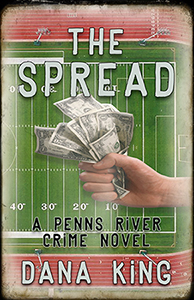
 I have known Elizabeth Bruce longer than either of us probably cares to remember. A talented writer and remarkably generous person, Elizabeth never tires of promoting the work of other creative artists, regardless of their field. When she heard I was having trouble getting a bookstore to launch The Spread, she opened her home to me and a bunch of strangers. It was as enjoyable an event as I have ever had.

I could get into all the things she works on during what would be for her a typical week, but it’ll all come off better if you hear it from her.

One Bite at a Time: Welcome, Elizabeth. We’ve known each other more than twenty years now and I’ve been a fan of your writing since the first time I heard you read. What was your biggest takeaway from the workshop we shared with John McNally?

Elizabeth Bruce: Well, you're right, Dana, you and I've known each other now for 20 plus years now, since we were both in that remarkable Jenny McKean Moore Fiction Workshop at George Washington University with the incredible writer John McNally. John has written twelve or thirteen books, many works of fiction including The Book of Ralph: A Novel, which has a twentieth anniversary edition coming out soon, and story collections, Troublemakers, and The Fear of Everything, plus a thriller, The Pinned Butterfly. He’s also written fantastic books on the writing craft, including Vivid and Continuous which is for serious writers grappling with complex craft issues.

We were in the McNally workshop with a bunch of other terrific writers whose careers have really blossomed. Melanie S. Hatter is a fabulous writer who has several books of fiction out in the world as well as works in progress. She’s a fellow Washington Writer Publishing House author whose novel, The Color of My Soul, was the all-school read at a DC Public High School. Her recent novel, Malawi’s Sisters, published by Four Way Books, was the winner of the inaugural Kimbilio National Fiction Prize, judged by the esteemed Edwidge Danticat.

Carole Burns, who’s based in Cardiff in Wales, has several books out, including her award-winning debut novel, The Same Country. Nick Kocz, has published a huge number of short stories, as well as an Amazon bestselling thriller, I Will Never Leave You, under the pseudonym S.M. Thayer.  Lynn Stearns, who taught at the Writers’ Center for years, has published lots of stories and flash fictions. Plus, other fabulous writers Holly Johnson, Susanna Jech Paul, Gua Liang, Vineeta Anand, and the late Jim Munford, who was in his late 70s during the workshop and was also an award-winning photographer who had a beautiful exhibit at Rockefeller Center on The Bars of Hell’s Kitchen in New York in the 1950s.

John was a fabulous instructor. He really walked us through a bunch of issues of craft. One that I remember vividly was something I believe he called “the third element.” I've tried to track this term down, and I think it originates with the great writer Allan Gurganus, who’s best known for his novel, Oldest Living Confederate Widow Tells All.  Gurganus and John McNally, as well as Richard Bausch, are graduates of the Iowa Writer's Workshop, which literary folks know as sort of the gold standard of MFA Programs.

“The third element,” as I recall, is a deeper context of more mythic proportions that runs under a work of fiction. It’s like a literary Jungian collective unconscious—a more symbolic, more mythic resonance. It’s not something the writer can intentionally embed. It’s elusive; it surfaces on its own through this deeper cultural, almost ancestral knowledge.

As a proud English major, I was really struck by this “third element” as a quality that makes a work of literature endure.

John’s a really funny, jaded fellow, but he’s also incredibly generous. You and your lovely wife Corky, aka “The Beloved Spouse,” had beers with him down in Lafayette, Louisiana, where he’s a tenured professor at the University of Louisiana. And at your urging I reached out to him for a quote for my story collection, and he gave me the most beautiful quote:

“Elizabeth Bruce’s stories have that rare quality of feeling as though they have always existed, the way the best stories always do. In a lesser writer’s hands, the conceit of beginning each story with ‘one dollar’ might seem like a gimmick, but here they echo Wallace Stevens’ ‘Thirteen Ways of Looking at a Blackbird,’ and I found myself eager for what came next, curious to see how each new story amplifies the previous story while also diverging from it, often in dramatically different points of view and styles. These are exquisite short stories that give me hope.” John McNally


OBAAT: Your novel, And Silent Left the Place, is one of my favorite books. It’s a wonderful story with well-crafted characters that is beautifully written without letting the writing get in the way. What’s the origin story there?

EB: Oh Dana, thank you so much for your good words about my debut novel, And Silent Left the Place. As you well know, that novel was written over a long period of time and workshopped extensively in this wonderful writer's group that you and I and several writers from the McNally group, as well as Richard Bausch’s Heritage Writers Workshop at George Mason University had for a decade.

The origin story of this novel, probably like most novels, began with a first draft abandoned in despair. The first 300-page draft was really a coming-of-age story that came out of the short time I spent at the University of Texas at Austin in the early 1970s before I went back to college in Colorado. It was both a love story and an exploration of the anti-war movement during the Vietnam War, but it had this ever-expanding plot that I wasn’t skilled enough to handle.

I was also startled into putting aside that first draft after talking to an old friend in Boulder, the late Vic Traibush, a brilliant man and World War II veteran who used to play the blues with Leadbelly and was a master Go player. I bought a life insurance policy from him when I was 24, and he became a friend and confidant. We were walking down the Boulder Mall when I was there with my husband Michael and our then 2-year-old daughter Maya, and telling Vic all about the novel in progress, and he says, Oh, so it’s about you and your mother. And I was stunned. Oh my gosh, I thought, I thought I’d disguised all the personal references. I can’t be one more middle-aged woman writing about her lost youth.

So, when I got back to DC, I shelved the first draft, and focused instead on a minor character who was about as unlike me as possible. I zeroed in this old man who had popped up in the first draft at his gas station in the desert of South Texas—Thomas Riley. I started thinking more and more about this old man.

Riley is a traumatized 81-year-old World War One veteran who came back from the Great War middle-aged and silent. He can speak, but he doesn’t speak—not to people anyway. The mystery of the novel is why Thomas Riley doesn’t speak. Riley dug himself an underground room behind his gas station, and he goes there to speak to his beloved wife Dolores, who is absent but not dead. Riley is very loosely based on my maternal grandfather who was a World War I veteran. He lost an eye and endured who knows what other horrors of that brutal war. He was a very quiet man.

The book, set in April of 1963, takes place in the Texas desert miles above Laredo in a tiny fictitious town. The whole present action happens in one 24-hour period in which a young couple passing through trespasses on a wealthy rancher’s land. The young man is arrested, and the young woman runs off into the desert. A search for her ensues, led by old John Hopper, the Body Hunter who “combs the desert looking for the dead. Bodies felled by heat or thirst or the hands of man that strung them up on scrawny trees, the bizarre brown fruit of a barren land.”

It’s s a very short novel with a very spare, plain-spoken style. There are no four syllable words in it. It’s also a “polyphonic” novel, meaning each chapter is told from a different POV character. The late, great writer Lee K. Abbott, with whom I workshopped at the Rappahannock Fiction Writers’ Retreat, told me the novel has a “3rd Person Central Consciousness POV,” meaning that the tone of the authorial voice mirrors the voice of the POV character. I asked Lee if he would sign a little POV ID card that I could laminate and whip out whenever the POV Police pulled me over.

 Short as it, though, the novel has a lot of backstory about the horrors of World War One and the Vietnam War, about racial violence, and the cruel, dry land itself. It's a pretty brutal, short work, told in a Texas vernacular and drawing upon an invented tall Texas tale. But through a series of plot twists, the reader does eventually learn why Thomas Riley doesn’t speak.

 OBAAT: Speaking of origins, your new book is a collection of short stories, Universally Adored and Other One Dollar Stories. The unifying feature is every story begins with the words, “One dollar.” Aside from that, they might be about anything. Where did the “one dollar” concept come from?

EB: A lot of folks have asked me that, and the short answer is, I don’t exactly remember. I’m pretty sure, however, that it started in a generative writing workshop at the Writers on the Green Line series I co-produced for 13 years at CentroNía. It was a free, monthly, intergenerational workshop that had rotating facilitators, many of whom received small stipends from the Readings & Workshops Program of Poets & Writers. My late friend and colleague, the late, great Timothea Howard, and I launched the Green Line at CentroNia, and she, and my husband Robert Michael Oliver, and I anchored it for all those years. So many noted area poets & writers facilitated over the years—it’s an impressive list!

I started writing short pieces that each began with the words “one dollar,” and they were well received, so I kept writing them. I loved thinking of all the manifold ways the “universally adored” American dollar could factor into a character’s life. I had to keep shaking my imagination.

Sometimes the dollar is an “intimate object” and key plot device, and sometimes it’s a prop for some “stage business,” (meaning the ways in which an actor interacts with objects on stage). A friend of mine joked about how a lifelong anti-materialist like me (I’m freakily frugal) could end up writing an homage to the almighty dollar! I was thrilled and honored that our former teacher John McNally likened the repetitive theme to Wallace Steven’s iconic poem, “Thirteen Ways of Looking at a Blackbird.”

Michael wanted me to get fifty one-dollar stories so I could call the collection “Fifty Dollars,” but I never got that far. All but one of them have been published somewhere. I’ve been sending stories abroad for many years now, and have been published in the USA, as well as the UK, Canada, Australia, New Zealand, India, South Korea, Israel, Sweden, Romania, Malawi, Yemen, and The Philippines.

OBAAT: The thirty-odd stories of Universally Adored Etc. are broken into five sections:

Couples; Parents and Children; Brothers and Sisters; Known Associates: and Gathered Loved Ones. Did you have this overarching structure in mind when you began the book, or did you have the stories written and realize these were reasonable groupings?

EB: Oh, thanks for both noticing this structure and asking about it. I didn’t have a particular structure in mind when I was writing them. But after I decided I had enough for a collection, I went through them a bunch of times to see what connective tissue there was beyond the one dollar opening line. I had lists of different “given circumstances”—to use a theatre term—in the different stories. You know, how many characters have dead mothers or failed relationships, what are the time periods they’re set in, should I order them chronologically, etc.

 What surfaced was the central relationship of the focal character. Couples are both straight and gay, married and not, young and old, etc. Parents and children include fathers and sons, mothers and sons, mothers and daughters, fathers and daughters. Siblings are of different configurations.

 The Known Associates section---I thought of you, Dana, as a hard-boiled crime writer with this category!—includes folks who hang out together for better or worse. This ranges from ex-cons to childhood best friends. Gathered Loved Ones includes folks with kinship ties that don’t fit the other categories, including the last story in the collection, “All Knowledge” in which the “gathered loved ones” are all the great books the bibliophile character has gathered.

 I must give a huge shout-out to my friend and fellow writer, David A. Taylor, who was in the inaugural Richard Bausch Heritage Workshop at George Mason University with me way back in 1999. David is a brilliant writer and documentary producer who’s written a number of books, including his The Soul of a People: The WPA Writers Project Uncovers Depression America, which was also a PBS documentary. He’s also a fellow Washington Writers’ Publishing House author; his beautiful collection, Success: Stories, was published the year after my debut novel.

Anyway, I leaned on David’s extremely generous nature to read the collection and ponder its structure. David had some great insights and thought of various ways to cluster the manuscript, but he too agreed that the central relationships worked best, though he suggested simplifying them into the current categories. David also suggested that I open the collection with the flash fiction, “Sweat,” that’s the love song of an aging blind woman to her late husband, and the ending story, “All Knowledge,” that’s a love song to great literature.

 I added one story (with the developmental editor’s blessing)—“Mouse Socks” (which had recently been published in Samjoko Magazine  in South Korea)--after the collection had been accepted for publication by the Athens, Greece-based independent, literary press Vine Leaves Press.

 I must say, I’ve had the most wonderful experience publishing with Vine Leaves Press. Everyone, from Publisher and Book Cover Designer Jessica Bell to Production Director Amie McCraken to Developmental Editor Melanie Faith. They have all been extraordinarily welcoming and exquisitely professional, and made my publishing journey a wonderful experience.


I’ll insert a quick plug for Vine Leaves Press’ current 2024 International Voices in Creative Nonfiction Competition that’s open until July 1, 2024.


OBAAT: I don’t want to provide ammunition for others in the “literary vs. genre fiction” debate, but I’ll confess I don’t read a lot of “literary” fiction. It’s not so much because, as some put it, “nothing happens,” but more because too many “literary” writers let the words get in the way of the storytelling, by which I mean they become preoccupied with the words and forget the words exist to tell the story, not to stand alone. You are truly a literary writer who crafts sentences as flowing and beautiful as any, yet you always manage to get them to serve the story and not come off as “look what a beautiful writer I am.” Is that something conscious on your part?

EB: Well, Dana, you are an incredibly prolific writer—you have like, ten books to every one of mine! —but we are both undeterred from examining the darker dimensions of the human condition. I’m assuming your readers know your work well—from the Nick Forte series to the Penns River series and beyond. They delve deeply into the recesses of the human heart and have intricate plots that move the action forward.

 My work is very short—even my debut novel is short—and these 33 stories are also very short. A number are “flash fiction,” meaning 1,000 words or fewer, though several are much longer.

 I’m delighted you find my work both accessible and “literary.” There are a lot of definitions of “literary fiction” out there, but mostly I think it means that the work is more character than plot driven.

In a lot of my fiction, I have a very spare writing style. I write primarily about forthright, regular folks with analog realities. I don’t tend to write about cerebral elites, with their neuroses and ruminations, witty and erudite though they may be.

 Perhaps most importantly, though, I don’t often write ironically—where the authorial voice holds itself apart from the characters or their narratives and comments on the world of the play with great cleverness and, in my view, judgement. Old school as it is, my heart is almost always with the characters. I’m rooting for their resilience more than chronicling their depravity or destruction. Which is not to say there’s no cruelty in the work; there’s a lot of brutality and hardship, and not everyone makes it. But more often my characters find a way to get through the day and find some respite.


Many of my stories are set in small communities, and often the characters speak or think in a vernacular from Texas or the South or West or the inner city. While the vocabulary I use is deceptively simple, everything I write is composed out loud. As a former character actor, I’m absolutely wedded to the cadence and rhythm of language. There are often extra words or long sentences that might look superfluous on the page, but if you read them aloud, you’ll hear the musicality of the voice.

 One of my all-time favorite lines, for example, comes from Chapter 1 of And Silent Left the Place. The highway patrolman coming off the graveyard shift remembers his father’s words: “You were raised on the parched flatness of south Texas where a man’s worth can be measured by the stillness of his shadow at sunset, and the liveliness of it at dawn.” The aforementioned great writer Lee K. Abbott loved that line, so I figured I was on to something.

 I have an author-read audiobook of Silent--which I invite all your readers to reach out to me for a copy--and I’m going to make an author-read version of Universally Adored, so stay tuned.

 But seriously, I’m thrilled that you like the collection, Dana. That is high praise!  I should warn your readers—though as your readers, I don’t imagine this is necessary---that a couple of the stories in Universally Adored & Other One Dollar Stories have a lot of profanity. A few folks have been put off by that language, but that’s just how those characters talk, so I figure either I don’t write about rough characters like these, or my readers just have to accept the roughness of their language.

 OBAAT: You and husband Michael Oliver do an entertaining and enlightening podcast called “Creativists in Dialogue.” How did that come about and how is it going?

EB: Yes, my esteemed husband and creative partner, Robert Michael Oliver, and I co-host and produce an audio podcast that we've been doing now for about a year and a half. It's called Creativists in Dialogue: A Podcast Embracing the Creative Life. It’s available for free on Substack at https://Creativists.Substack.com, though we’re thrilled, of course, with paid subscribers. We’ve been very fortunate to have some funding from both the DC Commission on the Arts & Humanities and HumanitiesDC.

To date, we’ve interviewed 53 people, and posted weekly podcast episodes since January 2022.

Creativists in Dialogue was really born out of the long history of discourse Michael and I have had as creative partners for 41 years. Almost every day we have a conversation about some aspect of the human condition, current events, literature, etc. I’ve always been amazed by Michael’s ability to take in and synthesize so much complex information. He’s a theatre director, actor, playwright, novelist and poet, as well as a lifelong humanities and theatre educator, so he’s read and taught all manner of literature and philosophy. He has a PhD from the University of Maryland in Theatre in Theatre and Performance Studies and an MFA in Directing. He’s a brilliant man with, what I call, “x-ray vision” for structure. Plus, living with him for the 10 years it took him to get his doctorate spared me from ever having to get a PhD myself!

Both of us believe deeply that in our fractured, traumatized world, the creative process can be profoundly healing. We wanted to celebrate that process for everyone, to raise it up and validate it in the lives of many kinds of people, not just so-called “artists.”

Our current sub-series is called “Innovators, Artists & Solutions,” supported by the Commission on the Arts & Humanities. We’re talking to a wide range of innovators who have been using creativity to address compelling issues, from campus-wide creativity initiators to an art therapist working in a sobriety program, to a founder of a trailblazing early childhood organization, a teaching-through-creativity pioneer, a leader of a steel band for youth, a multicultural theatre leader, and more.

We actually just concluded a year-long deep dive into theatre in Washington, DC, from the 1970s to about 2019 through our series, “Theatre in Community,” funded by HumanitiesDC. We posted 28 podcast episodes of our dialogues with 17 theatremakers, from Joy Zinoman of Studio Theatre to Molly Smith of Arena Stage to actor/playwright Clayton LeBouef, who was a regular on The Wire, to Nucky Waler and Marcela Ferlito of Teatro de la Luna, and many others. It’s a tremendous resource for theatre folk and anyone interested in the cultural history of DC.

In our inaugural season of Creativists in Dialogue we talked with people from all walks of life about the role creativity has played in shaping who they are—from a Nigerian international chessmaster to master chefs, translators, early childhood educators, fashion designers, a Double Dutch leader, a birth doula, a chemical engineer, immigrants from around the world, and more, as well as artists and writers.

We have a small, but mighty team of colleagues who’ve helped produce the podcast, including our Audio Engineer Elliot Lanes, our former Social Media Manager Erinn Dumas of Dumas83, and our Transcription Editor Morgan Musselman.

Increasingly, we’re publishing our interviews in two parts, each part being about 30 minutes or so. The audio interviews are posted every Wednesday at midday, and the transcript posts every Sunday at midday. The theatre interviews also have hyper-texted glossaries of theatre terms and names mentioned in the interview.

We’ve been thrilled and honored to have had so many different people from so many different walks of life join us for this independent, civil discourse about the complexities of our world.

While we’ve been very fortunate to receive some funding, absent that funding Michael and I will have to scale back the whole project. It’s extremely time-consuming and costly. So we’ll see.

Again, your readers can check us out at https://Creativists.Substack.com.

OBAAT: You typically have more irons in the fire than I can keep track of. What else is on your horizon?

EB: Well, I do have a lot of irons in the fire! In addition to the podcast, I’ve been really focused on book promotion these last few months, having lots of book launches and readings, and reaching out for reviews and interviews, etc. I’m working with a lovely young social media guy, Liam McCrickard, so there are a bunch of cool posts on my author pages at (1) Facebook. I have a great review in the Washington City Paper, and a bunch of online reviews.

But it's been great, and really satisfying to have a lot of people enjoy the readings and buy the collection and enjoy the stories.

As you know, we writers labor over our work, and labor over getting published, and labor over getting the word out, so actually having other people read and enjoy our stories is hugely gratifying. Granted, I’m not gonna be on Oprah anytime soon, but that’s ok with me.

I am also working on a novel-in-progress. I'm approaching a first draft. It’s kind of a sequel to the $1 collection. I take about 10 characters from different dollar stories and plunk them down in a fictitious diner in 1980 in a small town on the Gulf coast of Texas. It’s not my hometown; it’s a neighboring town called Texas City that’s a petrochemical, refinery town.

There’s a lot of backstory (of course, I am a queen of backstory) And there’s a lot of cross-fertilization between characters who either meet each other for the first time or have known each other for a while. A lot of my $1 characters are pretty lonely, and I’ve been worried about them, so I decided to introduce them to some other characters and see what happens.

While the novel is set in the analog days of 1980, there’s also a deep backstory about this horrible industrial accident in 1947 called the Texas City Disaster. A French ship full of ammonium nitrate blew up in the Port of Texas City, and that set off a cascade of other explosions at the adjacent refineries. Then another ship also full of ammonium nitrate blew up. The blast was heard hundreds of miles away. People thought it was an atomic bomb. The town was just flattened.

Almost 600 people died, and many thousands were injured. All but one of the 28 members of the Texas City Volunteer Fire Department were just vaporized. Until 9/11 it was the deadliest loss of firefighters’ lives in US history. In fact, the Texas City Disaster is still the deadliest industrial accident in US history.

In those post-World War II days, the industrial, petrochemical sector was roaring. There weren’t many occupational health and safety protocols. There certainly wasn’t an Environmental Protection Agency. A lot of safeguards about toxic substances came out of this tragedy.

My novel-in-progress has a somewhat unreliable narrator, who is a deeply traumatized survivor of both that disaster and Pearl Harbor who is haunted by the dead. He’s the absentee dad of the two brothers in the “Tuesday Theory” story. The younger brother is autistic, and his older brother became his guardian after their mother died of cancer. There’s also a lot of cancer in the backstories of several characters, this area being awash in carcinogens.

Like my debut novel Silent, this novel-in-progress is “polyphonic” (meaning more than one POV/point-of-view character). It has a “discontinuous” structure with intersecting story lines—think of the movies “Crash” or “Nashville” or the novel Let the Great World Sing. There isn’t just one central plot, the various narratives of a large cast of characters connect to each other, though they all eventually come together.

I’m having a lot of fun fleshing out the stories of these characters, including some very minor folks mentioned in the dollar stories. There’s the alcoholic grandfather and his daughter and grandson from “Flounder.” There’s the bibliophile from “All Knowledge,” and the Depression-era farm worker girl from “Evening in Paris.” There’s the woman fleeing her abusive ex in “Magic Fingers,” who’s the daughter of the waitress in “Tuesday Theory,” plus the abusive husband himself. Manny the Cook from “Tuesday Theory” is there as a Filipino veteran of the last mounted cavalry unit under US command in WW2, and Chester the bait man from “Flounder” resurfaces as well.

On the personal front, Michael and I are the happy new grandparents of our daughter Maya and her husband Nico’s baby daughter, Lucia—the joys of which I know you can understand, Dana, having just become a grandfather yourself. And there’s visiting our son Dylan and his partner Megan and daughter Ava in Colorado. I’m also trying to do this “Swedish Death Cleaning” and get rid of a ton of stuff that has accumulated in our little rowhouse in NE DC.

We have almost 1,000 theatre books—plays, methodology, history—that I’ve categorized and hope to sell for super cheap to a theatre institution. I’ve managed to sell about 1,000 of the other 4,000 books of fiction, critical theory, etc., though I haven’t even started on the poetry.

Plus, we have some domestic house projects, and the endless granular business of life. So, on a personal level, life is good.