Thursday, November 4, 2021

Dietrich Kalteis, Author of Under an Outlaw Moon


I met Dietrich Kalteis through mutual friends at Bouchercon several years. It was a fortuitous introduction. In addition to being an outstanding writer, Dieter is as nice a person as you’re going to met, even by Canadian standards. His new book Under an Outlaw Moon, dropped earlier this week from ECW Press, which provided the perfect opportunity to see what he’s been up to.


One Bite at a Time: Welcome back, Dietrich. It was great to leave you alone on the blog for your previous visit, though The Beloved Spouse™ commented you left the seat up. What’s the quick and dirty on your new book, Under an Outlaw Moon?


Dietrich Kalteis: The novel’s based on the true story of Bennie and Stella Mae Dickson. He’s out for kicks and she longs to feel wanted. When they pull a bank robbery to celebrate her sixteenth birthday, the ensuing fireworks are more than they ever bargained for.


OBAAT: Your three most recent books are period pieces: Under an Outlaw Moon and Call Down the Thunder are Depression-era pieces; Cradle of the Deep is late 70s. What is it about times past that’s drawing your attention?


DK: The setting comes about depending on the story that I have in mind, wanting the perfect time and place to set the story’s mood. 


The seventies was the right for Cradle of the Deep. A woman flees from her gangster boyfriend, running off with the gangster’s ex-chauffeur. Jumping into the front seat of the gangster’s Cadillac, they take off. Of course, there was no GPS, cell phones, or satellite networks back then that would betray them. As the couple races through northern British Columbia, heading to a remote town bordering Alaska, they are being hunted by a stone killer sent by the jilted gangster. The remote setting creates a dead end, and adds to the peril they find themselves in.


Call Down the Thunder is the story of a couple who are on the verge of losing everything due to hard times, and they’re pushed to the wall. The bleakness, desolation, and threat of danger surround their life on the struggling farm back in Dustbowl times.


While researching that story, I stumbled across the true story of Ben and Stella Mae Dickson, a couple of real-life bank robbers from the same era. I was intrigued by their story and decided it was one that wanted to be told.


OBAAT: UaOM is based on a real couple. Is this the first time you’ve done this? What was it about these two outlaws that attracted you?


DK: Yes, it’s the first time I’ve written about real people, getting to know them and their story through a lot of research. They weren’t vicious killers, just two young people in the wrong place at the wrong time, landing on the FBI’s most wanted list, and ending in the crosshairs. 


OBAAT: I don’t suppose you ever tire of being linked as a writer to Elmore Leonard. (I know I wouldn’t.) In one of our earlier interviews, you cited him and James Ellroy influences. Has that changed, or evolved? If not, are there different things about their writing that influence you now?


DK: Every now and then I get the Elmore craving, rereading one of his novels. And I’m still catching up on a couple of Ellroy novels that I haven’t read yet. There are many authors and books that draw me in, and the wonderful thing is there are so many great ones out there. Lately I’ve been reading Walter Mosley, Tim Dorsey, Daniel Woodrell, James Lee Burke, and Reed Farrel Coleman’s Parker books — all of them inspiring.


Outside the crime genre I’ve been reading Philip Roth, Margaret Atwood, Stephen King, Donn Pearce, Saul Bellow, Thomas Berger, Salman Rushdie, and Tom Wolfe to name a few — and all highly recommended.


OBAAT: I know you like to make up stories as you go. Have you ever been well into a book and realize you’ve written yourself into a corner? If so, what do you do. (Asking for a friend.)


DK: Dear friend of Dana: I don’t usually paint myself into a corner, but I’ve had to back up a few times. It usually starts with a single idea, to which I create the characters I want to see involved, and I write it scene by scene. I’ve balled up my share of paper and reworked chapters and changed direction midstream, but that’s all part of the process, and it’s how I get it to where I want it to be. On a second draft, I usually write a timeline, a way of checking the sequence of events. It’s what works for me.   


OBAAT: The standard concluding question: What are you working on now?


DK: Right now, I’m shaping a few ideas for a new novel, and I’m at that ‘I don’t know if this will work’ stage. And I have one more complete and set to come out next Spring from ECW Press. It’s called Nobody from Somewhere, a crime tale set in Vancouver in present time. There’s also got another crime story complete and signed after that. And I’ve just sent in a historical novel, based on another true crime story.


Many thanks, Dana, for inviting me over. You ask the best questions.


Thursday, October 28, 2021

Going Down Yonder


The Beloved Spouse™ and I have wanted to go to an event at Yonder since it opened. Life (read: covid) conspired to prevent such an excursion until last week. It was worth the wait. (I’ll not get into the fact that we shouldn’t have had to wait so long. Thanks, you unvaccinated assholes.)


For those unaware, Yonder – Southern Cocktails and Brew, is a drinking establishment and meeting place in Hillsborough, NC that has been described as Hillsborough’s living room. Owned and operated by Eryk Pruitt and his lovely wife Lana Pierce (of whom Eryk is wholly undeserving), Yonder holds regular musical and literary events, including Noirs at Bars a few times a year. (If you unfamiliar with Noir at the Bar, look it up. This is One Bite at a Time, not fucking Wikipedia.)


Last Thursday (October 21) the good people at Yonder (and Eryk) held a special Noir at the Bar to commemorate Halloween by inviting several horror writers along with a top shelf cast of crime authors. The result was the best Noir at the Bar I’ve ever been to, and I’ve been to a goodly number. (Read at several, and hosted one, too. Yonder’s horror night was still best.)


A few general observations before I get specific.

·       Those typically associated with crime all had an element of crime in their stories, the horror writers, not so much.

·       Crime writers tend to tell their stories through dialog; horror writers are typically more narrative-based. This is not a hard and fast rule.

·       I have never been to a Noir at the Bar where the performance level was close to this high. Not only were all the stories outstanding (let’s face it, N@Bs are anthologies, so maintaining a uniform level of quality can be an issue), the readings were uniformly excellent. No one just read; they performed, and they all nailed it.


This was among the fastest two-and-a-half hours I ever spent.


Everyone deserves credit. I had three beers, so I don’t remember the exact sequence in which everyone read, so here’s the list in alphabetical order.

·       Nathan Ballingrud read the opening of a story about a bookseller who clearly deals more than paperbacks out of the back room. What, we don’t know. I’ve already ordered his book so I can see what happens next.

·       Natalia Barron’s excerpt was as dark as its subterranean setting would suggest, and left everyone wondering where the story would go.

·       Michele Tracy Berger read a cautionary tale of the potential dangers of moving from one fast food employer to another.

·       S.A. Cosby supplied a harrowing tale of the backstory to a horrific shooting binge.

·       Rob Hart told of a new restaurant experience in New York City that will give you pause before going to another potluck dinner.

·       Jamie Mason’s story talked about one supernatural entity rousing itself to fight another, more malevolent one.

·       Katy Munger took the Halloween theme seriously, telling a story that combined laugh out loud humor with a disquieting warning of who can hide in plain sight on Halloween.

·       Eryk Pruitt creeped everyone out with a tale of a side of dom/sub relationships people never think of.

·       Todd Robinson read of redemption and forgiveness after a horrific tragedy.

·       Cadwell Turnbull’s vampire story taught the dark side of eternal life.


I’m not a horror guy, so I was unfamiliar with the horror writers who read that night, and was profoundly impressed at the quality of their stories, and writing, compared to what I remembered from my young adulthood, when I read a fair amount of it. A personal re-assessment of the genre may be in order. They were also all new to the Noir at the Bar experience, so it was a treat to see how much fun they had in the company of people who love to write and read.


No assessment of the festivities would be complete without mention of the host, Tracey Reynolds. I’ve hosted a Noir at the Bar and can attest that, while it’s not particularly difficult, it’s not something you just roll out of bed and do. One must prepare, and an ability to read an audience and pace the performance is imperative. I’ve never seen anyone do it better than Tracey. (And no one – no one – handles a microphone condom better.)


In addition to all the above (like that wasn’t enough), this was an opportunity for The Beloved Spouse™ and me to reconnect with some good friends face-to-face. The trip would have been a success had the reading flopped, just so we could see Eryk, Lana, Todd, and Shawn to trade hugs, news, and insults. I knew Rob Hart slightly from social media, and it was a treat to get to meet him in person, as well.


As it was with everyone I met. I made a point of telling the writers I didn’t know beforehand how much I enjoyed their work, and not just because I know how good that feels after such an event. I genuinely did enjoy their stories, and I hope this becomes an annual event at Yonder.

Thursday, October 21, 2021

The Process Evolves


I have long considered first drafts to be the heavy lifting of writing. I enjoy playing with ideas as I put together the outline, and there’s great satisfaction in editing and rewriting, as I can see the raw material of the first draft evolve into what I’d consider an acceptable book.


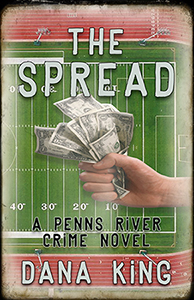
I’m trying something new with the first draft of the next Penns River book (working title The Spread). It’s early on – only a handful of chapters in – but the idea shows great promise, and it’s making the first draft a lot more fun to write.


A little background: I used Scrivener for the first drafts of the last couple of books, mainly so I can re-arrange the outline as needed, and to keep notes on the same screen as the chapter I’m working on. For the second draft, I split my screen, with Scrivener on top and Word below, then retype everything. To me, that’s better than trying to edit what I’ve already written, as once it’s on the screen, there’s a certain permanence implied. I talked about this before when discussing how it’s easier to leave one’s darlings along the side of the road than it is to kill them.


For The Spread I decided to leverage the idea that I was re-writing the first draft no matter how it went. This first draft is much sketchier. What I know goes in, which is mostly dialog, I write up. Everything else – attributions, narrative, descriptions, action – is condensed into a more or less comprehensive set of notes that I can flesh out when I do the rewrite. The end result is somewhat similar to a screenplay, at least visually:


[THEY ROLL UP ON THE HOUSE. MCGINNISS COVERs THE BACK. SISLER AND BOSTON GO TO THE DOOR. AS DOC DOESN’T HAVE HIS VEST ON, SISLER KNOCKS.]

S. Jamal Whitlock!

[WHITLOCK STEPS ONTO STOOP BETWEEN COPS.]

JW. Took ya’ll motherfuckers long enough to get here.

S. Stop right there.

JW. I’m give myself up. [DOC DRAWS HIS WEAPON.] Whoa. Ain’t no need for gun play. I told you I’ze giving up.

[CONFUSION. THE COPS DON’T WANT HIM THAT CLOSE, HANDS OPEN OR NOT. THERE’S SOME TUSSLING WHILE THEY GET THE SITUATION HOW THEY WANT IT. PART OF IT CONSISTS OF THEM TRYING TO GET WHITLOCK INTO THE HOUSE AND HIM TRYING TO STAY ON THE PORCH.]

JW. Motherfuckers! I told you I’m coming out, let me get out and you can cuff me up right here on the stoop.

[DOC HAS HIS GUN DRAWN AND AIMED]

D. put your hands out to the sides with your palms facing me.


The idea is not to get bogged down in describing things that are peripheral to the main point of the scene. I’ll make those decisions in the second draft


What I don’t know yet, and won’t for a couple or three months, is if this makes the second draft as burdensome as the first draft used to be. I’m betting that it doesn’t. First, much of what I’ll have to describe will have had time to ripen in the back of my mind. I’ll also have the context of what else is to come, so if I want to drop in a telling detail, I’ll already know it’s telling.


It may also give me an opportunity to decide something doesn’t need to be said. I’ve noticed George V. Higgins having more of an influence on my writing of late, without me consciously making an effort to allow him to do so. (Unlike how I deliberately added some Joe Wambaugh-esque elements in recent books.) I’m not trying to be Higgins – no one can do that – but if that’s where my voice seems to want to go, I know better than to tell it not to.


Like I said, it’s an experiment, and it’s early days. Check back here when I’m halfway through the second draft and see how pissy I am. Or, hopefully, not.

Thursday, October 14, 2021

An Interview With Terrence McCauley

 Terrence McCauley and I have been friends since we shared a panel at the Albany Bouchercon in 2013. He’s an even better person than he is a writer, and he’s a damn fine writer with a range that encompasses crime, thrillers, Westerns, and whatever he puts his mind to that day. He recently accepted a position with Wolfpack Press, a growing force in the industry, which gave me an excuse to catch up with him. (“Excuse” as in “He’s a person I’d interview just to bullshit with him but space doesn’t really allow for that.”)


One Bite at a Time: Hi, T-Mac. It’s been a while. It’s good to see you here again. You recently took a position with Wolfpack Publishing. What’s the new gig and how did it come about?


Terrence McCauley: It’s always great to hear from you, my friend. I when I reacquired my rights to my previously published books, Wolfpack was interested in breathing new life into them. New covers, a new marketing plan and a chance to add to the existing stories I’ve told. I was impressed with the team they have in place at Wolfpack and told them I’d be happy to help them in any way I could. As we began talking about ideas, we all decided it would be a good idea for me to take on the responsibilities of Director of Public Relations. I did it in the public sector for twenty-five years, so I had a lot of transferable skills that prepared me for the role. They’re a fine bunch of people and I’m honored to be working with them.


OBAAT: I’ll confess, Wolfpack was under my radar until I read your hiring announcement. I checked the website and saw authors there who have considerable juice. Tell us a little about the company, such as what its goals are, and how it plans to achieve them.


TM: The company was started in 2013 by Mike Bray and L.J. Martin. It has quickly grown into a powerhouse in the publishing industry. They company is proudly built on publishing new and classic western novels and will continue to do so. They have recently expanded into Young Adult titles with their Wise Wolf imprint and Mystery/Crime/Thriller novels through the acquisition of Rough Edges Press.


Their goal is simple in all the genres they publish. To give readers the best fiction available for an affordable price in both digital and, in their newer publications, print format.


When they announced the acquisition of Rough Edges Press, we sent notices to every writing organization we could think of to let them know we were open for business and eager to give under-represented voices a chance at publication. That commitment was one of the main reasons why I agreed to work for them and I’m excited about the future, both for my work and for the work of all the writers who join us.


OBAAT: This is a great opportunity to get your books consolidated under a single umbrella. Was that part of your consideration when taking the job, or was it a serendipitous benefit? Were there any problems with getting the rights?


TM: My westerns are still being published by Kensington, where I have a spinoff series coming out next year. Wolfpack acquired all my Terry Quinn, Charlie Doherty and University Series novels. They’re also publishing the new Doherty novel, The Wandering Man, and the new University novel, The Moscow Protocol. I had already signed with them for several weeks before we discussed the possibility of me joining the team. I was lucky that everyone involved agreed that Wolfpack Publishing was a better home for the kinds of novels I’ve written and want to continue to write. So, Kensington is home for my westerns and Wolfpack/Rough Edges Press is home for everything else and I couldn’t be happier. 


OBAAT: You write in as many genres as anyone I can think of. What are you working on now?

TM: Right now, I’m finishing up a western novel, then will switch over and write a prequel to Prohibition I’ve tentatively titled The Duke Of New York. It’ll be about Terry Quinn in the days after he joins the Doyle mob and how he helps that mob grow in power and prestige. It’ll take place in the same timeline as The Wandering Man. My goal is to write three books apiece that lead up to the events in Prohibition and Slow Burn respectively.


I got the idea for those novels because a lot of people have told me they were interested in Quinn and Charlie’s backstories. The Doherty books are in first-person, so I get to show that world from his jaded perspective. Quinn is third person, but anchored in his point of view, so the reader experiences the story from his place in it.


I’ll also continue The University Series with as many books as Wolfpack wants to publish.


OBAAT: You recently began both a blog and a podcast, both of which I keep tabs on. (And encourage readers to do the same.) What prompted the decisions to do both, and how is it working out for you? Do you enjoy one more than the other?


TM: Both are fun in their own ways. I did it because I realized a lot of people did not know that I write in other genres. Fans of my westerns often suggested I write suspense. I was happy to tell them that I have and show them my other books. That’s why the podcast is interesting for me because I cover my approach to each book I’ve written. I talk about the struggles I faced writing each western and how I overcame it. I plan on doing that with all my books in the hopes that writers can hear it and learn from what I went through as I wrote across genres. No book is written in a bubble, and I think others can learn from what I did right and what I did wrong. The podcast also taught me some new skills, which is always good.


The blog allows me to mouth off about topics that are top of mind. I like to discuss something current, such as conventions, then add another topic like protecting yourself as a writer.


OBAAT: I looked at your website while preparing for this interview (I do prepare for interviews), and it’s beautiful. I see your name next to the copyright notice, so I have to ask if you did it yourself. (Note to Maddee James: No worries. I have no thoughts of changing web teams.)


TM: I had done my original website by myself, but after I left my state job more than a year ago now, I decided to invest in my writing career. I worked with Krista Rolfzen Soukup at The Blue Cottage Agency about ways I could enhance my online presence. She suggested Corey Kretsinger of Midstate Design to build it out. Together, the three of us worked on creating something unique. I wrote the content and created the logo. That much I can take credit for. The rest was a team effort and I recommend Krista and Corey to anyone who’s looking to refine their digital presence.

Thursday, October 7, 2021

Remakes


A fmonths ago The Beloved Spouse™ and I had the bright idea to watch both versions of 3:10 to Yuma back-to-back. It was great fun, and educational to boot. We’ve kept up with the practice and have a few more examples, which required me to alter a core belief. We’ll get to that later.


Rio Bravo (1959) & El Dorado (1966). Not announced as a remake, but it is. Same basic story, and the remake is definitely better. The story has more depth, as do the characters. Hell, replacing Dean Martin and Ricky Nelson with Robert Mitchum and James Caan practically guarantees the second would be better. John Wayne’s in both, and, as Chili Palmer says, he plays John Wayne.


The Italian Job (1969 & 2003). Same basic story, updated to reflect advancing technology in the heist department, and audiences’ desire for higher octane action sequences. The first, starring Michael Caine, has a much more whimsical approach. The remake, with Mark Wahlberg in Caine’s role, takes advantage of societal and filmmaking advances to be a lot of fun itself. Neither aspires to be taken seriously, but both succeed admirably at what they set out to do. I give a slight nod to the remake because Charlize Theron.


The Taking of Pelham 1-2-3 (1974 & 2009) Another remake that pays homage to the original in many aspects while still bowing in the direction of contemporary sensibilities, notably in the areas of technology and villain motivation. The skills of the primary actors are pretty much a wash (Walter Matthau vs. Denzel Washington), and, while I’d give Robert Shaw a nod over John Travolta, the screenwriter did a nice job in changing the character to suit Travolta’s style. (Not that Travolta isn’t a fine actor—he’s a favorite of mine—but there was only one Robert Shaw.) I liked the remake a little better. It provided a better sense of urgency and the added subplot involving the mayor (James Gandolfini) added depth to the story. The original ending was better, but overall, I preferred the remake.


Which leads us to my change in philosophy. I always thought remaking what was already a good film was stupid, especially when there are so many candidates for do-overs among crappy films that failed to realize good ideas. I now see that’s not true. Things change, and if the filmmakers choose and execute their material wisely, they can update a film and maybe add a few things that weren’t available to their peers of forty years ago. This would not be true of all films, but I’ll no longer dismiss a remake out of hand. I consider it growth on my part.


(PS. The Beloved Spouse™ and I were considering repeating this process with The Magnificent Seven, but a trusted source waved us off. I may still watch the remake, but possibly to prove the point of another thought I’ve had along these lines as to decide which I like better.)


Thursday, September 30, 2021

Summer's Favorite Reads

 I had a nice post written but when I came back to edit it, OneDrive had disappeared it into the ether, even though it still appeared on my Recent Files list. So here’s an abbreviated version, and, while we’re at it, fuck you, Microsoft.


Bottom Feeders, John Shepphird. The mystery is good, and well told, but the inside baseball stuff about how low-budget vanity project movies are made is fascinating.


Time to Murder and Create. Lawrence Block. I’m done beating myself up over how long it took me to dig Block. Now I’m just going to dig him.


Murder, DC, Neely Tucker. The second of three Sully carter novels; for me it completes the cycle. All are outstanding, all are different. Tucker has a gift for describing a reporter’s life without getting bogged down in any single aspect.


The Friends of Eddie Coyle, George V. Higgins. There’s nothing I can say about this book that hasn’t been said. If you don’t know what I’m talking about, get a copy.


The Black Marble, Joseph Wambaugh. Working my way through Wambaugh in order is a lot of fun. The Black marble is a relatively early book, but it’s outstanding as it weaves three disparate stories together with earned pathos and the humor that became one of Wambaugh’s trademarks.


The Eviction of Hope, Colin Conway (editor) et al. I don’t usually list books I contributed to here, but this is as well-organized, and uniformly excellent, a collection as I have been involved with.


Midnight Lullaby, James D.F. Hannah. I read the two Shamus nominees (and one winner) from this series already, so I’m reaching back and starting over. This is the first Henry Malone book, and as good a first novel as I’ve read in a long time.


Thursday, September 23, 2021

Creatures, Crimes, and Creativity 2021: A Look Back

 This year’s Creatures, Crimes, and Creativity conference took place in Columbia MD September 10 – 12 and may have been the best ever, despite several obstacles. Part of this success was, I’m sure, the result of people just wanting to get back with their tribe. Columbia and Howard County are among the most-vaccinated and least-infected locations in the country, and the hotel and organizers did well with their safety and masking policies. I felt secure the entire weekend.


A few weeks ago I laid out what past C3 experiences have been like, and what to expect this year. Today I’ll look back.


FRIDAY, SEPTEMBER 10

12:00                 Old home week commenced with Austin and Denise Camacho welcoming everyone. C3 feels more like a family reunion than a conference, and no one is more responsible for that than those two.

12:45                 “Secrets to Snappy Dialog.” Not the most auspicious start, as the moderator forgot his notes and had to wing much of the session. His panelists were up to the challenge and the end result was solid.

1:45          “Pitfalls to Avoid When Writing a Series.” I was a member of this panel, and happy to be there. Norwood Holland touched all the bases the title implied, and everyone on the panel (Karen Neary Smithson, Kelli Peacock, Ilene Schneider) had slightly different perspectives on series writing.

2:45          “Living With a Professional Liar.” This was the spouses’ panel, and The Beloved Spouse™ acquitted herself well. This has become an annual event and is always entertaining. I’ve seen several and can’t help but think how these better halves (regardless of gender) keep the writers on their toes, while supporting their (our) often unusual needs.

3:45          “Adapting the Written Word to Screen.” Christopher Chambers piloted James Grady and John Wren through a fascinating 45 minutes of advice, war stories, and tales of horror. A couple are worth recounting, but this is not the place.

4:30          Cash bar and book signings. Basically a social hour. Given those who attend C3, it’s always a damn fine social hour.

6:00          Dinner, followed by keynote speech by Hank Phillippi Ryan. Hank’s new book dropped that week, and she was busy doing promotional work, but she carved out time to join the conference virtually on a couple of occasions. She also worked out a virtual book signing to prove what a class act she is.

7:30          Noir at the Bar. I hosted this year, and got an outstanding group of authors to work with, including Lanny Larcinese, Kelli Peacock, Mark Bergin, D.W. Maroney, Ef Deal, Bruce Robert Coffin, Maria Kelson, and Jeff Markowitz. (Listed in reading order.) All not only wrote excellent and varied stories, they read them well (not something one can assume at most N@Bs), and were all good sports when I took liberties with their bios.


Then I closed the bar, with assistance from The Beloved Spouse™, Bruce Coffin, and Lanny Larcinese.


SATURDAY SEPTEMBER 11

9:00          “Espionage for Everyone.” Outstanding panel that explored fictional espionage vs. the real thing. Made me want to consider shifting genres, if I weren’t already booked solid. (See what I did there? “Booked” solid? You know, a writer? Booked? I crack myself up sometimes.)

10:00                 “Just the Facts, Ma’am.” It is no slight toward Noir at the Bar when I say this was my highlight of the conference. I moderated a panel of three retired law enforcement professionals discussing where fictional cops get it right and wrong. This is a favorite topic of mine and Mark Bergin, Bruce Coffin, and Jeffery Higgins were perfect as the panel. Maybe the best panel I’ve ever been involved in, regardless of conference.

11:00         “Write Drunk, Edit Sober.” I was a panelist this time as Ellen Geib Butler led three of us (Rick Pullen, Lane Stone) through a discussion of writing techniques, with and without alcohol.

12:00                 Lunch, followed by Hank Phillippi Ryan interviewing Kathleen Barber, neither of whom was actually in the room. Hank was still on tour, and Kathleen, who has two small children, wisely chose not to risk exposing herself to the virus.

1:15          “Murder is Everywhere.” Once again, I was a panelist (thank God for lunch; they were working me to death) as Austin Camacho, D.W. Moroney, and I followed Jeff Markowitz through an exploration of the effects of location on our writing.

2:15          “Mixing Fact With Fiction: Does Historical Fiction Need More Than Just a Time Frame?” I haven’t given up on ever writing a Western (not yet) and was happy for John Wren to help Serg Koren, Ellen Butler, Frank Hopkins, and Bill Rapp show me what to beware of when writing of periods I have no direct connection to.

4:30          Cash bar and book signings. There were panels at 3:15, but I was exhausted. Nap time.

6:00          Dinner and keynote by Sherrilyn Kenyon. Any time you think you had it rough as a kid, check out her story, then shut up.


I closed the bar once more, with the able assistance of Bruce Coffin (again), Kelli Peacock, and a very nice gentleman who didn’t wear his name tag so I have no idea who he was.


“It’s a Small World” Award to Sherrilyn Kenyon, whose father was post sergeant major at Fort McPherson GA when the Army stationed me there in the early 80s.


SUNDAY SEPTEMBER 12

8:00          Breakfast, and Austin Camacho interviewed James Grady. As one would expect from those two, funny and informative.

9:15          CLASS: James Grady – Mastering Your Writing. A true master class, as Grady is a master with enormous class. I’ve been writing for quite a while and sessions like these are why I keep going to conferences.

10:15                 “Journalism in Mysteries.” Another outstanding panel. Rick Pullen led John DeDakis, Mark Bergin, and Jeffery Higgins (former journalists all) through a discussion of how authors use journalism in fiction, and journalistic trends in general.


And then, alas, the end. There was another panel session, but The Beloved Spouse™ and I had to check out of the hotel and take care of a couple of administrative things before going home to collapse. Was this the best C3 I’ve been to? I have to admit the fact we had to skip last year, and this is the first time I’ve been with my writer tribe since November of 2019 in Dalla might affect my judgment, but I can think of none better. The hotel laid out perfectly, the staff was courteous and helpful, and, aside from a couple of minor technical problems with the remote speakers, the conference went off with out a hitch. The Beloved Spouse™ and I registered for 2022 on our way out. We’ll see you there.


(PS

Joe Lansdale will be one of the 2022 keynotes. If that’s not incentive, I don’t know what is.)