Thursday, October 27, 2022

August was PI Immersion Month. What Did I Learn?

 I want to try something different with the Penns River series, which will require time to research if I am to do it justice. I also have a couple of stories I’ve been wanting to write about my Chicago-based professional investigator, Nick Forte. No thought needed, right? Write a PI novel.


Easier said than done. I had an outline I liked, fleshed it out, and got to work, but things weren’t jelling as they had been for the Penns River books. The writing didn’t flow and the voice wasn’t what I wanted.  I considered re-reading a couple of Forte novels until it occurred to me that I should read someone good instead.


I dedicated the month of August to reading nothing but PI novels. The list included Ace Atkins (writing a Spenser novel), James Lee Burke, Reed Farrel Coleman, Robert Crais, Dashiell Hammett, Declan Hughes, Dennis Lehane, John McFetridge, Bill Rapp, and Mickey Spillane. (I’d read James Crumley and Robert B. Parker only a few months ago; I did not read any Raymond Chandler for reasons I’ll go into later.)


Here are the primary takeaways:

·       I had forgotten how much I love PI stories. This exercise reminded me of that.

·       Elmore Leonard didn’t write PI fiction, but good PI fiction holds one of his rules in high regard. Very little of what I read sounded like writing. The best PI fiction is a conversation, albeit one-sided, between the narrator PI and the reader.

·       First person is the preferred point of view for a good reason. Not only does it work best as a conversation, it allows the narrator’s mind to wander without sounding too much like an authorial intrusion. After all, he is the author.

·       Along these lines, define the protagonist by what he notices and passes onto the reader. Or doesn’t.

·       Wise-ass comments and snark in narrative and description are not only allowable, they’re desirable, assuming the observations are in character for the detective. (They are in Forte’s case.)

·       A lot of things have to happen off-stage. One person can’t know as much as an entire police department, no matter how small the department.

·       Real-life detectives have no more privileges than you or I, but half the fun of writing PIs is letting him get away with things. Within reason.

·       Even though the reader lives in the narrator’s head, dialog still carries the story. I was bogged down writing a chapter in which Forte interacted with no one. The chapter dragged on to the point where I made a few notes and left it for the rewrite. A couple of weeks ago I figured a way to insert more dialog and rewrote it. The chapter still needs work, but it’s much better, and tighter.


I’m sure a couple of questions came to mind as you read the above:


1. Where are the woman writers?

With a couple of exceptions, I specifically picked authors whose voices, at least in their PI fiction, were similar to, or had affected, mine. Laura Lippmann, Sue Grafton, and Sara Paretzky are great writers, but not indicative of Forte’s voice. That’s no slight to the talent of those, and other, women. They just weren’t what I needed at the time.


2. Where’s Raymond Chandler? (I told you I’d get to him.)

Chandler is, as much as any single writer, the reason I wanted to write these kinds of stories. Over time my tastes have evolved toward the leaner writing of Hammett. I noticed this even as I was reading the impressive list of authors above. There were times when the back of my mind wished they would just get on with it.


So what’s the end result? Even if I had learned nothing, I had a ball during what was a difficult month for me. (Covid and post-infection fatigue kept me pretty much housebound for the month.) I will work more PI fiction into my reading regimen as time goes on. Most important, this exercise reminded me of why I love to read and write PI stories, much as a brief stint in a local concert band rekindled my love of playing the trumpet by reminding me why I wanted to be a musician in the first place.


It also put this book back on track. It will be different from the earlier Forte efforts in many ways, but that’s a good thing. A series either evolves or becomes stagnant. No one can say in advance how any evolution will work out, but at least I know now it won’t be stagnant.

Thursday, October 20, 2022

Beau Johnson, Author of Old Man Rider

 No one has guested in this blog more than Beau Johnson. (Editor’s Note: He did not research this, at all, but it sounds right.) There’s a reason for this: he’s a great interview. His new book, Old Man Rider, drops this week and I’m delighted to have Beau back to talk about Rider, cheeses, and life in general. (Mostly cheese.)


One Bite at a Time: Welcome back, Beau. It’s always a pleasure to have you here on the blog. The new collection is Old Man Rider. What’s Bishop Rider up to now?

Beau Johnson: Hi Dana!  As ever, thanks for lifting the ban and having me back! As for Rider and what he’s up to now—if I'm honest, the answer remains the rest of his life. The stories within the pages of Old Man Rider harken back to the beginning of Bishop’s struggle (A Better Kind of Hate), then fast forwarding to his end (All of Them to Burn), and if I’m honest again, many of the stories in-between (The Big Machine Eats and Brand New Dark).


OBAAT: It’s been five years since you were first here to discuss A Better Kind of Hate, the collection in which Bishop Rider debuted. Since then you’ve written close to a hundred Rider stories. Has he changed over the years? If so, how? If not, what keeps him on the same path through all the trials he’s faced?

BJ: He’s still as angry as ever, and that pretty much has been his defining point throughout his life-–the very thing which has kept him on the path. So no, he hasn’t changed all that much.  Down some body parts, sure, but I believe that’s par for the course with a character such as Rider. 


OBAAT: Back in 2017 I asked “Where did [Bishop Rider] come from? In what ways is he like, and unlike, you?” You replied “I'm pretty far removed from Bishop Rider. He's combination of many things, but anger is the thing which drives him most. Call him Frank Castle. Call him Charles Bronson. Call him a man who is trying to save himself by saving others.” That’s a good description of his character, but it doesn’t really answer the question of where in your imagination he came from. So, give it up before I taunt you with cheese.

BJ: Ha! Well, it was his sister, April Rider, who came first.  Me having a picture in my mind of six men in masks and her life ending because of them. This is how Rider was truly born.  He’s a response, really, to an image I had almost fifteen years ago. Oh how the time flies!


OBAAT: How did you come up with the name “Bishop Rider?” It’s not bizarre, though it is unusual, and it’s a great name for such a character. I sometimes drop in homages to book or movie characters when naming minor players in a book. For example, I once named my head of investigations for the Chicago Crime Commission after an FBI agent made notable thorugh his efforts to bring down the Chicago Outfit, and the Western I never finished has a couple of variations of names from The Wild Bunch included. Was anything like that involved in Bishop Rider’s gestation, or did you pull names from the phone book? (Naming characters always fascinates me.)

BJ: You ever see the movie ALIENS? Anyway, the android played by Lance Henricksen, he’s where Rider’s first name came from. Unfortunately, I have no such story for his last name save I knew there would always be an i and never a y.


OBAAT: Last month you tweeted “I’ve been told going shirtless and misting myself in baby oil may—may—help me sell more books. We’ll see what I can come up with.” How’d that work out for you?

BJ: Ha! Yeah, that happened over on the Facebook. I keep things pretty PG in my promos, though, so such a misting was never really in play. Also: third nipple. (I kid. I kid.)


OBAAT: You published your first book five years ago. Now that you’re a literary veteran, what about being a writer has surprised you the most?

BJ: How hard it remains. How new obstacles appear. How perfect strangers will champion you more than your own family and friends ninety-five percent of the time.  That there are more people rooting for your success than your failure but that apathy is rampant regardless and I will no longer keep my head in the sand about such things. Also: editors are your friend.


OBAAT: The quintessential final question for any interview: Understanding each meal may be our last, what’s the most recent cheese you ate, and how was it chosen.

BJ: Marble, baby.  And only because we were out of Havarti! Thanks again, Dana.  For having me.  Fun was had!


And not just by Beau. Buddy, you’re always welcome here.

Thursday, October 13, 2022

Creatures, Crimes, and Creativity 2022 - Part Two

 (Last week’s post covered the first half of my experience at this year’s Creatures, Crimes, and Creativity conference, held September 30 – October 2 in Columbia MD. Today we’ll look at the second half of the conference.)


They put me back to work right after lunch on Saturday. Kelli A. Harmon led Chris Bauer, William Donahue, Lanny Larcinese, and me though Dark and Dirty Bits: Writing Thrills, Chills and Toe Curling Squeals. Mostly we looked at the similarities and differences between thrillers and horror. Kelli made an excellent executive decision by adding Chris Bauer at the last minute, as he writes in both genres. It was a good panel that showed these two genres may have more in common that most people think; much of the difference is in the presentation.


In From Script to Screen, Adam Meyer led a discussion of screenwriting tips and horror stories that I wish I had a recording of. Everyone agreed that what you need to have appear on screen (location, sets, period, action, etc.) affects costs, and cost determines how likely it is your project sees the light of day.


Kathryn O’Sullivan – screenplay descriptions need to suit the tone (comedy, suspense, etc.). You’re writing for the producer’s readers. Link one scene to the next to keep them turning pages. You want them to read it in one sitting.


Adam Meyer – when reading notes, look for the note behind the note. What they tell you is a problem may be due to something else that doesn’t set it up properly.


Kathryn O’Sullivan said to be mindful of punctuation in dialog. Actors will read it almost like musical notation, and that no line of dialog should be more then twelve words long. Let the actor act. Give no more stage direction than necessary.


Vonnie Winslow Crist and Kelli A. Harmon then gave a master class on how to write for, and be accepted into, anthologies. I had a hard time keeping up with all the good stuff here, but I’ll give it a shot.


If an editor rejected your story, look for another element in it that may qualify for a different anthology.


If a market accepts reprints, send them one. Use your new pieces for those that require them.


For themed anthologies, pick the angle no one else will think of.


SUNDAY OCTOBER 2

“Hardboiled” was the panel name, and, as usual, Austin Camacho brought out the best in all his panelists, even me. (Patrick Hyde and Lane Stone needed far less help.) This was one of my two favorite panels of all time and I truly wish it had been recorded so I could have a copy. I can’t take notes when I’m as actively engaged as I am on panels, so you’ll have to take my word for it.


C3 2022 concluded (for me) with Allie Marie leading Mark Bergin, Bruce Robert Coffin, and Wayland Smith on a discussion of police procedurals. As you know, I’m a procedural junkie, so this fascinated me start to finish. Here are some examples of why:


Panelists’ pet peeves:

Mark Bergin – cops never do any paperwork

Bruce Robert Coffin – having a social life when working a homicide. Describe the cop’s social life through what he’s missing.

Wayland Smith – fights over jurisdiction are much more likely to be about getting rid of a case. (Think THE WIRE, Season 2)


Who gets it right?

Wayland Smith – Barney Miller, NYPD Blue

Bruce Robert Coffin – Michael Connelly (shows differences between experienced and new cops), Joseph Wambaugh

Mark Bergin – Wambaugh, Bruce Coffin

Allie Marie – Adam-12 (admittedly dated but shows the bond between partners), Cagney & Lacey


Who gets it wrong?

Mark Bergin – the cop who gets out of the car and charges his gun, maybe more than once.

Bruce Robert Coffin – All the CSI shows. Cops still break most cases by talking to people.

Wayland Smith – any show where they get anything useful from a surveillance camera. Ring cameras can be good, depending on the installer.


Bruce Robert Coffin – each crime scene should have one way in and one way out.


Wayland Smith – best way to keep unnecessary personnel off a crime scene is to have a cop stand at the entrance with a clipboard, taking everyone’s name and telling them they have to file a supplementary report if they cross the line.


A poorly written report can damage an investigation. Multiple cops and supervisors will go over them and an officer can be recalled from home to fix something found inadequate by a supervisor, as no one can edit another officer’s report once it’s filed.


Factual omissions and errors can occur due to workload and divided attention.


Reports may be on paper or computer. Depends on the department.


*  *  *


And then The Beloved Spouse™ and I went home and napped.


This was my eighth C3, and the best yet. We’re already looking forward to next year, September 8 – 10 in Columbia MD.

Thursday, October 6, 2022

Creatures, Crimes, and Creativity Conference 2022 - Part One

 The ninth Creatures, Crimes, and Creativity conference took place September 30 – October 2. It’s over now and I’m sorry to see it go. This was my eighth, and best, C3. While I now view panel attendance as more entertainment than education – which stands to reason after attending conferences for going on fifteen years – I took more notes at last week’s C3 than I have for any conference in quite a while. To give an idea of how action-packed things were, I skipped only one of the fourteen panel slots.


The plan here was to recap the highlights in this week’s blog, but it would run over 1600 words and I have more respect for your time than that. We’ll do about half today and half next week. If you’d like to learn more, there’s nothing stopping you from attending next year’s conference, September 8 – 10, 2023 at the Doubletree Hotel in Columbia MD.


Note: I attributed comments to their utterers without putting them in quotes, as my note taking skills are not that great. Apologies if I didn’t get some as intended. My personal thoughts are in parentheses.


FRIDAY, SEPTEMBER 30

I hit the ground running, moderating a panel on what the FBI actually does, and doesn’t do, and dispelling some myths. Panelists Bruce Robert Coffin, Jeffrey James Higgins, and Allie Marie all had experience interacting with the FBI and supplied a lot of good information from a perspective of one foot inside and one foot out that provided an excellent mix of distance and intimacy with the Bureau’s workings.


In the Historical Fiction panel, Wayland Smith noted you need to write things that could have happened, even if not verifiable. (If it helps your story to have Bill Hickok and Seth Bullock meet in Deadwood, go for it. They were there at the same time, though there is no record of a meeting.)


In the Complex Plotting panel, Charles Salzberg noted something that more writers need to hear: avoid characters who are there just to die. (If the reader has no other connection, they won’t care.)


Journalism panels at C3 are always exceptional. Austin Camacho led Mark Bergin, John DeDakis, William Donahue, Rick Pullen, and Dylan Roche. My notes have 170 words on this panel alone. Here’s what stood out most:


Dylan Roche – writing fiction improves your journalism and vice versa. (Journalism improves fiction by teaching you to stay on point. Fiction improves journalism by teaching you how to tell a coherent story.)


Rick Pullen – bias may appear in newspaper headlines, but the stories are generally solid. Not true of TV.


John DeDakis – “What does it mean” is critical to good journalism.


Rick Pullen – would like to see more emphasis on process and the desire to get things right in fictional journalists. They’re not there to break the rules.


John DeDakis – double sourcing is essential.


Rick Pullen – going off the record only means you can’t print what he said. You can still use what you learn to inform future questions.


Austin Camacho – journalists will call each other out for getting something wrong.


Mark Bergin – papers often report what someone said and readers will incorrectly attribute that opinion to the paper.


John DeDakis – The perceived accuracy of a story may depend on the quality of the information the source dispenses.


SATURDAY OCTOBER 1

In the Diversity in Fiction panel, Cheryl Head noted that what makes a character “diverse” (race, gender, LGBTQ, etc.) should not define that character. (Cheryl said this much better. My notes are hard to read.)


In the panel on writing female protagonists, Terry Brooks noted that people relate to a character depending on how much of themselves or others they recognize, and that we should only describe characters as much as is necessary to the story.


Moderator Dani Pettrey mentioned that Sue Grafton never sold the Kinsey Millhone stories to the movies because she didn’t want to upset the readers’ mental image of Kinsey.


Austin Camacho came back to moderate the Reality in Fiction panel.


Raymond Benson once asked the FBI if he could speak to their human trafficking expert as research. She let him shadow her for a day. (You’d be surprised at how accommodating people and agencies can be.)


Along those lines, the Marines allowed Tom Young to spend a day at the sniper school at Quantico.


Words to the wise from Jeffrey James Higgins when writing action: if a person is knocked out for more than a minute or so, they’re seriously injured. (So don’t have them doing extraordinary things anytime soon.)


Two excellent quotes, courtesy of Tom Young:

·       “If you know a topic well enough, you’ll know what to leave out.” (Attributed to Hemingway.)

·       “Stuff isn’t story.” (Attributed to Tim O’Brien.)


Discussing how much of your research to include in the book, Jeffrey James Higgins recommends that writers give the reader the minimum amount they need to understand the story.


That took us to lunchtime. Come back next week for the highlights of the rest of the conference.


Thursday, September 29, 2022

Favorite Reads, Summer 2022

 August was the month I set aside for reading PI novels as a way to familiarize myself with the genre in an effort to jump start my work in progress. It was time well spent, as the length of this season’s favorites column shows.


The Ice Harvest, Scott Phillips. The Beloved Spouse™ and I watch the movie every Christmas Eve, I read the book every few years, and the enjoyment derived never falters. Phillips hit the ground running with this first novel.


The Judgment of Deke Hunter, George V. Higgins. Maybe my least favorite of Higgins’s novels, but still damn good. The story is fascinating and he does his usual wonderful job of letting it unfold through oblique dialog, but some of the dialog is thicker than narrative in a Russian novel and so far off topic, and for so long, it strained my patience.


The Deadwood Bible: A Lie Agreed Upon, Matt Zoller Seitz, editor. Highly recommended for fans of Deadwood and David Milch. Much of the book is a mini-biography of Milch, followed by an oral history of the show and movie, and concluded with critical essays. A fascinating read and detailed study of an exceptional, and exceptionally flawed, man. I’ll admit, some points made in the essays are head scratchers. (No link available. The book was a Kickstarter project.)


The Maltese Falcon, Dashiell Hammett. Almost a hundred years old and still maybe the greatest—and most perfect—detective story ever written. You disagree? Bring it on.


All the Dead Voices, Declan Hughes. It had been a while since I read an Ed Loy novel, and I chose wisely with this one. Probably the best of the lot and exquisitely crafted to tie the late aughts back to the Troubles.


Gone Baby Gone, Dennis Lehane. The best of the Kenzie-Gennaro books, which says a lot. The film is an excellent adaptation.


Indigo Slam, Robert Crais. Crais is as good a storyteller as anyone in the genre, and this is one of the better stories. His plots are complex without being confusing, due in large part to the clarity of his writing. No one gives the reader a fairer chance to keep up without boring those more intimately involved.


Every City is Every Other City, John McFetridge. A re-reading of this year’s Shamus winner for best paperback original. I loved this book when I first read it, and may have liked it even more this time. McFetridge’s style and voice are perfect for part-time PI Gord Stewart, and the low-key romance between Gord and Ethel is as entertaining and rings as true as any you’ll read. The intermingled plots work well and sustain interest, but this is Gord’s story, and well worth the time.


Something Bad Wrong, Eryk Pruitt. I don’t often mention ARCs here, but this is worthy of exception. Pruitt weaves together different viewpoints and timelines into a cohesive whole that doesn’t raise the curtain for its reveals so much as it allows the fog to dissipate. Not just an outstanding book; an accomplishment. Look for this one next march. (Link is to pre-order.)


Thursday, September 22, 2022

A Cautionary Tale

 Of all the people involved in getting material to readers, the writer lives at the bottom of the food chain.


Today’s case in point:


Bingeing Homicide: Life on the Street inspired me to write a short story that takes place entirely in a police interview room, hence the title: “The Box.” I am as proud of this story as I am of anything I have written, including the two Shamus-nominated novels.


I submitted “The Box” to [magazine name redacted], figuring I might as well start at the top and work my way down. It was a pleasant surprise when they accepted it right away, as is. For reasons unclear to me now (and this is my fault), I expected publication this fall.


A few weeks ago I saw a new issue of [magazine name redacted] was available and I wondered if “The Box” was in it. It was not. I poked around and found the story came out earlier this year. Way earlier. So early there are no print copies left.


This was news to me. I wrote the publisher and asked if, in fact, I was reading this correctly and the issue containing “The Box” had already been out for over six months, and, if so, why I wasn’t notified.


He replied the same day to tell me “we can’t promise we will reach out to everyone although sometimes we try to do so. It’s a matter of bandwidth… only communication with authors would run into hundreds per month (400+ to be exact).


“In the past we have encouraged our dear authors to follow our newsletters and check our shop.”

Follow-up messages revealed “The Box” was published in the February-March 2022 issue. 

I never claim to be a big shot. I don’t ask for special consideration. Writers understand that all the industry shit that rolls downhill comes to rest on our shoes. I get that. But is it not enough that publications no longer feel the need to extend the basic courtesy of a rejection (the general attitude is “Submit and fuck off. We’ll call you if we want you.”), but they no longer even feel it necessary to tell you when the story they accepted will be in print? Honest to God? For him to cite “400+” authors to reply to, he clearly meant those who submitted and were rejected. That’s bad enough, but I made the cut and it was still on me to divine their publication schedule?


I would have bought a print copy; they’re gone. (The Beloved Spouse™ found one for me online. Said purchase exhausted what I was paid for the story.) I can’t even self-publish it or put it on my web site, as [magazine name redacted] owns the “exclusive rights to publish” for “the full term of copyright,” which, as I understand it, is my lifetime plus 70 years. That’s my fault for not reading the contract more carefully when I signed it. My life plus 70 is a lot to give away for $25.


I have never made money from a book. Not one time. Author’s copies for promotion and consignment sales, web site maintenance, and marketing costs have overwhelmed all proceeds. My average monthly royalties from Amazon for the five self-published books averaged $1.75 over the past year. Bookstores won’t stock my books because they can’t return them.


I wouldn’t mind if my average rating on Amazon for all 13 books wasn’t 4.6. Of course, that’s based on only a total of 144 ratings. Don’t misunderstand me. I am grateful for all my readers. (Especially since I appear to know most of you personally.) I am flattered when asked to sit on panels or contribute to anthologies, especially when I see who I’m surrounded by. I will not ever dispute that I have been fortunate to have such respect and I want you all to understand I never take any of the good things for granted.


Still, it’s tough. The excitement of an approaching release is now tinged with the anticipation of the disappointment to ensue when the book sinks like a stone. More than one person told me White Out, released July 11, is my best book; it has six reviews as of this posting. They’re all five stars.


I never expected to earn a living as a writer. Mostly I hoped it would pay for a conference or two each year. (I can’t write off the trips, as the IRS considers my writing to be a hobby.) I write because I enjoy the challenge of crafting a story. Finding the right tone, getting the dialog just so and fixing the descriptions so I can say, while not perfect, “this is the best I can do.” All of that remains as true as it ever was, but there is a point where the satisfaction derived is overcome by the frustration endured. I’m not there yet, but I can see it from here.


I’m not asking for sympathy. I went into this a grown-ass man with his eyes wide open. Consider this a detailed PSA for fledgling writers: don’t kid yourself. Do your homework. Take pride in the fact that you provide the raw material that drives an industry, and understand that industry will treat you no better than a mining company treats topsoil.


Thursday, September 15, 2022

An Interview With Frank Zafiro, Author of Too Many Books to Mention on This Line


Award-winning author Frank Zafiro writes gritty crime fiction from both sides of the badge. He was a police officer in Spokane, Washington, from 1993 to 2013, and retired as a captain. He write police procedurals in his River City series and Charlie-316 series (with Colin Conway) and the criminal side of things in his SpoCompton series, Ania series (with Jim Wilsky), Bricks & Cam Jobs (with Eric Beetner), and others. To date, he’s written more than forty novels and done so much collaborating crowds gather demanding his haed be shaved..


Frank lives in Redmond, Oregon, with his wife Kristi, dog Richie, and a very self-assured cat named Pasta. He is an avid hockey fan and a tortured guitarist. (Editor’s Note: I can’t speak to Frank’s guitar playing, but, as a devotee of the Philadelphia Flyers, he can also be described as a tortured hockey fan.)


One Bite at a Time: Frank, welcome back. it’s always a pleasure to have you. Next week marks the debut of your eleventh River City book, The Worst Kind of Truth. Tell everyone a little about this one.


Frank Zafiro: Thanks, Dana! Glad to be back. In The Worst Kind of Truth, Detective Katie MacLeod investigates a pair of sexual assaults, and struggles with all of the obstacles that come with these cases.


OBAAT: The Worst Kind of Truth is a bit of a departure from its predecessors in the series. How is it different?

FZ: It’s the first time I’ve opted for a single point-of-view. River City has always been an ensemble cast of police officers. As a result, the books all had multiple viewpoints. That generally works well for a police procedural of this nature. However, I felt like the series was beginning to suffer from too much sprawl… that is, too many viewpoints. Too many spices in the soup, if you take my meaning.


For this book, I tightened the story by sticking to one POV – Detective Katie MacLeod.


It’s an approach I plan to stick with for the next outing. After that, I may allow a couple of minor secondary viewpoints back into the series, but nothing like the way it was in the earlier books. There’s nothing inherently wrong with how I did it before, mind you. In fact, it was probably the best way to lay the groundwork for the series. But now I can tell a tighter story because the foundation is already there—I don’t have to establish it anymore.

OBAAT: You re-tooled the entire River City series earlier this year. What did you do, and why?

FZ: River City has always been a big setting. I had the main series, the spin-off Stefan Kopriva mysteries, four collections of short stories, and three standalone novels.


I eventually realized that the larger story that I was telling—the River City story, if you will—wasn’t


necessarily getting through to all the readers. Some read the main series and nothing else. As a result, there were entire character arcs that the reader missed. Large (and small) events in the canon that weren’t seen. And frankly, some books that were getting less attention than I think they deserved.


So I merged all of the books set in River City into the series proper. The only exception was the Stefan Kopriva mystery series, which I think has its own style and is more effective if remains separate. And a significant majority of readers make the jump from River City to Kopriva anyway.


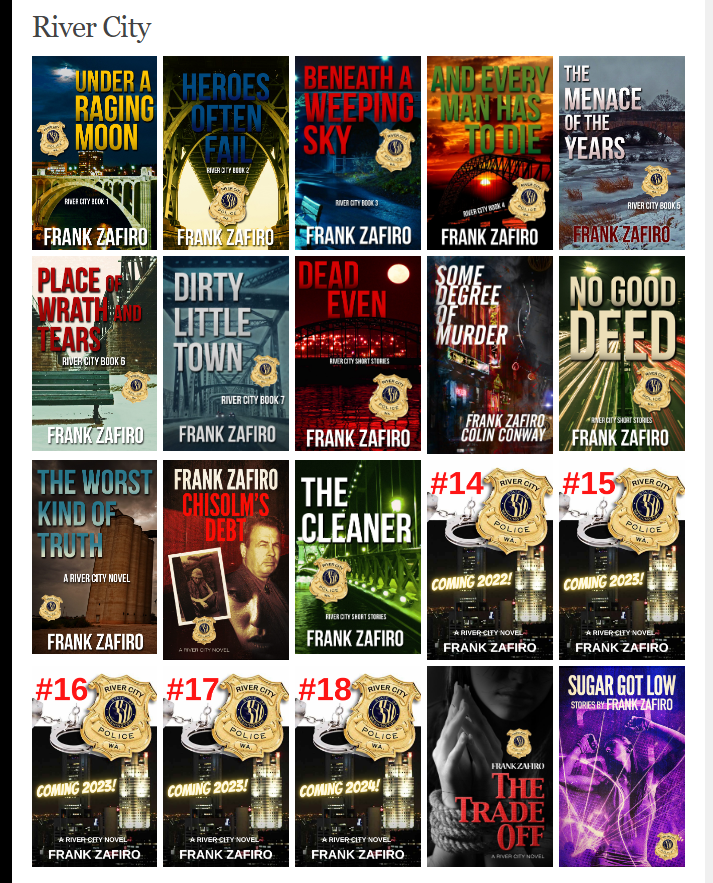
This process took some thought. Chronology had to be factored in, especially in terms of where to put the short story collections. But I think the current order of the books is one that will work for most readers.  Of course, it might confuse some as well, since The Worst Kind of Truth is #11 and #12 and #13 are already published. Also, books #14-18 in the series are still forthcoming, even though #19 and #20 are also already published. This ordering was necessary to keep things chronological. It will take me until sometime in early 2024 to “catch up” and fill in those forthcoming titles.


Even so, the intention is that, if one were to read the series from the beginning, the meta-story is much more complete.

OBAAT: My work in progress is a return to the private eye genre, which will limit the focus of the book somewhat from what I’ve been doing, as well as shorten it. (I think. It’s still a work in progress.) The Worst Kind of Truth is also a little narrower in both scope and length, so I’m curious. What brought about that decision and what was its practical impact on your writing?

FZ: As I mentioned, I felt like the series was beginning to suffer from too much sprawl—specifically, too many viewpoints. I routinely spent time with each important event in the book through the eyes of the person I thought was the best character to relate that event.


For this book, I tightened the story by sticking to one POV. All of the things that would happen in a multiple viewpoint presentation still occur in the River City world, but the reader gets all of it through Katie’s eyes.


This creates a more concise telling, which was my goal.


As for impact, it forced me to find a way to show events in short snapshots through Katie’s eyes in a way that allows the reader to infer all of the story behind the event… without actually seeing it.


A good example (minor spoiler alert) is in the two events that bookend The Worst Kind of Truth. There is a wedding early on, and a retirement at the end. The journey of the couple getting married is chronicled in great detail in earlier books. Same with the cop who retires at the end. If I hadn’t changed my usual storytelling approach, there would have been multiple scenes from the POV of these characters sprinkled throughout the book to tell that continuing story. But since I’ve told enough of it already, what Katie sees at both of these events is enough to let the reader know all s/he needs to know about both of those story arcs. There’s no need for those additional scenes.

OBAAT: You got a lot of attention last spring with your book The Ride-Along. Tell us a little about that one, how it came about, and what you wanted to accomplish there, as it is also a departure from your typical stories.


FZ: The Ride-Along was born of my dual frustrations with both a public that isn’t very knowledgeable about police work (yet very opinionated) and a profession (my own, prior to retirement) that isn’t very keen to explain itself, and which is often its own worst enemy. I was torn by my own knowledge of how hard the job is, how dedicated the overwhelming majority of people are who do that job (and this includes support staff, too), and how misunderstood the true realities of the job are by the general public… while at the same time, I saw what I believe are strategic failures of the profession, and a few outright bad acts that are difficult to reconcile, to say the least.


These frustrations were exacerbated by the fact the no one listens to each other. They shout. They speak in sound bites. If they listen at all, it is to prepare a counter-argument.


So… I created a situation where two people have to listen to each other. I put a police reform advocate in a patrol car with a veteran officer on a graveyard shift. Two good people with very different views spending ten hours in the close confines of a police cruiser… so, yeah, they gotta talk. And sure, sparks fly. But they also end up listening, too.


Neither character is intended as a straw person for the other to knock down. Instead, we were very intentional in being balanced in our approach, making honest points from the perspective of each character. We wanted to explore nuance in a fair way, since nuance is something that people today seem to have little time for.


Neither Colin nor myself are full enough of ourselves to think we can change the world with a book. But we do hope that it will give readers some cause for thought. And that’s a start.

OBAAT: I introduced you as “Award-winning author Frank Zafiro.” What did you win and how did that come about? ( could have said, but it will be more fun for you to do it.)

FZ:  I recently won three awards from the Public Safety Writers Association. The big one was a first


place award for “One Fine Day,” my short story that is included in The Tattered Blue Line: Short Stories of Contemporary Policing. It is set in River City and explores the aftermath of the death of George Floyd, which sparked actual events—both peaceful and violent—in Spokane (the real life River City) that I drew upon for this story.


I also won second place for “Hallmarks of the Job” (A Stanley Melvin PI Story) and honorable mention for “The Last Cop,” which appears in the anthology To Serve, Protect, and Write: Cops Writing Crime Fiction.


Awards are subjective, of course. But I was thrilled to win these, especially since the awards for short fiction are judged blindly.

OBAAT: This is a standard closing question but one that’s loaded for you, who has replaced Eric Beetner as the Hardest-Working Writer in Show Business™. (Apologies to the late James Brown.) So, what’s on the horizon for you?

FZ: After The Worst Kind of Truth, my next release is my fourth SpoCompton book, Live and Die This Way, coming in October. SpoCompton is a fun series for me because it is, quite literally, the other side of the badge from River City. This time out, my protagonist is a pint-sized female burglar trying to scrape by on her wits while taking care of her addict brother. Aside from being the same gender, she’s about as far from Katie MacLeod as one can get.


I’m fortunate enough to have a story in Josh Pachter’s forthcoming anthology Paranoia Blues, featuring crime fiction inspired by the songs of Paul Simon. Mine is “A Hazy Shade of Winter.”


And by the time this interview goes live, I’ll be waist deep in the fourth Stefan Kopriva mystery, which still bears the inventive title of Kopriva #4. I suspect it will be out (with a much better title) in December or January.


For those readers who like River City specifically, the follow-up to The Worst Kind of Truth is on the docket after Kopriva, so Q1 of 2023. If you find yourself jonesing for police procedurals in the meantime, I’d like to give a plug for Colin Conway’s 509 series, or your Penns River series, both of which will scratch that itch.


Thanks for having me back!