It’s my pleasure once again to welcome Beth Kelly to
write about movies. Last time she
delved into Westerns; today’s topic is significantly less rustic.
Today's
Movies Reflect a Modern Day Dystopia
In the
last century, film has emerged as a dominant form of mass-produced art.
Alongside this, humanity’s exponential technological growth has enabled the realization of
science-fiction, not only as a future possibility but in some instances, as a
reality. This development is equally applicable to an age-old concept closely
tied with science-fiction: the dystopia. The advancement of the dystopia from
the distant future to the tangible present is demonstrated in these four major
films of the last century:
Metropolis (1927)
 One of
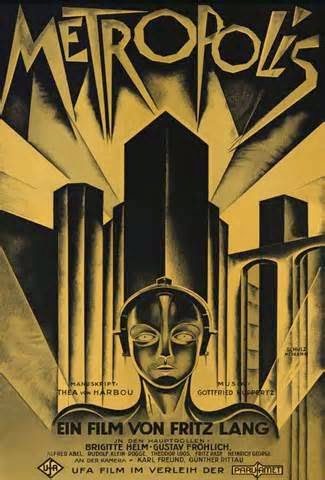
the first movies to depict fear of machines is in Fritz Lang’s Metropolis,
where the working class slaves away in the city’s underbelly to support
the aristocratic lifestyle of a slim minority. As an early work of dystopian
film, the movie establishes a long precedence for the theme of the futuristic
city as a source of awesome power, at the cost of nightmarish living
conditions. Metropolis is a classic that set the standard for robot
films today that depict technophobia in an age where technology is everywhere.
Of course, in the modern day, our technology has completely advanced since the
1920’s, protecting us with home security and giving us jobs that are impossible to
complete without computers. However, this isn’t to say that we are completely
comfortable with technology, as evidenced in modern day films that portray our
technophobia such as Chappie and Avengers: Age of Ultron.
One of
the first movies to depict fear of machines is in Fritz Lang’s Metropolis,
where the working class slaves away in the city’s underbelly to support
the aristocratic lifestyle of a slim minority. As an early work of dystopian
film, the movie establishes a long precedence for the theme of the futuristic
city as a source of awesome power, at the cost of nightmarish living
conditions. Metropolis is a classic that set the standard for robot
films today that depict technophobia in an age where technology is everywhere.
Of course, in the modern day, our technology has completely advanced since the
1920’s, protecting us with home security and giving us jobs that are impossible to
complete without computers. However, this isn’t to say that we are completely
comfortable with technology, as evidenced in modern day films that portray our
technophobia such as Chappie and Avengers: Age of Ultron.
The Trial (1962)

Orson
Welles’ The Trial centers on Josef K., a man accused of an unknown
crime. His eventual execution is just as bewildering as the rest of the film.
The audience is left without an explanation, only the implication that a regime
has the capability to wake a man one morning and have him killed, all without
letting slip the least bit of information as to why. Welles takes a descent into madness
that’s bureaucratic in the film’s execution, with an all-pervasive sense of
dread that taints the protagonist's surroundings, infecting the audience with
his (justified) paranoia.
2001: A Space Odyssey (1968)
 Stanley
Kubrick’s 2001: A Space Odyssey is dystopian by implication, rather than
being so explicit as the films above. The artificial intelligence used on the
Jupiter mission, Hal, is humanity’s pinnacle of technological creativity. He
ultimately determines that the humans on this mission must die in order for him
to complete the mission. The fact that humanity is objectively seen by the AI
they created as disposable, even obstructive, does not bode well for the
off-screen humans back on Earth. As a whole, the film thematically establishes the forward progression of
human evolution, mysteriously linked to the appearance of the black monolith
seen in each of the movie’s four acts. However, with great power comes
casualties. The cost of this progress is highlighted by Hal’s betrayal and
again by the last lingering shot of the film, where the film’s protagonist has
been transformed into a gazing star-child, left on a higher plane of existence
but now bereft of humanity.
Stanley
Kubrick’s 2001: A Space Odyssey is dystopian by implication, rather than
being so explicit as the films above. The artificial intelligence used on the
Jupiter mission, Hal, is humanity’s pinnacle of technological creativity. He
ultimately determines that the humans on this mission must die in order for him
to complete the mission. The fact that humanity is objectively seen by the AI
they created as disposable, even obstructive, does not bode well for the
off-screen humans back on Earth. As a whole, the film thematically establishes the forward progression of
human evolution, mysteriously linked to the appearance of the black monolith
seen in each of the movie’s four acts. However, with great power comes
casualties. The cost of this progress is highlighted by Hal’s betrayal and
again by the last lingering shot of the film, where the film’s protagonist has
been transformed into a gazing star-child, left on a higher plane of existence
but now bereft of humanity.
The Omega Man (1971)
 Directed
by Boris Sagal, The Omega Man finds the (seemingly) last man in the
world, Robert Neville surviving in the ruins of Los Angeles, fighting off
mutants caused by biological plague. Neville spends a lot of time on screen
alone, making for long stretches of unbroken silence, one man contemplating his
solitude, lending a reflective mood to the empty, dystopian world. As the
source of cure to the plague, Neville is comparable to a biblical savior and
because he is the enemy of the infected cult, the Family, the movie presents
some Christian undertones.
Directed
by Boris Sagal, The Omega Man finds the (seemingly) last man in the
world, Robert Neville surviving in the ruins of Los Angeles, fighting off
mutants caused by biological plague. Neville spends a lot of time on screen
alone, making for long stretches of unbroken silence, one man contemplating his
solitude, lending a reflective mood to the empty, dystopian world. As the
source of cure to the plague, Neville is comparable to a biblical savior and
because he is the enemy of the infected cult, the Family, the movie presents
some Christian undertones.
Even
after clarifying the dystopian themes of these films, are they still relevant
today? After all, they are old. Could this line of thinking be out of date? Not
at all. Recent cinema is full of examples that still point to a public
fascination with imminent dystopia: from The Road to The Hunger Games,
Ender’s Game to The Matrix, and everything in between, the
dystopia is very much alive in film. The cinematic dystopia remains an
intriguing subject, as it projects humanity’s hopes and fears for the future.