Showing posts with label david simon. Show all posts

Monday, March 25, 2019

Homicide: Life on the Street


My birthday fell during the government shutdown so The Beloved Spouse™ gave me one of my gifts early, seeing as how I’d have time to properly appreciate it: the boxed set of Barry Levinson’s groundbreaking series Homicide: Life on the Streets.

I discovered Homicide late in its run; TBS had never seen it. Only heard
of it because I liked to talk it up based on what I remembered and because I’d read her excerpts from David Simon’s book during my periodic re-readings. I had high hopes and she figured she was along for the ride. We were both pleasantly surprised.

Homicide was a show that exemplified Joseph Wambaugh’s dictum of how a good cop story is less about how the cops work on the case than it is about how the case works on the cops. Each character is unique and each responds differently to the demands of the job. Members of Al Giardello’s squad come and go and not always on the best of circumstances. The egos are large—these are, after all, murder police, the cream of the crop—and so is the pressure.

Fans of The Wire who have not seen Homicide need to. Not only does it capture the essence of the book that so much of The Wire was based on, you’ll see countless characters who later showed up in the later series. You won’t know the names of a lot of them, but you’ll recognize them. “Hey, that’s the medical examiner from The Wire!” “That’s the councilman in the wheelchair!” The vibe is also similar, or at least as similar to HBO as a 90s TV show could get.

As with all great TV, the writing is superb. Showrunner Tom Fontana pulled together a crew of writers (eventually to include David Simon himself, still working at the Baltimore Sun when the show premiered) that looked at the life of a homicide cop from every angle. They not only weren’t afraid to go against the standard car chase and shootout cop show, they became the anti. There are shows early on where almost the entire episode takes place in The Box, where cops take their turns looking to work confessions form people who wouldn’t even talk to them if they had a clue. One episode takes place almost entirely on a subway platform, a commuter crushed between a train and the platform, talking to one of the detectives while the rest of the squad investigates whether this is an accident or a crime and others search for the victim’s girlfriend so they can say good-bye.

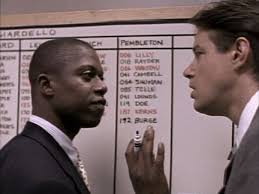
As important as the writing is, no scenes so confined could work without superb acting and Homicide had no shortage of talent. The show is at its best when Frank Pembleton (Andre Braugher) and Tim Bayliss (Kyle Secor) are tag-teaming suspects in the box. Early seasons make more of the partnership dynamic than later seasons and the show is better for it. Bolander (Ned Beatty) and Munch (Richard Belzer), Howard (Melissa Leo) and Felton (Stephen Baldwin), Lewis (Clark Johnson) and Crosetti (Jon Polito) all establish and maintain their own rhythms. Yaphet Kotto’s performances are subtle masterpieces as he plays a half-black, half-Italian unit commander who contains bits of Father Knows Best, Gunnery Sergeant Hartman, and Vito Corleone.

The first two or three seasons are consistently the best, but even a relatively weak episode in the later seasons is as good as anything else you’ll see on television. Episodes that take your breath away pop up put of the blue with unnerving regularity. Just as you feel the show is settling into a formula something will happen that leaves you slumped in your chair when it’s over. Not all the major events will be to your liking. None of the characters is completely good, and the rivalries and ego clashes that erupt keep the squad room from being anything but a “business as usual” environment, but that’s part of what makes the show special: you’re never comfortable watching it.

I’ve become much more interested in interviews than forensics over the past couple of years and Homicide came along for me at the perfect time. Crime scene details, fibers, ballistics, and DNA reside in their proper roles of supporting the cops who gathering witness statements and work people in the box. In other words, actual drama.

No show that has to produce 22 episodes a year can be uniformly special, but few, if any, pulled it off as well as Homicide. If you haven’t seen it, you should. And if you have, you should watch it again, if only to catch the really special episodes. They’re masterclasses in pacing, dialog, and suspence.

Monday, December 21, 2015

Greater Empathy Through Fiction?


I’ve heard it said that those who read fiction develop a greater sense of empathy. Maybe. It could also be an example of my favorite Latin logic fallacy, which I trot out at the drop of a hat because I love how it sounds: post hoc ergo propter hoc. (After this, therefore because of this.) It could be people with greater senses of empathy are attracted to novels, and those with less of that quality read non-fiction. I’ll leave that for greater minds to debate. There is no shortage of them in the world.

What I do know is that I have far more empathy for those whose situations vary from my own than I did as a younger man. There is no single date or occurrence that prompted it. I can say when the tide began to turn: The Wire. I came late to the show (as usual), picking up Season One with Season Four already in progress. I’d already read Homicide, so I was primed. Around this time I read The Corner and I started to to look past the superficial dissimilarities between my rural upbringing and what happens in the inner city of Baltimore.

My reading remained focused on crime, but crime with more diversity. While reviewing books for the New Mystery Reader web site I became sort of the unofficial Irish crime fiction reviewer, routinely assigned books by Declan Burke, Declan Hughes, Adrian McKinty, and Ken Bruen. NMR also exposed me to Tim Hallinan’s Poke Rafferty thrillers, set in Bangkok. Charlie Stella’s looks at mob life from the underside. Arnaldur Indriưason’s Iceland novels and Leighton Gage’s Chief Inspector Silva series. J. D. Rhoades’s unique brand of redneck noir. Friends steered me toward Daniel Woodrell

I learned that once one gets past the superficial differences in language, culture, justice systems, availability of weapons, and which side of the road to drive on, people are pretty much the same. With outliers on either side, the great majority of people pretty much want to be left alone to live their lives as happily as they can, and for their children to have it better than they do. The only thing that made me special was having the foresight to be born in a country that allowed me to do those things.

It’s now easier for me to imagine—and I am grateful beyond words that I only have to imagine—what it must be like to live in a place where those things are denied to people. Even worse, a place where your life—and the lives of your family—is in danger because of things you have no control over. Gender. Sexual orientation. Race or ethnicity. I include religion, too, as the major organized religions all preach peace. (I’ll not hold it against any religion if some of its followers defame the faith by their very existence. These people are apostates, and they exist in every religion.) How would I feel if I lost everything I owned and faced the option of death or flight that took me to a place where I didn’t speak the language and my customs seemed as strange to the current inhabitants as theirs do to me.

It has become fashionable to declare at great length and volume against immigrants and refugees, and every nation certainly has the right to set its own polices for both. When doing so, let’s not forget that the only thing that allows us to pass judgment on who is worthy to cross our borders is an accident of birth. I served in the military, pay my taxes, vote, and comply with summonses for jury duty without complaint. I view them as debts owed that I can never fully repay, but do the best I can.

Let’s remember how we all got to where we are during this holiday season. Some work harder than others, but it’s a sin of hubris for anyone in this country to believe for an instant that he or she has earned what we have. We’ve done our part, but we also started ahead of the game by being born into a situation that allowed—and often encouraged—us to become everything our gifts and efforts warranted. Any “earning” we did came after the fact. With that in mind, let’s take a minute this holiday season to reflect on our great and largely undeserved good fortune and learn a little fucking humility.

Thursday, August 21, 2014

Difficult Men

Difficult Men is Brett Martin’s brilliant and entertaining look behind the key shows of what he calls the Third Golden Age of television, a period spearheaded by HBO with the prison drama Oz laying the foundation from which The Sopranos would become a phenomenon.

The title has double meaning. The programs that make up the core of Martin’s third golden age focus largely on the lives of forty-ish men in crisis: Tony Soprano, Vic Mackey, Walter White, Don Draper, and several cops, politicians, and drug dealers in The Wire. Those are the guys the public saw. The men responsible for their creation were forty-ish themselves, and they were, by and large, the truly difficult men.

The biggest takeaway, for me, was, “Why would anyone want to write for television?” Even if you overcome innumerable hurdles and are lucky enough to get on a first-rate show, you may get to work for a David Chase, a David Milch, or a Mathew Weiner. Chase never got over the idea he was too good for television. Weiner comes off as an arrogant an asshole ever to draw breath. Milch is such a whack job he makes James Ellroy look as eccentric as Jimmy Carter.

The stories of how all these men achieved their positions are fascinating. How events, timing, critical masses of people, and the pure luck of pitching the right idea to the right network at the right time came together to create something special. How HBO owned the franchise until it got a little complacent and FX leadership decided maybe that network didn’t have to be an afterthought at Fox, after all. AMC’s good fortune when looking for a program with gravitas, but not a crime show, which had done the heavy lifting to that point. Martin talked to a lot of people in position to know, and what they told him was too good to have been made up.

Not all the showrunners were off the rails. David Simon comes across as argumentative, but fair, and extremely loyal to both his people and his vision, which could cause friction. Shawn Ryan (The Shield) called in personal favors from friends for his pilot and to keep the cast together—casting his wife as Vic Mackey’s wife because “I know I can get you back”—and using the guerilla film tactics born of budget necessity to create something special both onscreen and off. Vince Gilligan appears to be a mensch. So, no, one does not have to be a neurotic asshole to be a big success, though it doesn’t seem to hurt.

Difficult Men is a great read for any fans of any of the shows cited, and for anyone curious about how shows get made—or, more often, don’t get made—in Hollywood. A quick read, written by Martin in an engaging manner with the perfect distance from the subject matter. Not so distant he looks down on his subjects, yet not so close he fails to recognize the lunacy. This is pretty much a pitch perfect tale.

One last thing. Despite giving David Chase every opportunity to justify the ending of The Sopranos, when all is said and done, it was still chickenshit.


Wednesday, September 3, 2008

Generation Kill

I finished my binge watching of HBO’s Generation Kill over the weekend. (Binge watching is a technique for watching serial programming the Spousal Equivalent and I perfected when catching up on Deadwood after missing the first season. Don’t watch the shows when they’re broadcast; record them, and watch them in chunks of two or three hours—or more—at a time. We spent New Year’s Eve 2007 watching five hours of The Wire and were pissed because we ran out of episodes.) Generation Kill is a worthy addition to the David Simon/Ed Burns oeuvre, not as dissimilar to The Wire as the setting suggests.

First, GK is a well-done drama. It’s scary and frustrating and laugh out loud funny, sometimes simultaneously. The major characters are multi-dimensional and well-rounded. Using real people helps, but we’ve all seen movies—books and television shows, too—where real people were made to look as one-dimensional as any comic book. Evan Wright—who wrote the original Rolling Stone articles—worked hand in glove with Simon and Burns to make sure they got it right. A military advisor made sure the equipment and tactics were accurate, and having an actual member of the 1st Marine Recon Battalion in the cast didn’t hurt. (Sergeant Rudy Reyes plays himself.)

In addition to being a thought-provoking look at our military in Iraq, Generation Kill is highly entertaining. I’ve not read the book, but I understand the miniseries to be a faithful reproduction. There are a few quibbles on the Internet about how faithful Wright’s articles and book are to the events portrayed, but it can be assumed he wrote the story from the perspective of the grunts in his platoon. Complaining about NCOs who are assholes and incompetent officers is a time-honored prerogative of the man whose boots are in the mud. (For a well reasoned and thoughtful second opinion of GK by someone in a position to know, click here.)

Simon and Burns leverage this perspective to make the same point they made so artfully in The Wire, and in their previous television effort, The Corner: the “system” won’t save. Doesn’t matter if it’s the military, law enforcement, or government, the only hope anyone has for redemption is in his or her own hands. The system is the system, and its primary task, almost by definition, is to perpetuate itself. That’s not necessarily bad thing—it depends on the system—but whatever system you’re involved with isn’t likely to save you.

The other great, and more hopeful, accomplishment of Generation Kill is to humanize the Marines, and, through them, all of the military. They’re not perfect. The language is foul, and some of them enjoy the act of killing a lot more than they ought to. Overall, though, their redemption comes in the form of the pride in completing their mission, and in their dedication to their peers. They get tired and scared and angry and profane and violent like anyone would in situations such as they’re exposed to, and consistently acquit themselves well. No one died in the 1st Marine Recon during their involvement in Operation Iraqi Freedom, which shows, as Lt. Colonel Shoup points out in his excellent commentary referenced above, the leadership couldn’t have been as bad as perceived by the men in their positions of limited situational awareness.

Sergeant Major Sixta is a prime example. He’s shown as the biggest asshole in the battalion for most of the series, jerking men around over the grooming standard and the length of their mustaches. He’s missing through much of the middle part of the series, and reappears during a period of questionable morale to ask a junior officer whether it was time to enforce the grooming standard again. Far from being petty, it’s an indication that Sixta knows Marines are always bitching, and it’s better to direct that bitching away from something that would become counterproductive and potentially dangerous down the road.

Lt. Colonel Stephen “Godfather” Ferrando, commander of 1st Recon, is shown as a hard-driving, career-oriented, tough, yet compassionate officer, torn between two sensibilities: one to his mission, and the other to his men. He’s not perfect, and he’s been given missions neither he nor his men appreciate, but he’ll do the best he can. We’d all do well to remember this about those who have fought in all our wars. They’re not saints, they’re not wholly selfless, and they’re not a bunch of baby-killing psychopaths. They get tired and cold and hungry and have to go to the bathroom and get horny just like everyone else. Teaching the rest of us how it all plays out day-to-day under the mix of tedium and terror that is military life may be Generation Kill’s greatest accomplishment.