Thursday, September 29, 2022

Favorite Reads, Summer 2022

 August was the month I set aside for reading PI novels as a way to familiarize myself with the genre in an effort to jump start my work in progress. It was time well spent, as the length of this season’s favorites column shows.


The Ice Harvest, Scott Phillips. The Beloved Spouse™ and I watch the movie every Christmas Eve, I read the book every few years, and the enjoyment derived never falters. Phillips hit the ground running with this first novel.


The Judgment of Deke Hunter, George V. Higgins. Maybe my least favorite of Higgins’s novels, but still damn good. The story is fascinating and he does his usual wonderful job of letting it unfold through oblique dialog, but some of the dialog is thicker than narrative in a Russian novel and so far off topic, and for so long, it strained my patience.


The Deadwood Bible: A Lie Agreed Upon, Matt Zoller Seitz, editor. Highly recommended for fans of Deadwood and David Milch. Much of the book is a mini-biography of Milch, followed by an oral history of the show and movie, and concluded with critical essays. A fascinating read and detailed study of an exceptional, and exceptionally flawed, man. I’ll admit, some points made in the essays are head scratchers. (No link available. The book was a Kickstarter project.)


The Maltese Falcon, Dashiell Hammett. Almost a hundred years old and still maybe the greatest—and most perfect—detective story ever written. You disagree? Bring it on.


All the Dead Voices, Declan Hughes. It had been a while since I read an Ed Loy novel, and I chose wisely with this one. Probably the best of the lot and exquisitely crafted to tie the late aughts back to the Troubles.


Gone Baby Gone, Dennis Lehane. The best of the Kenzie-Gennaro books, which says a lot. The film is an excellent adaptation.


Indigo Slam, Robert Crais. Crais is as good a storyteller as anyone in the genre, and this is one of the better stories. His plots are complex without being confusing, due in large part to the clarity of his writing. No one gives the reader a fairer chance to keep up without boring those more intimately involved.


Every City is Every Other City, John McFetridge. A re-reading of this year’s Shamus winner for best paperback original. I loved this book when I first read it, and may have liked it even more this time. McFetridge’s style and voice are perfect for part-time PI Gord Stewart, and the low-key romance between Gord and Ethel is as entertaining and rings as true as any you’ll read. The intermingled plots work well and sustain interest, but this is Gord’s story, and well worth the time.


Something Bad Wrong, Eryk Pruitt. I don’t often mention ARCs here, but this is worthy of exception. Pruitt weaves together different viewpoints and timelines into a cohesive whole that doesn’t raise the curtain for its reveals so much as it allows the fog to dissipate. Not just an outstanding book; an accomplishment. Look for this one next march. (Link is to pre-order.)


Thursday, September 22, 2022

A Cautionary Tale

 Of all the people involved in getting material to readers, the writer lives at the bottom of the food chain.


Today’s case in point:


Bingeing Homicide: Life on the Street inspired me to write a short story that takes place entirely in a police interview room, hence the title: “The Box.” I am as proud of this story as I am of anything I have written, including the two Shamus-nominated novels.


I submitted “The Box” to [magazine name redacted], figuring I might as well start at the top and work my way down. It was a pleasant surprise when they accepted it right away, as is. For reasons unclear to me now (and this is my fault), I expected publication this fall.


A few weeks ago I saw a new issue of [magazine name redacted] was available and I wondered if “The Box” was in it. It was not. I poked around and found the story came out earlier this year. Way earlier. So early there are no print copies left.


This was news to me. I wrote the publisher and asked if, in fact, I was reading this correctly and the issue containing “The Box” had already been out for over six months, and, if so, why I wasn’t notified.


He replied the same day to tell me “we can’t promise we will reach out to everyone although sometimes we try to do so. It’s a matter of bandwidth… only communication with authors would run into hundreds per month (400+ to be exact).


“In the past we have encouraged our dear authors to follow our newsletters and check our shop.”

Follow-up messages revealed “The Box” was published in the February-March 2022 issue. 

I never claim to be a big shot. I don’t ask for special consideration. Writers understand that all the industry shit that rolls downhill comes to rest on our shoes. I get that. But is it not enough that publications no longer feel the need to extend the basic courtesy of a rejection (the general attitude is “Submit and fuck off. We’ll call you if we want you.”), but they no longer even feel it necessary to tell you when the story they accepted will be in print? Honest to God? For him to cite “400+” authors to reply to, he clearly meant those who submitted and were rejected. That’s bad enough, but I made the cut and it was still on me to divine their publication schedule?


I would have bought a print copy; they’re gone. (The Beloved Spouse™ found one for me online. Said purchase exhausted what I was paid for the story.) I can’t even self-publish it or put it on my web site, as [magazine name redacted] owns the “exclusive rights to publish” for “the full term of copyright,” which, as I understand it, is my lifetime plus 70 years. That’s my fault for not reading the contract more carefully when I signed it. My life plus 70 is a lot to give away for $25.


I have never made money from a book. Not one time. Author’s copies for promotion and consignment sales, web site maintenance, and marketing costs have overwhelmed all proceeds. My average monthly royalties from Amazon for the five self-published books averaged $1.75 over the past year. Bookstores won’t stock my books because they can’t return them.


I wouldn’t mind if my average rating on Amazon for all 13 books wasn’t 4.6. Of course, that’s based on only a total of 144 ratings. Don’t misunderstand me. I am grateful for all my readers. (Especially since I appear to know most of you personally.) I am flattered when asked to sit on panels or contribute to anthologies, especially when I see who I’m surrounded by. I will not ever dispute that I have been fortunate to have such respect and I want you all to understand I never take any of the good things for granted.


Still, it’s tough. The excitement of an approaching release is now tinged with the anticipation of the disappointment to ensue when the book sinks like a stone. More than one person told me White Out, released July 11, is my best book; it has six reviews as of this posting. They’re all five stars.


I never expected to earn a living as a writer. Mostly I hoped it would pay for a conference or two each year. (I can’t write off the trips, as the IRS considers my writing to be a hobby.) I write because I enjoy the challenge of crafting a story. Finding the right tone, getting the dialog just so and fixing the descriptions so I can say, while not perfect, “this is the best I can do.” All of that remains as true as it ever was, but there is a point where the satisfaction derived is overcome by the frustration endured. I’m not there yet, but I can see it from here.


I’m not asking for sympathy. I went into this a grown-ass man with his eyes wide open. Consider this a detailed PSA for fledgling writers: don’t kid yourself. Do your homework. Take pride in the fact that you provide the raw material that drives an industry, and understand that industry will treat you no better than a mining company treats topsoil.


Thursday, September 15, 2022

An Interview With Frank Zafiro, Author of Too Many Books to Mention on This Line


Award-winning author Frank Zafiro writes gritty crime fiction from both sides of the badge. He was a police officer in Spokane, Washington, from 1993 to 2013, and retired as a captain. He write police procedurals in his River City series and Charlie-316 series (with Colin Conway) and the criminal side of things in his SpoCompton series, Ania series (with Jim Wilsky), Bricks & Cam Jobs (with Eric Beetner), and others. To date, he’s written more than forty novels and done so much collaborating crowds gather demanding his haed be shaved..


Frank lives in Redmond, Oregon, with his wife Kristi, dog Richie, and a very self-assured cat named Pasta. He is an avid hockey fan and a tortured guitarist. (Editor’s Note: I can’t speak to Frank’s guitar playing, but, as a devotee of the Philadelphia Flyers, he can also be described as a tortured hockey fan.)


One Bite at a Time: Frank, welcome back. it’s always a pleasure to have you. Next week marks the debut of your eleventh River City book, The Worst Kind of Truth. Tell everyone a little about this one.


Frank Zafiro: Thanks, Dana! Glad to be back. In The Worst Kind of Truth, Detective Katie MacLeod investigates a pair of sexual assaults, and struggles with all of the obstacles that come with these cases.


OBAAT: The Worst Kind of Truth is a bit of a departure from its predecessors in the series. How is it different?

FZ: It’s the first time I’ve opted for a single point-of-view. River City has always been an ensemble cast of police officers. As a result, the books all had multiple viewpoints. That generally works well for a police procedural of this nature. However, I felt like the series was beginning to suffer from too much sprawl… that is, too many viewpoints. Too many spices in the soup, if you take my meaning.


For this book, I tightened the story by sticking to one POV – Detective Katie MacLeod.


It’s an approach I plan to stick with for the next outing. After that, I may allow a couple of minor secondary viewpoints back into the series, but nothing like the way it was in the earlier books. There’s nothing inherently wrong with how I did it before, mind you. In fact, it was probably the best way to lay the groundwork for the series. But now I can tell a tighter story because the foundation is already there—I don’t have to establish it anymore.

OBAAT: You re-tooled the entire River City series earlier this year. What did you do, and why?

FZ: River City has always been a big setting. I had the main series, the spin-off Stefan Kopriva mysteries, four collections of short stories, and three standalone novels.


I eventually realized that the larger story that I was telling—the River City story, if you will—wasn’t


necessarily getting through to all the readers. Some read the main series and nothing else. As a result, there were entire character arcs that the reader missed. Large (and small) events in the canon that weren’t seen. And frankly, some books that were getting less attention than I think they deserved.


So I merged all of the books set in River City into the series proper. The only exception was the Stefan Kopriva mystery series, which I think has its own style and is more effective if remains separate. And a significant majority of readers make the jump from River City to Kopriva anyway.


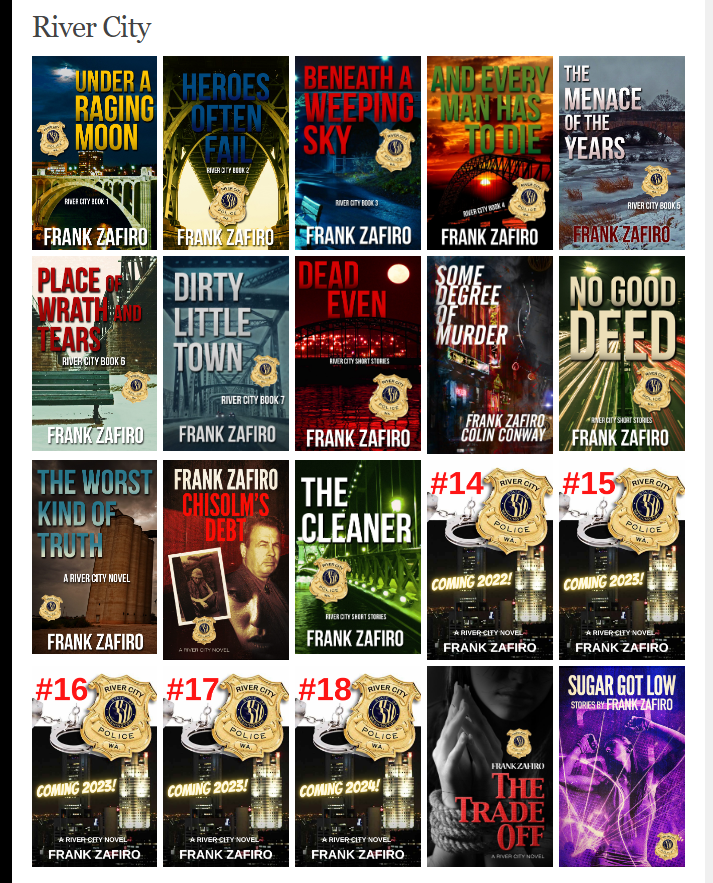
This process took some thought. Chronology had to be factored in, especially in terms of where to put the short story collections. But I think the current order of the books is one that will work for most readers.  Of course, it might confuse some as well, since The Worst Kind of Truth is #11 and #12 and #13 are already published. Also, books #14-18 in the series are still forthcoming, even though #19 and #20 are also already published. This ordering was necessary to keep things chronological. It will take me until sometime in early 2024 to “catch up” and fill in those forthcoming titles.


Even so, the intention is that, if one were to read the series from the beginning, the meta-story is much more complete.

OBAAT: My work in progress is a return to the private eye genre, which will limit the focus of the book somewhat from what I’ve been doing, as well as shorten it. (I think. It’s still a work in progress.) The Worst Kind of Truth is also a little narrower in both scope and length, so I’m curious. What brought about that decision and what was its practical impact on your writing?

FZ: As I mentioned, I felt like the series was beginning to suffer from too much sprawl—specifically, too many viewpoints. I routinely spent time with each important event in the book through the eyes of the person I thought was the best character to relate that event.


For this book, I tightened the story by sticking to one POV. All of the things that would happen in a multiple viewpoint presentation still occur in the River City world, but the reader gets all of it through Katie’s eyes.


This creates a more concise telling, which was my goal.


As for impact, it forced me to find a way to show events in short snapshots through Katie’s eyes in a way that allows the reader to infer all of the story behind the event… without actually seeing it.


A good example (minor spoiler alert) is in the two events that bookend The Worst Kind of Truth. There is a wedding early on, and a retirement at the end. The journey of the couple getting married is chronicled in great detail in earlier books. Same with the cop who retires at the end. If I hadn’t changed my usual storytelling approach, there would have been multiple scenes from the POV of these characters sprinkled throughout the book to tell that continuing story. But since I’ve told enough of it already, what Katie sees at both of these events is enough to let the reader know all s/he needs to know about both of those story arcs. There’s no need for those additional scenes.

OBAAT: You got a lot of attention last spring with your book The Ride-Along. Tell us a little about that one, how it came about, and what you wanted to accomplish there, as it is also a departure from your typical stories.


FZ: The Ride-Along was born of my dual frustrations with both a public that isn’t very knowledgeable about police work (yet very opinionated) and a profession (my own, prior to retirement) that isn’t very keen to explain itself, and which is often its own worst enemy. I was torn by my own knowledge of how hard the job is, how dedicated the overwhelming majority of people are who do that job (and this includes support staff, too), and how misunderstood the true realities of the job are by the general public… while at the same time, I saw what I believe are strategic failures of the profession, and a few outright bad acts that are difficult to reconcile, to say the least.


These frustrations were exacerbated by the fact the no one listens to each other. They shout. They speak in sound bites. If they listen at all, it is to prepare a counter-argument.


So… I created a situation where two people have to listen to each other. I put a police reform advocate in a patrol car with a veteran officer on a graveyard shift. Two good people with very different views spending ten hours in the close confines of a police cruiser… so, yeah, they gotta talk. And sure, sparks fly. But they also end up listening, too.


Neither character is intended as a straw person for the other to knock down. Instead, we were very intentional in being balanced in our approach, making honest points from the perspective of each character. We wanted to explore nuance in a fair way, since nuance is something that people today seem to have little time for.


Neither Colin nor myself are full enough of ourselves to think we can change the world with a book. But we do hope that it will give readers some cause for thought. And that’s a start.

OBAAT: I introduced you as “Award-winning author Frank Zafiro.” What did you win and how did that come about? ( could have said, but it will be more fun for you to do it.)

FZ:  I recently won three awards from the Public Safety Writers Association. The big one was a first


place award for “One Fine Day,” my short story that is included in The Tattered Blue Line: Short Stories of Contemporary Policing. It is set in River City and explores the aftermath of the death of George Floyd, which sparked actual events—both peaceful and violent—in Spokane (the real life River City) that I drew upon for this story.


I also won second place for “Hallmarks of the Job” (A Stanley Melvin PI Story) and honorable mention for “The Last Cop,” which appears in the anthology To Serve, Protect, and Write: Cops Writing Crime Fiction.


Awards are subjective, of course. But I was thrilled to win these, especially since the awards for short fiction are judged blindly.

OBAAT: This is a standard closing question but one that’s loaded for you, who has replaced Eric Beetner as the Hardest-Working Writer in Show Business™. (Apologies to the late James Brown.) So, what’s on the horizon for you?

FZ: After The Worst Kind of Truth, my next release is my fourth SpoCompton book, Live and Die This Way, coming in October. SpoCompton is a fun series for me because it is, quite literally, the other side of the badge from River City. This time out, my protagonist is a pint-sized female burglar trying to scrape by on her wits while taking care of her addict brother. Aside from being the same gender, she’s about as far from Katie MacLeod as one can get.


I’m fortunate enough to have a story in Josh Pachter’s forthcoming anthology Paranoia Blues, featuring crime fiction inspired by the songs of Paul Simon. Mine is “A Hazy Shade of Winter.”


And by the time this interview goes live, I’ll be waist deep in the fourth Stefan Kopriva mystery, which still bears the inventive title of Kopriva #4. I suspect it will be out (with a much better title) in December or January.


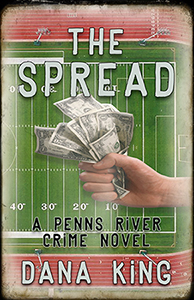
For those readers who like River City specifically, the follow-up to The Worst Kind of Truth is on the docket after Kopriva, so Q1 of 2023. If you find yourself jonesing for police procedurals in the meantime, I’d like to give a plug for Colin Conway’s 509 series, or your Penns River series, both of which will scratch that itch.


Thanks for having me back!

Thursday, September 8, 2022

Bouchercon Memories

 Since I can’t be at Bouchercon in person this year, I thought I’d use this space to recap my favorite memories. The lost got ling, so not everything is here. If any strike your interest and you’d like more detail, let me know in the comments and I’ll dedicate a post to it/them.


Baltimore, 2008

My indoctrination began in earnest when Peter Rozovsky (one of three people I already knew going in) introduced me to Scott Phillips, who’d written one of my favorite books (The Ice Harvest).

Meeting Declan Hughes in the men’s room.

Speaking with Michael Black and learning that reading Connie Fletcher’s books, which I was already doing, was as good a way as any to understand cops and police work.

Zoe Sharp, who I knew only through the Murderati blog, asking me to sign a get well card for J.T. Ellison.


Indianapolis, 2009

Scott Phillips recognized me in the bar and asked if I’d like to get something to eat with the group he was with. Our only previous interaction had been when Peter introduced us in Baltimore.

Speaking with Max Allen Collins about his work with Mickey Spillane.


Cleveland, 2012

My first panel: “Murder in Small Towns,” moderated by Sandra Parshall,  with co-panelists Erika Chase and Brenda Chapman, all of whom made my first experience facing the audience not just a pleasure, but damned easy on my blood pressure.

Standing at the bar wearing my “What Would Al Swearengen Do?” tee shirt and having a stranger accost me with “I want that shirt.” This was the opening act of what became an enduring friendship with Tim O’Mara.


Albany, 2013

Panel: “Goodnight, My Angel: Hard-boiled, Noir, and the Reader's Love Affair With Both,” moderated by Peter Rozovsky, with Eric Beetner, Mike Dennis, Terrence McCauley, and Jonathan Woods. I was already friends with Peter, Eric, and Mike, and became friends with the others two, Terrence famously so..

Albany had what they called Author’s Choice slots, where individuals or groups could sign up for half hours to do whatever they wanted. I used my time to discuss Raymond Chandler’s ideal detective and established a bit of a footprint in the community, thanks to the substantial audience that remained after the Thuglit reading that preceded it. Thanks to Todd Robinson for packing them in for me.


Long Beach, 2014

Noir at the (Breakfast) Bar, featuring readings by Les Edgerton, Tim Hallinan, and John McFetridge.

My first Shamus dinner. The Beloved Spouse™ and I sat with Tim Hallinan; Tim and I were both nominated, though in different categories. Neither of us won, but I was down with the dinners forever after.

Running into the late Sue Grafton the morning after she received her lifetime achievement award at the Shamuses. I approached and got as far as “Hello, Ms. Grafton” before she interrupted with “Please, call me Sue” and chatted for a bit. A class act all the way.


Raleigh, 2015

Panel: “Just the Facts: The Police Procedural.” James O. Born moderated Colin Campbell, Stephanie Gayle, Larry Kelter, and me in a discussion of police methods and how best to portray them. This may be my favorite panel ever, as Jim took time after my first answer to tell folks that what I said was dead on. I floated out of there.

The next day Jim did a solo event on police tactics, and the escalation of force spectrum. J.D. Rhoades was there to answer the recurring question “Can I shoot him now?”

Chicken and hush puppies at Clyde Cooper’s.


New Orleans, 2016

My first moderator gig, with Heather Graham, Terrence McCauley, and a writer whose name I am keeping to myself for reasons those who were there will understand. I honest to God do not remember the topic and there’s nothing about the panel in my contemporaneous notes, so I guess I was fully in the moment.

Dinner with John McFetridge and Laurie Reid at the Chartres House.

My second Shamus nomination, and we sat at the Down & Out Books table with J.L. Abramo, nominated in the same category as I. To show what a good guy Joe is, he won, I lost, and we’re still friends.

Losing my wallet in my pants.


Toronto, 2017

Panel: “Heroes and Antiheroes: Are heroes possible even in fiction? Do we need them?” J. Kent Messum led a star-studded cast of Eric Campbell, Allison Gaylin, Stuart Neville, and David Swinson (and me) through what was likely the most elevated panel discussion I’ve been part of.

The Beloved Spouse™ and I spent a day at Niagara Falls on the way to Toronto and had a ball.

Korean Barbecue with John McFetridge and friends.


St. Petersburg, 2018

Terrence McCauley and his lovely wife Rita hosted a marvelous dinner for about twenty friends; The Beloved Spouse™ and I were honored they chose to include us. A truly special event.

TBS and I rode to the Shamus dinner in an actual Lincoln Town Car, not one of the compromised second drafts they’re passing off as Town Cars now. Our driver owned the car service and had worked as a stand-up comedian. We had a ball both going and coming.


Dallas, 2019

Noir at the Bar, hosted by Eryk Pruitt and featuring a hilarious and insightful reading by Joe Lansdale,.

The most memorable panel was one I was not a member of, on police procedurals. When asked by an audience member who was writing good procedurals today, both Frank Zafiro and Mark Bergin – retired cops, no less – called me out. It doesn’t get any better than that.

Dinner with James D.F. Hannah and Adam Plantinga, with apologies to Mark Bergin, with whom our wires got crossed.

Apologies to my co-panelists. My vision issues were at their worst in Dallas, and much of what happened there is a literal blur.


I’ll have no new memories this year, and San Diego is likely outside our comfortable travel radius. We’ll be loaded for bear in Nashville.

Thursday, September 1, 2022

Reviving the Annual Bouchercon Post


(What follows is an edited version of a post I make every year right before Bouchercon. The truth doesn’t change just because I won’t be there this year.)

 Readers are, by and large, introverts. By definition, introverts expend energy around other people and recharge when alone. That doesn’t mean introverts don’t like other people, though we may be somewhat more discerning than extroverts when it comes to who we choose to be around. It’s not that we don’t like spending time with people who share an interest, but we’d have to leave the house to meet them and that cuts into our reading time.

 (The Sole Heir™ and I used to have this conversation fairly often when I was between marriages:

 TSH: Do you ever go out?

Me: Not much.

TSH: Why not?

Me: If I go out I’m going to see a lot of people I don’t know.

TSH: What’s wrong with that?

Me: I hate people I don’t know.

After a year or so she came up with the next logical question.

TSH: Why do you hate people you don’t know?

Me: It saves time.)

 Bouchercon is the perfect place for such a person. True, it’s close to two thousand people in relatively confined quarters, but it’s not just that. It’s hundreds of people who are geeked up about the same thing you are, and are often hungry for others to talk to about it. Even better, it’s not just the thousand-plus like-minded readers you’ll see: you’ll also be tripping over the people who write the books you’re so revved up about.

 It can be expensive, but it’s a bargain compared to many other similar events. The conference fee itself is always reasonable and I’m constantly surprised when I see the room rate the committee gets at the host hotel. The only complaint I’ve had is the hotels routinely do not put enough additional staff on the bar. Doesn’t mean I don’t socialize; I just don’t drink as much. The hotel’s loss is my liver’s gain.

 So, dear readers, if you’re curious to see what over a thousand readers and several hundred crime fiction writers look like in the wild, there’s no better place to find out than Bouchercon. Family health issues will keep me away this year, but there will still be hundreds of writers who will happily talk to you and maybe give a few tips on to get the most out of your conference. (No worries, we’ll be fine; it’s more a matter of ill timing. See what I did there? Health issues? Ill timing?) Just exercise common civility when approaching, and wait until they’re not involved in another conversation or eating or taking a dump.

 By way of example, my favorite Bouchercon story began in 2008, in Baltimore, at my first conference, and several years before I was published. Standing on the walkway between hotels with Peter Rozovsky, one of about three people I actually knew then. He asked was I having a good time.

 Me: Sort of.

PR: What’s wrong?

Me: I don’t really know anyone here. (See above statement about people I don’t know.)

PR: (Looks around) Do you know Scott Phillips?

Me: I know who he is….

PR: (Waving) Scott! Come here a second! (Scott Phillips comes over.) Scott, this is Dana King. Dana, this is Scott Phillips. He wrote The Ice Harvest. (Peter does not know I am head over heels for The Ice Harvest.)

SP: (Extends hand) Hi, Dana.

(We chat for five minutes and Scott has to go to a panel.)

PR: See? Now you know Scott Phillips.

 One year later. Indianapolis. I’m on the periphery of the crowd at the bar looking for anyone I know. I see Scott with a group of people, but he’s someone I’ve met for five minutes a year ago, not someone I know. Scott notices me and waves me over.

 SP: Dana, we’re going to get something to eat. You want to come?

 That’s what Bouchercon is like. If in doubt, go. If not this year, then 2023 in San Diego. Or 2024 in Nashville. 2025 in New Orleans. If you’re reading this blog, you really owe it to yourself to go at least once. It’s like Vegas for introverts.


Thursday, August 25, 2022

J.L. Abramo, Author of Homeland Insecurity


J.L. Abramo was born and raised in the seaside paradise of Brooklyn, New York on Raymond Chandler's fifty-ninth birthday.


A long-time journalist, educator, and theatre artist, Abramo earned a Bachelor of Arts degree in Sociology and Education from The City College of New York and a Master of Arts Degree in Social Psychology from The University of Cincinnati. At Cincinnati, Abramo led the published research study Status Threat and Group Dogmatism (Human Relations, 31 (8): 745-752).


Abramo is the author of Catching Water in a Net, winner of the St. Martin's Press/Private Eye Writers of America Award for Best First Private Eye Novel; the subsequent Jake Diamond Novels Clutching at Straws, Counting to Infinity and Circling the Runway (Shamus Award Winner); Chasing Charlie Chan, a prequel to the Jake Diamond series; Gravesend; Brooklyn Justice; Coney Island Avenue (a follow-up to Gravesend); and the generational novel American History.


Homeland Insecurity is Abramo’s first book-length work of non-fiction.


He and I first met at the Shamus Award banquet in New Orleans, where we shared a table with the team from Down & Out Books. That’s the year Joe won for Circling the Runway, besting, among others, me. I was more than hapopy for him. He’s a good guy, a fine writer, and the book is more than a deserving winner.


Let’s talk about Homeland Insecurity.


One Bite at a Time: Homeland Insecurity is quite a departure for you. What made you dip your toes into the non-fiction realm?


J.L. Abramo: I had done a good amount of journalistic writing before trying my hand at fictionand that experience has always influenced my novels.


In the Jake Diamond mystery series, there have always been references to events of the times—as well as mention of period music, movies, and the like.


In Chasing Charlie Chan, a novel taking place primarily in 1994, and flashing back to 1940s Hollywood and Las Vegas, there are a good number of historical events and real-life characters—the O.J. Simpson murder trial, Major League Baseball strike, the Charlie Chan films and the fate of Benjamin “Bugsy” Siegel to cite several examples.


In my novel American History, as the title may suggest, more than ninety years of historical events are woven into the fictional generational tale of two feuding Italian-American families.


So, tackling strict nonfiction was not a tremendous leapand was something I had probably been drifting toward for some time.


OBAAT: There were hundreds of murders in this country during the time frame from which you picked those you chose to write about. What made them special?


JLA: I first came across the Edgar Smith/Victoria Zielinski case when I found Smith’s book, Brief Against Death, at a yard sale. I had read other books that were written from within prison walls, and had always found them compelling. Smith had been on death row for more than 11 years when the book was published and he had managed to recruit an influential supporter, William F. Buckley Jr., as Jack Henry Abbott had done with Norman Mailer.


In 2003, Gerald Mason was arrested less than a mile from where I lived in South Carolina—accused of murdering two young police officers in California more than 45 years earlier.


Smith and Mason were born eight days apart in 1934, and both crimes took place in 1957.  These coincidences were what started me thinking about taking the cases together if I eventually decided to go ahead with a project.


OBAAT: You intercut actual events that occurred on the day things you focused on happened, or that took place in the intervening time since you last described your primary story. It’s highly effective for giving the reader a sense of the world at that time. What gave you the idea to do that, and how much research was involved?


JLA: These crimes took place when I was ten years old. To attempt gaining insights, I tried to look at these events in relation to the changes America was going through following World War II and throughout the fifties and sixties—the Red Scare; the new icons in music, film, and literature; the proliferation of crimes against children; serial killings; and the decrease of confidence in political leaders. I began seeing it as a story of how the murders may have affected the times and how the times may have perhaps instigated the crimes. That led to my decision to present these cases as I did—within the context of the time periodsrelying on a considerable amount of research as well as on my own personal memories of growing up in those decades.


OBAAT: Court transcripts and police interviews figure prominently in the book. Court transcripts are a matter of public record, but how were you able to dig up police interviews from 65 years ago?


JLA: There was coincidence here as well. Guy Calissi was the Bergen County prosecutor in the Smith murder trial. Calissi was born in the same year as my father in 1909. He died the year my father died, in 1980. By the time I first came across the case, and ultimately decided to explore it, Calissi was gone.


However, he did have a son—born the same year I was born—and he was an invaluable help. Ronald E. Calissi had written a book about his father’s famous casepublished in 1972not long after Edgar Smith’s release from prison. He was able to supply me with the transcripts of police interviews from 1957, a transcript of the ‘infamous’ Q&A Assistant Prosecutor Fred Galda conducted with Smith, and full trial transcripts. The younger Calissi passed away in 2016.


OBAAT: You obviously had a well-formed idea when you started on the book. Did your research change your thoughts about anything, or solidify them?


JLA: After reading Brief Against Death I began, as Bill Buckley obviously had, considering Edgar Smith’s innocence. When I finally located Smith’s follow-up book, Getting Out, I was fascinated by how the legal system worked in this—and in many cases. For nearly fifteen years, Smith professed his innocence and remained on death row in Trenton, New Jersey. When he ultimately plead guilty to a lesser offense, Smith was immediately released.  As I continued to investigate, my thoughts and opinions about Smith changed considerably.


In the case of Gerald Mason, I was aware of the outcome before researching the background of the 1957 crimes—but my exploration changed my thoughts and opinions about the power of persistence in criminal investigation.


OBAAT: Did you discover anything in your research that surprised you beyond the routine surprises one expects when doing research, whether the surprise was pleasant or unpleasant?


JLA: There were great surprises but, to avoid what would be terrible spoilers, I will have to leave them to the readers of Homeland Insecurity to discover.


*  *  *

And we’ll leave you with this perfect setup to buy the book and see what it is Joe has been talking about. It’s a fascinating read.


Thanks to J.L. Abramo for taking the time to chat with OBAAT today. Best of luck with the book, Joe.


For more about Joe, please visit:

www.jlabramo.com

www.facebook.com/jlabramo


Thursday, August 18, 2022

Is Robert B. Parker Overrated?

 I recently re-read Robert B. Parker’s Double Deuce after having been away from his work for quite a while. I followed up with the first of Ace Atkins’s Spenser books, Lullaby. This brought me to two conclusions:

1.   Atkins taking over the franchise was an improvement over the later Parker books

2.   Parker wasn’t as good as he’s often made out to be


Blasphemy, I know. I have my reasons.


The early Spenser books, up through about Looking for Rachel Wallace, are excellent. They’re tight, they’re reminiscent of Chandler in a good way, and the suspense holds through to the end. Especially in Rachel Wallace, there’s a true sense of danger and suspense.


After A Catskill Eagle, not so much.


Spenser and Hawk become almost cartoonish superheroes, wisecracking their way through violent encounters that I can’t take seriously because they don’t appear to. This is particularly grating when the situation calls for treating the antagonist with some seriousness, such as in a negotiation where they need or want something. I’m all for graveyard humor, but Spenser and Hawk just bullshit. It’s generally high-quality bullshit, but that’s all it is.


Let’s look at Double Deuce, since that’s fresh in my mind. Using David Mamet’s screenwriting technique of reading the book, putting it in a drawer, then going with one’s memory, here’s what Double Deuce is about:

·       Spenser is hired as security for a housing project

·       Spenser and Hawk sit around in cars bullshitting, waiting for something to happen

·       Spenser and Hawk prevail


Spenser and Hawk morph into such badasses that there’s no sense of danger directed toward them. It’s as if Spenser was Superman and there was no kryptonite.


There are other issues.


Among the better aspects of Lullaby is the refreshing lack of screen time for Susan Silverman and Pearl the Wonder Dog. I’m not a shrink, and I don’t know what either Frasier or Niles Crane would say about Spenser and Susan (or of Parker and his wife Joan, for that matter) but this is not a healthy relationship, and it gets tedious. Parker too often stops a story to show cloying interludes where Spenser and Susan flirt eruditely to show off their intellect and taste (to each other?) and Spenser makes something to eat.


Spenser can cook, as Parker reminds the reader often and in intimate detail. The books became less about stories as the series went on and more about the filler of Susan and cooking and bullshitting that didn’t really move things along.


“It’s a PI novel. Even you have to admit they’re character studies of the detective.” Good point. Read enough Spenser novels and you’ll find the cooking and the attention to attire and the woke male elements are all there is. There is little or no nuance to the character. He never changes.


Add to that something that appears obvious to me, though I know there are those who will argue: by the end, Parker was mailing them in. I once took a 300-page book out of the library, started reading it after I got home from a writers group meeting, and finished by bedtime. I am not a speed reader. There was more white space than book, and not just because Parker wrote a lot of dialog. The margins and space between the lines were enormous.


For a man who wore his wokeness so much on his sleeve well before woke was a thing, he also had a lot of archaic tendencies. Appaloosa, the first Virgil Cole / Everett Hitch book, is an excellent story well told. (This series also tapers off book by book.) The relationship between Cole and Allie is much the same co-dependent bullshit as with Spenser and Susan.


The Sonny Randle novels, written ostensibly to show a strong woman, not only portray Sonny as Spenser with internal plumbing, she might as well be an alcoholic. Not because of her drinking, but because the books are inevitably about how much Sonny doesn’t want to call on her ex-husband and his mob connections to save her, while we know all along that’s exactly what she’s going to do.


Robert B. Parker made a ton of money from his novels, and deservedly so. He gave a lot of people, including me, much entertainment over the years. I’m happy when any writer gets paid, so I’m glad to see the series have continued on with other authors, though I wonder if maybe at some point the Parker heirs might want to find real jobs. Popularity doesn’t make one great. We can all name writers who have sold even more books than Parker who, frankly, don’t write all that well. (Not that I’m going to name any here. Sour grapes and all.) Parker struck a chord that resonated with a lot of people, but, in the end, his body of work is not impressive enough to mention him with the greats such as Hammett, Chandler, Macdonald, Crais, or Lehane.