Showing posts with label frank zafiro. Show all posts

Friday, July 24, 2026

Favorite Reads, Spring 2026

 I’m a little late with my Q2 list. That doesn’t mean I had trouble finding books to recommend. On the contrary, it was a good quarter.

 The Big Empty, Robert Crais. I’ve been a fan of Crais’s work for over twenty years. His consistency is such I’m hard pressed to say which of his Elvis Cole books is my favorite. Until now. The Big Empty is the work of a master of the craft at the peak of his powers. Not only is this a compelling story with characters as well drawn as any in the literature, Crais handles with aplomb things that cause even the best of writers to stumble, such shifting points of view and timelines. Even if you’re not typically a fan of PI fiction, do yourself a favor and read this one.

 Mirage City, Lev AC Rosen. A new voice to be reckoned with in the PI genre. Rosen sets his novel in the gay community of Los Angeles in the 1950s, when homosexuality was still a crime. The story is complex and well told, and Rosen never stoops to preaching. The issues of the time – more than a few of which still linger, though not officially – are described matter of factly to allow the reader to draw his or her own conclusions. Outstanding book. I’ll look for his earlier novel.

 Gray Dawn, Walter Mosley. There aren’t any compliments for Mosley’s Easy Rawlins novels that haven’t already been said, so I’ll leave it at this: Gray Dawn has everything one would expect from a Rawlins novel without seeming repetitious in any way. Easy’s family life evolves, but he still reaches back to former acquaintances for help when needed. His name may be misleading – things are never easy for Mr. Rawlins – but reading Mosley’s books is never a chore. The writing flows like water over a cliff. No oner does a better job of putting readers firmly in a place they’ve never been.

 Hatchet Girls, Joe Lansdale. Hap and Leonard ride again. I don’t know if there’s anything exceptional about this book when compared to the rest of the Hap and Leonard oeuvre – except maybe the premise – but the voice is so comforting and familiar to readers of the series that you feel like you’ve settled in with an old friend you haven’t seen for a while by the time you finish the first page.

 Crooks, Lou Berney. This book is currently on all kinds of award lists, and deservedly so. The story of a family of, well, crooks, who are proud of their heritage and happy to work together to enhance it. Berney’s writing is easy on the eyes and the story – stories, actually – each could stand alone as novellas. In Berney’s deft hands a framing story ties everything together as the children make their own ways after Mom and Dad had set their courses. Crooks proves a book can be great fun and still thought-provoking.

 At Their Own Game, Frank Zafiro. Why isn’t this guy better known? He’s worked on multiple crime series himself and collaborated on two others (that I know of) and I’m hard pressed to say one is better than the other. Usually a police procedural writer, At Their Own Game takes the POV of a cop turned criminal to examine both sides. The story is complex, with several twists I didn’t see coming until I found myself mumbling, “Of course,” though I never felt adrift. If you’re not familiar with Zafiro’s work, you’d be wise to take a look. Everything he writes is good.

 The Killing of the Tinkers, Ken Bruen. I picked this up at a used bookstore shortly after I heard of Bruen’s death. Two chapters in I realized I’d read it before but never thought of stopping. Jack Taylor is Jack Taylor, and sometimes Bruen makes him suffer more than he should, but Bruen’s ability to tell a tragic story with a little whimsy, and his unsurpassed control of the language, make everything he wrote a treat. His passing is a great loss.

Thursday, September 15, 2022

An Interview With Frank Zafiro, Author of Too Many Books to Mention on This Line


Award-winning author Frank Zafiro writes gritty crime fiction from both sides of the badge. He was a police officer in Spokane, Washington, from 1993 to 2013, and retired as a captain. He write police procedurals in his River City series and Charlie-316 series (with Colin Conway) and the criminal side of things in his SpoCompton series, Ania series (with Jim Wilsky), Bricks & Cam Jobs (with Eric Beetner), and others. To date, he’s written more than forty novels and done so much collaborating crowds gather demanding his haed be shaved..


Frank lives in Redmond, Oregon, with his wife Kristi, dog Richie, and a very self-assured cat named Pasta. He is an avid hockey fan and a tortured guitarist. (Editor’s Note: I can’t speak to Frank’s guitar playing, but, as a devotee of the Philadelphia Flyers, he can also be described as a tortured hockey fan.)


One Bite at a Time: Frank, welcome back. it’s always a pleasure to have you. Next week marks the debut of your eleventh River City book, The Worst Kind of Truth. Tell everyone a little about this one.


Frank Zafiro: Thanks, Dana! Glad to be back. In The Worst Kind of Truth, Detective Katie MacLeod investigates a pair of sexual assaults, and struggles with all of the obstacles that come with these cases.


OBAAT: The Worst Kind of Truth is a bit of a departure from its predecessors in the series. How is it different?

FZ: It’s the first time I’ve opted for a single point-of-view. River City has always been an ensemble cast of police officers. As a result, the books all had multiple viewpoints. That generally works well for a police procedural of this nature. However, I felt like the series was beginning to suffer from too much sprawl… that is, too many viewpoints. Too many spices in the soup, if you take my meaning.


For this book, I tightened the story by sticking to one POV – Detective Katie MacLeod.


It’s an approach I plan to stick with for the next outing. After that, I may allow a couple of minor secondary viewpoints back into the series, but nothing like the way it was in the earlier books. There’s nothing inherently wrong with how I did it before, mind you. In fact, it was probably the best way to lay the groundwork for the series. But now I can tell a tighter story because the foundation is already there—I don’t have to establish it anymore.

OBAAT: You re-tooled the entire River City series earlier this year. What did you do, and why?

FZ: River City has always been a big setting. I had the main series, the spin-off Stefan Kopriva mysteries, four collections of short stories, and three standalone novels.


I eventually realized that the larger story that I was telling—the River City story, if you will—wasn’t
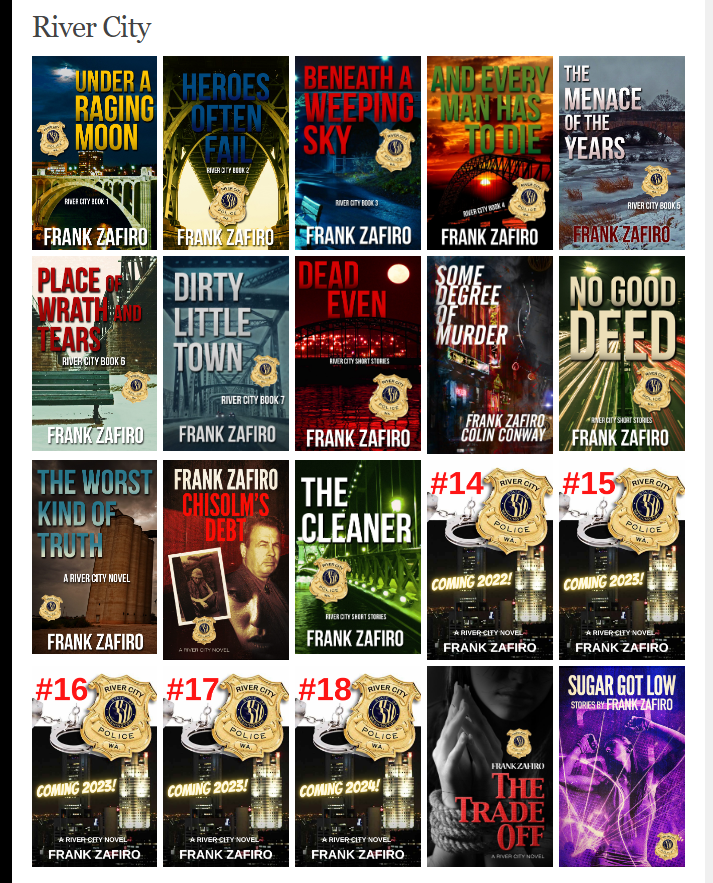

necessarily getting through to all the readers. Some read the main series and nothing else. As a result, there were entire character arcs that the reader missed. Large (and small) events in the canon that weren’t seen. And frankly, some books that were getting less attention than I think they deserved.


So I merged all of the books set in River City into the series proper. The only exception was the Stefan Kopriva mystery series, which I think has its own style and is more effective if remains separate. And a significant majority of readers make the jump from River City to Kopriva anyway.


This process took some thought. Chronology had to be factored in, especially in terms of where to put the short story collections. But I think the current order of the books is one that will work for most readers.  Of course, it might confuse some as well, since The Worst Kind of Truth is #11 and #12 and #13 are already published. Also, books #14-18 in the series are still forthcoming, even though #19 and #20 are also already published. This ordering was necessary to keep things chronological. It will take me until sometime in early 2024 to “catch up” and fill in those forthcoming titles.


Even so, the intention is that, if one were to read the series from the beginning, the meta-story is much more complete.

OBAAT: My work in progress is a return to the private eye genre, which will limit the focus of the book somewhat from what I’ve been doing, as well as shorten it. (I think. It’s still a work in progress.) The Worst Kind of Truth is also a little narrower in both scope and length, so I’m curious. What brought about that decision and what was its practical impact on your writing?

FZ: As I mentioned, I felt like the series was beginning to suffer from too much sprawl—specifically, too many viewpoints. I routinely spent time with each important event in the book through the eyes of the person I thought was the best character to relate that event.


For this book, I tightened the story by sticking to one POV. All of the things that would happen in a multiple viewpoint presentation still occur in the River City world, but the reader gets all of it through Katie’s eyes.


This creates a more concise telling, which was my goal.


As for impact, it forced me to find a way to show events in short snapshots through Katie’s eyes in a way that allows the reader to infer all of the story behind the event… without actually seeing it.


A good example (minor spoiler alert) is in the two events that bookend The Worst Kind of Truth. There is a wedding early on, and a retirement at the end. The journey of the couple getting married is chronicled in great detail in earlier books. Same with the cop who retires at the end. If I hadn’t changed my usual storytelling approach, there would have been multiple scenes from the POV of these characters sprinkled throughout the book to tell that continuing story. But since I’ve told enough of it already, what Katie sees at both of these events is enough to let the reader know all s/he needs to know about both of those story arcs. There’s no need for those additional scenes.

OBAAT: You got a lot of attention last spring with your book The Ride-Along. Tell us a little about that one, how it came about, and what you wanted to accomplish there, as it is also a departure from your typical stories.


FZ: The Ride-Along was born of my dual frustrations with both a public that isn’t very knowledgeable about police work (yet very opinionated) and a profession (my own, prior to retirement) that isn’t very keen to explain itself, and which is often its own worst enemy. I was torn by my own knowledge of how hard the job is, how dedicated the overwhelming majority of people are who do that job (and this includes support staff, too), and how misunderstood the true realities of the job are by the general public… while at the same time, I saw what I believe are strategic failures of the profession, and a few outright bad acts that are difficult to reconcile, to say the least.


These frustrations were exacerbated by the fact the no one listens to each other. They shout. They speak in sound bites. If they listen at all, it is to prepare a counter-argument.


So… I created a situation where two people have to listen to each other. I put a police reform advocate in a patrol car with a veteran officer on a graveyard shift. Two good people with very different views spending ten hours in the close confines of a police cruiser… so, yeah, they gotta talk. And sure, sparks fly. But they also end up listening, too.


Neither character is intended as a straw person for the other to knock down. Instead, we were very intentional in being balanced in our approach, making honest points from the perspective of each character. We wanted to explore nuance in a fair way, since nuance is something that people today seem to have little time for.


Neither Colin nor myself are full enough of ourselves to think we can change the world with a book. But we do hope that it will give readers some cause for thought. And that’s a start.

OBAAT: I introduced you as “Award-winning author Frank Zafiro.” What did you win and how did that come about? ( could have said, but it will be more fun for you to do it.)

FZ:  I recently won three awards from the Public Safety Writers Association. The big one was a first


place award for “One Fine Day,” my short story that is included in The Tattered Blue Line: Short Stories of Contemporary Policing. It is set in River City and explores the aftermath of the death of George Floyd, which sparked actual events—both peaceful and violent—in Spokane (the real life River City) that I drew upon for this story.


I also won second place for “Hallmarks of the Job” (A Stanley Melvin PI Story) and honorable mention for “The Last Cop,” which appears in the anthology To Serve, Protect, and Write: Cops Writing Crime Fiction.


Awards are subjective, of course. But I was thrilled to win these, especially since the awards for short fiction are judged blindly.

OBAAT: This is a standard closing question but one that’s loaded for you, who has replaced Eric Beetner as the Hardest-Working Writer in Show Business™. (Apologies to the late James Brown.) So, what’s on the horizon for you?

FZ: After The Worst Kind of Truth, my next release is my fourth SpoCompton book, Live and Die This Way, coming in October. SpoCompton is a fun series for me because it is, quite literally, the other side of the badge from River City. This time out, my protagonist is a pint-sized female burglar trying to scrape by on her wits while taking care of her addict brother. Aside from being the same gender, she’s about as far from Katie MacLeod as one can get.


I’m fortunate enough to have a story in Josh Pachter’s forthcoming anthology Paranoia Blues, featuring crime fiction inspired by the songs of Paul Simon. Mine is “A Hazy Shade of Winter.”


And by the time this interview goes live, I’ll be waist deep in the fourth Stefan Kopriva mystery, which still bears the inventive title of Kopriva #4. I suspect it will be out (with a much better title) in December or January.


For those readers who like River City specifically, the follow-up to The Worst Kind of Truth is on the docket after Kopriva, so Q1 of 2023. If you find yourself jonesing for police procedurals in the meantime, I’d like to give a plug for Colin Conway’s 509 series, or your Penns River series, both of which will scratch that itch.


Thanks for having me back!

Friday, June 7, 2019

Frank Zafiro and Colin Conway, Authors of Charlie-316


I always thought of myself as an ensemble player when I was a musician, so a collaborative effort is nothing new to me. That said, I’ve always been a little in awe of writers who can collaborate well, as I can’t imagine doing it. The thing is, collaborating in a musical is a simultaneous thing; collaborative writing is much more of a taking turns thing. The rough edges don’t disappear after a fleeting second as in music. They live forever.

That’s why I was so knocked out by Charlie-316. Frank Zafiro and Colin Conway have created a seamless, fast-paced, and engaging police procedural/thriller that kept me engrossed throughout. I wondered how they did it—all of it—and it was a pleasure to get them both to sit and pull back the curtain a little.

One Bite at a Time: Charlie-316 is an officer-involved shooting story with a couple of twists, so I don’t want to say too much about it. Why don’t you fill us in?

Colin Conway:  Charlie-316 is the lead character’s patrol designation.  It was also my call sign for a year while assigned to a power shift team on the Spokane Police Department. 

As a writer, I always liked the sound of that call sign – Charlie-three-sixteen.  Not only does the name ‘Charlie’ have a nice sound to it, but the numbers “316” are very familiar to most of us because of the biblical verse John 3:16 which states that “God so loved the world that he gave his only begotten Son, that whosoever believeth in him should not perish, but have ever lasting life.”

It was the marriage of those two ideas, the police officer and sacrificing a loved one for the sins of others, that became the germ of this story.

Frank Zafiro: Colin had this great idea to start with, and we really built on it (and continue to build on it in the remaining three books in this arc). We knew we wanted to show how all kinds of different people reacted to a controversial shooting – the officer himself, his peers, the investigators, the brass, the media, different interest groups, and city hall, just to name a few.

Throughout the whole book, we kept to the ideas that a) everything is not always as it seems, b) perspective matters, and c) people are complex, gray creatures, not a good or evil archetype. Most of them, anyway.

OBAAT: Officer-involved shootings are now a hot topic. (The next book I have planned for the Penns River series revolves around one.) You took this one down a wholly unexpected path. Or two. Three, even. Did you get together and plot everything out like The Wire or Ray Donovan, laying out all the story beats in advance so whoever writes each episode knows what needs to happen? Or was it more organic?

Frank: Colin had a pretty good skeleton of a plot when he brought the idea to me, and we expanded on that considerably. As I remember it, we developed a fairly detailed bullet point outline, so we both knew what was coming. That said, we discovered a few surprises we didn’t expect.

We also flipped the script to explore the scenario in a different way. Spokane is over ninety percent white, so the racial dynamics are different than in some of the cities that have seen controversial shootings. By reversing the races of the officer and the civilian/suspect/victim (depending on how you see it), it opened a different way of discussing the event.

OBAAT: I had to keep reminding myself this was a collaboration. No seams at all. What was your writing process? Did you edit each other’s work? Take turns chapter by chapter?

Colin:  Thank you for the compliment on seamlessness.  I think a lot of
that came from how we prepared for the story.  After drafting our outline and developing the character whose POVs the readers would see, we both selected a couple of characters that would be “ours.”  After that, we shared the writing duties on several characters and tried to evenly distribute the workload.

For example, I would write a character’s POV, then send it to Frank for his review/addition/subtraction, then he would write his chapter and send it to me.  I would then go back to my original chapter, review the changes he made and approve/add/delete, then edit his chapter, and write my new one.  Afterwards, my work would be sent to him.  The result would be a long snake of edits which would get cleaner as we moved deeper into the story.

When we finished the first draft, it was the cleanest I’d ever seen.  It was a wonderful experience.

Frank:  I love our process for several reasons. It keeps us both involved
in 100% of the work. There’s no mine/yours, just ours. By the time a passage has been written and revised and revised again, it’s no longer mine or Colin’s, but something separate. That’s probably why it seemed seamless to you – there was only one voice, in the end.

The other great thing about our process is that it spurs some great discussions and ideas that can really improve the work. We hash out suggestions, ideas, and resolve differences of opinion pretty fluidly this way.

From a technical standpoint, the extra revision as we go also means that by the end of the first draft, it’s very tight.

OBAAT: How did you two get together?

Colin:  We first met when I was on the department while we were working patrol.  Frank was a corporal and I was a rookie on his team.  Neither of us knew the other wrote at that time.  I was just trying to make sure I showed up on time, did my job professionally, and went home safely at the end of shift.

Fast forward a few years, I ended up in an administrative gig across the hall from Frank, who was a Sergeant at the time.  We began talking and somehow writing came up.

Most of my writing then was short stories.  I was essentially learning the craft and spent hours alone (as most writers do) creating weird and odd crime fiction tales.  They were fun to write then, but they are painful to read now.

Frank was much further along in his writing when we first met.  He had a vision and really understood what he was doing.  It was great to have someone like that around who I could bounce ideas off.  I always felt motivated after one of our writing conversations.

Frank: I have to credit Colin with really super-charging my desire to get back to my writing, and to write crime fiction in particular. I’d written a draft of Under a Raging Moon (River City #1) back in 1995, but it went into a drawer. These were the days when it literally went into a physical drawer because it was printed out on a dot matrix printer… Anyway, in 1996, I was working full time as a cop, and I went back to college full time. From 1996-98, I wrote a lot of police reports and a lot of papers for my history degree, but no fiction. Then, in 1999, I got promoted to corporal, so I was busy learning a new job. In 2001, I made detective – new job. Same in late 2002 – made sergeant, new job. By 2004, though, I’d settled into that role and got assigned to Volunteer Services, where I oversaw five different volunteer programs with about 140 total members ranging from fourteen years old to ninety. It was a challenge, but it was an office gig… so my hours were a little steadier, and I could stop and grab coffee or lunch with Colin, and we talked a ton of writing. It really spurred me on, and from 2004 onward, my output has been pretty good, with a few minor dips due to life events.

I think this illustrates how important it is to find people in your tribe, and to support each other. With technology today, those connections don’t even have to be in person. One of my earliest and best writer friends (and a hell of an editor) is Jill Maser in New Jersey, and we’ve never met face to face. This is someone I’ve exchanged Christmas gifts with, but never hugged. It’s weird, but that’s our world, right? I finally got to meet Eric Beetner in person at Bouchercon in 2018, and will meet Jim Wilsky (and hopefully Larry Kelter) at Bouchercon in Dallas in 2020. I’ve written books with these guys!

I’ve also written a book with Bonnie Paulson, and we’ve met, so that’s more normal. And then there’s Colin and I. We’re good friends and there’s something uniquely powerful about that friendship/collaboration connection that really drives the creative process. When we’re able to get together in person and brainstorm or outline or just talk about one or the other of our solo projects, it is such a positive thing for me.

////

Frank Zafiro writes several different series by himself (River City, Stefan Kopriva, SpoCompton) and teams up with other authors like Colin Conway, Eric Beetner, Jim Wilsky, Larry Kelter, and Bonnie Paulson for additional mayhem. He is a retired cop and a tortured guitarist.

Colin Conway is the author of The Side Hustle, the first book in 'The 509 Crime Stories' series.  He is a former police officer and currently works in the commercial real estate industry.

Sunday, February 24, 2019

Look for the Unexpected


Frank Zafiro (if that is his real name, which it is not) stopped by a couple of weeks ago to talk about how serendipity plays a role in what gets written next. Frank and co-author Jim Wilsky thought they were finished with the Ania trilogy, which was logical, having written three books. The vagaries of publishing opened a door, an idea presented itself, and the Ania trilogy now has a fourth book. It’s nice when a plan comes together, and even nicer when the plan presents itself, unbidden, from out of the ether.

Writing is like that, mainly because life is like that. We can make all the plans we want but should always prepare for the unexpected. That advice means to be ready to take care of what pops up that puts the plan at risk, but it should also keep us willing to adjust the plan in the event something better comes.

This is why it’s good to revisit things, whether novels, non-fiction, how-to-write books, movies, good television, whatever. It’s also a good idea to get ideas from various sources. Musicians should always study with various teachers even if perfectly content with who they have and only looking for a temporary change of scenery. The other teacher may see something in the student the regular teacher missed. Might suggest something different that works. Might even suggest the same thing but in a different way that makes more sense.

More to the point of my revisiting example, either teacher may suggest something to the student in the same way as the other did but a couple of months or years later when the student is better prepared to accept, understand, or leverage that information. We’ve all seen movies or read books that didn’t quite move us only to revisit them twenty—or even two—years later and see how outstanding they are. The book or movie didn’t change. We did. We learned and grew and had new experiences. Maybe the work of art had layers we couldn’t appreciate at first because we were caught up in the surface level.

It’s a running joke among a few of my friends that I now watch LA Confidential several times a year. I’ve seen it at least twenty times. It’s not one of the “comfort” food films I drag out when I want to settle in for the evening and relax and feel good. (You’re going to ask, so I’ll tell you: The Big Lebowski, Get Shorty, Butch Cassidy and the Sundance Kid, Animal House, Monty Pythion and the Holy Grail, and a few others.) Every time I watch LA Confidential I see something new in it, or something I’d seen before that prompts a different thought process. That’s where the true genius of the Curtis Hanson – Brian Helgeland collaboration comes out. They took an overly-detailed mess of a gloriously-written book and created a precisely-detailed film that succeeds on every level. I’ve found a few flaws, but none that detract from my enjoyment.

Writing is planning and attention to detail. Even the most hardcore plotter must keep in mind what happened already and the most dedicated pantser cannot ignore what has to come later, especially when editing. Those considerations may seem like restrictions—and they are—but they’re also opportunities. I can’t begin to guess how many times I put something in a first draft because it struck me as a nice thing to add that gave me a new direction for the story well down the road. Could be something as simple as a unique eye color or hairstyle or even a reference to a minor character’s occupation when their job could have been anything; I picked this at random. Later I’ll be chugging along and realize, “Oh, shit! Dudley Wishbone works (or worked if he’s the victim) at the lumber yard!” and everything after that realization is affected, though not always directly.

I still plot everything I write; Scrivener has been a boon to my messy process. Even more so because of the changes of direction my books so often make well after I think the outline is finished and I’m well into the writing. Pay attention to the opportunities that present themselves. They don’t do it often, and they rarely come around a second time. As I said in the post I wrote for Elizabeth White when she was kind enough to provide space for me to promote Ten-Seven*: Pay attention.

(* -- Just because I’m not beating you over the head about it every day doesn’t mean Ten-Seven has gone out of print. It’s still available at all the fine booksellers noted here.)

Friday, February 15, 2019

"Why This? Why Now?" A Guest Post by Frank Zafiro


If only I could tell you how many women have said those exact words to me. Fortunately the rest of you are in luck, as today we have what’s called in the publishing industry “a treat.” Frank Zafiro has stopped by to talk about writing, collaboration, his Ania series, as well as his newest and most precedent-setting series The Grifter’s Song. I could go on a while here, but Frank will tell all of it better than I could.

Why This? Why Now?

So far, I’ve written more than two dozen books. Most are crime fiction. Roughly half have been collaborations. And like probably every other writer I know, these books represent about one percent of the ideas I’d like to turn into books and get out into the world.
That being the case, it might seem a little surprising to some that I chose in 2018 to re-visit the seemingly completed Ania trilogy that I co-authored with Jim Wilsky. Starting with Blood on Blood, this hard boiled series was written in a dual first person narrative with alternating chapters. I wrote one character (Mick) while Jim wrote the other (Jerzy). These two half-brothers find themselves walking a tightrope between cooperating and competing with each other while in pursuit of the diamonds their father hid after his last heist. When Ania, a siren grifter, enters the scene, things get even dicier.
Ania is the thread that links the books of the series, as it continues in Queen of Diamonds, where Jim and I wrote the characters of Cord and Casey, respectively, as they face off in a high stakes poker match where Ania seems to be the prize. The series ends in Closing the Circle, as both John and Andros pursue the wily grifter from Chicago to Vegas and out to northern California. The trilogy most definitely gets wrapped up, and that was 2013, so why revisit it in 2018?
Well, there’s three reasons, really. There’s a business reason, there’s an artistic reason, and there’s an inspiration reason.
The business reason is simple. The fine folks at Down and Out Books decided to re-issue the series under their banner, complete with new covers. That alone got Jim and I talking about the stories again, and the possibility of maybe writing another one. After all, having a new book to add to the re-released trilogy makes some marketing sense, right?
But it was the artistic reason that really took hold. Both Jim and I had long wondered about our mysterious antagonist. After spending time with her for three books, we still didn’t know as much about her as we’d like. Who was she? Where did she come from? How did Ania…become Ania?
That led to some discussions and some exploration, and that led to a new book – a prequel aptly titled Harbinger (you can thank Jim for three out of four titles for this series. My lone contribution was the first book). In it, we discover at least part of the Ania origin story, through the eyes of Boyd and Hicks, presented in the same dual first person narrative of the previous books. Boyd, the pragmatist, and Hicks, the beach bum, both find out who Ania is, and how she became the sensual con artist that she is. Along the way, we discovered a twist neither of us saw coming.
So that’s the second reason to come back to a series that has been completed – that artistic need to ferret out answers to questions that were still interesting to me. Luckily, Jim had some of the same questions, and found them just as worthwhile to answer.
But a third reason emerged, and one that I was completely unaware when my conversations with Jim started. You see, spending time with Ania was inspirational in the sense that it got me excited about another pair of grifters whose story I wanted to get out into the world – Sam and Rachel.
Called A Grifter’s Song, the tale of Sam and Rachel is one of two grifters, deeply in love, and deeply in trouble. Having tried to rip off the mob and failing, they are on the run. Each episode takes place in a different locale, involves a different con, and is a complete story unto itself. But in addition to whatever perils they might face from their current job, the specter of the pursuing mob is always there as well.
As I initially envisioned it, I’d write all of the novella-length episodes and release them about once a quarter. Once the saga was complete, I figured I’d collect them into a compendium of some kind. Writing Harbinger moved the project of A Grifter’s Song up my queue significantly. The first episode, The Concrete Smile, started knocking, and then pounding, on my door.
Working on Harbinger with Jim was a reminder of how much I enjoy collaborating with another author, and how satisfying it can be. The entire process feels akin to how attending a mystery conference or just having coffee with another writer drives up the motivation and excitement about your own work. With that in mind, I took a look at the format of a proposal Gary Phillips had made, to which I had submitted a story idea. The format was also novella-length, with multiple episodes, but….every episode had a different author.
I realized that would be a much more satisfying way to go with A Grifter’s Song. It would keep the stories fresh and different. Best of all, it would be collaborative. So I did what all smart artists do, and promptly appropriated the idea for the format. Instead of me writing each novella, I’ll write the first and last of the series, and ten other authors will write the rest.
I pitched the idea to Down and Out Books, who jumped on it. Eric Campbell and I worked out that the series would take place over two “seasons” of six episodes each. He created a subscription model that included a discount for anyone who subscribed to the whole season. I agreed to write an additional story that only subscribers would get, and set about recruiting writers.
Gary Phillips, of course, was the first email I sent. That only seemed fair, right? And Jim Wilsky had to be included, too, since it was our work on Harbinger that got this project going for me. Add in two other authors I’ve collaborated with successfully (Colin Conway and Lawrence Kelter) and the always edgy J.D. Rhoades, and the first season was set. The second season took a little longer, mostly because of how selective I was, but finally rounded out as well. Season two will include Eryk Pruitt, Scott Eubanks, Asa Maria Bradley, Holly West, and Eric Beetner.
True to form, Eric Campbell commissioned some beautiful covers for the series. The tattered paperback novel look that Zach McCain put together really captures the feel of the stories, and ought to at least engender a second look from any crime fiction fan.
The idea of A Grifter’s Song isn’t new. Cons and heists are as old as the noir sub-genre itself. A man/woman team is classic noir. My intention wasn’t to create something completely new. If anything, my hope is that the series will be a modern homage to some of the great works of Richard Stark (maybe not the Parker novels, but the Alan Grofield ones like Lemons Never Lie) and Lawrence Block’s The Girl with the Long Green Heart (and you owe it to yourself to listen to the Alan Sklar narration).
What is new, though, is the subscription model. The collaboration aspect isn’t common, either. I’ll be interested to see how both fare in what is a capricious marketplace, but I’m proud of the fact that Down and Out Books and all of these authors are taking a stab at something a little bit different.
And really, when it comes down to it, that’s why I’m doing this, and that’s why now.    

Wednesday, October 3, 2018

A Conversation with Frank Zafiro


Frank Zafiro is a name I’ve been familiar with for a while, tied into the crime fiction community as I am, but I’d never met him until this year’s Bouchercon in St. Petersburg. Raconteur, bon vivant, man about town, former military and retired cop, Frank’s the good when looking for an authentic voice in crime. Unlike many with that pedigree, Frank’s writing is highly entertaining and reads like butter.

Frank has written at least half of 26 novels and contributed to many short story collections. For a complete listing, head on over to his web site, which also contains lots of other educational and entertaining stuff. Bonus info: “Zafiro” is a pen name. I’m not going to tell what his real name is, but “Azfori” is an anagram. Draw your own conclusions.

One Bite at a Time: First off, it was a real treat, one of my personal Bouchercon highlights in St. Petersburg, to get to meet and spend some time with you. I write police procedurals and have received comments about how I get most things right, but you write police procedurals drawing on your history as a cop. Fill us in on your law enforcement background.
Frank Zafiro: It was a definite highlight of Bouchercon to meet you and get to hang out. It was a blog post that you wrote that really made me feel more comfortable about going to the conference in the first place, and then as serendipity would have it, you were one of the first people I met, so that was cool.

I spent twenty years and a day as a cop in Spokane, Washington (River City is a thinly veiled version of this burg), retiring in 2013 as a captain. I was fortunate enough in my career to do a lot of different jobs and see many different aspects of the department, whether as an officer or detective, or later as a leader. As a result, I experienced Patrol, Investigations, K-9, SWAT, Hostage, volunteers, Dispatch…pretty much every part of the agency. In my leadership role, I got to see beyond even the PD, interacting with other agencies, other departments within the city, and various elements within the community. I had good experiences and bad ones, and (although I didn’t look at this way at the time) all of those were valuable to me as a writer.

OBAAT: I was familiar with your name more than your work when we met and my ears perked right up when I learned you write a series of police procedurals set in River City, as one might expect for an author who writes a series of police procedurals set in a town called Penns River. What’s the scoop on River City?
FZ: Well, as I mentioned, it’s a thinly veiled Spokane. In fact, the more I write in River City, the less I change about geography or other aspects from the real city it is based upon. The series itself is a police procedural with an ensemble cast. The first book, Under a Raging Moon, was purely patrol level (which is fairly uncommon in the genre), but the net has since widened as the series has progressed, first to include detectives and some mid-level brass, and now the entire breadth and width of the agency from the chief’s office on down.

That said, there are a few characters that have primacy, and the core character of the series for me has become Officer Katie MacLeod. She definitely has a supporting cast who play large secondary roles, but since book #3 she’s definitely who I’d say is the main character. Other big players include the veteran patrol officer Thomas Chisolm, Detective John Tower, and Lieutenant (spoiler alert:  he is promoted in book #5) Robert Saylor, among a host of others.

Since these are written in third person with multiple viewpoints, the reader gets to see what is happening from a variety of perspectives. As the series progresses, the reader also gets to see the development and changes these characters go through, and to share their history.

Essentially, I want the reader to feel like s/he has had a career at RCPD, and has seen all that has happened around them.

OBAAT: There definitely ain’t no flies on you. Your web site lists 26 novels and 18 anthologies contributed to. In the past three weeks alone, Book 5 of the River City series (The Menace of the Years) dropped, Book 3 of your Ania series was re-released (Closing the Circle) and a new series of novella was announced. Plus you do monthly podcasts. How do you balance all of this?
FZ: Meth.

No, not really. Coffee, though.

After I retired from law enforcement, I spent about four years teaching leadership in a national program that took me all over the US and Canada (including your old stomping grounds). This was great for both personal and professional reasons, but it did take its toll on my productivity. I hung up my PowerPoint clicker for good back in December of 2017, which allowed me to write full time. With that being my primary focus, I’ve been able to get a lot more work done.

Also, my first novel was published in 2006, so some of those numbers have been accomplished more though longevity than rapid writing.

Sometimes I do have to take a step back, however. I put my podcast on hiatus during the summer months in order to spend more time with my wife (she’s a teacher).

I guess the simplest answer to your question about balance is simply to be aware, and to manage my time.

OBAAT: You’ve worked on several collaborations with other authors, so you must enjoy the process. Tell us a little of how that works, how the process differs from partner to partner, and what you like best about it.
FZ: You’ve exposed another reason for the number of books I’ve written – I cheated. Eleven of my books are co-authored, and a twelfth will be published by Down & Out Books next year. When you only have to write half a book to take credit for having a whole book published, it sorta skews your numbers!

My first collaboration was with my friend and colleague, Colin Conway. We wrote Some Degree of Murder together, and set it in River City. At the time, we set the book ten years ahead of the most recent RC book I’d released (Heroes Often Fail, set in 1995). The format was a dual first person narrative with alternating chapters. In other words, I wrote one character (a police detective) and Colin wrote the other (a mob enforcer). We both wrote in the first person. I wrote a chapter with my guy, then he wrote one with his. As such, the reader gets the intimacy of the first person, but a wider viewpoint than in traditional first person books.

This format has actually served me well. Jim Wilsky did the same thing in our Ania novels. Eric Beetner and I went this route with our Bricks & Cam Job series, and Bonnie Paulson and I stuck with it for The Trade Off.

But Lawrence Kelter wanted to go with a single POV in The Last Collar, so I gave it a go, though not without some apprehension. I was concerned that two writers penning a single first person voice would end up sounding schizophrenic. In the end, though, our styles blended well to create a singular voice. We went the same route in Fallen City, though with multiple, third person viewpoints. That worked so well that I was happy to use that same format with Colin in our newest book, Charlie-316 (due in 2019).

To date, I’ve collaborated with five different authors on twelve books. Four men, one woman. They hail from New York, California, Texas, Idaho, and Washington. Pretty varied group, but they all have one thing in common… great people. And that made the process an absolute joy. In each case, it was akin to those writer meetings over coffee that always have you coming away jazzed up and full of positive writer energy. I enjoyed the entire process, from the planning, to the writing, to the revisions. All of us were very good about putting egos aside, or at least subordinating ego to story, so I don’t recall a single argument. Disagreements and discussions, sure, but all of it focused on bettering the book.

I wrote about become a collaborator in a D&O blog post, if people find that process interesting. I also interviewed all of my collaborators in an episode of Wrong Place, Write Crime, if readers want to get their take on how it all went down.

OBAAT: I came across the Ania series while researching this interview. It sounds fascinating, a main series character who moves through stories that are the schemes of others, carving out her own niche. How did you come up with the idea?
FZ:  Actually, I’m pretty sure Jim Wilsky came up with the idea for the first book, Blood on Blood, once we decided to write a novel together. We put some meat on his bare bones idea, but the initial story wasn’t about Ania. It focused on two half-brothers who were cooperating and competing to find the loot from their father’s last heist. Jim invented Ania in an early scene with his character, and as the story grew, so did her role. It was a classic case of a character refusing to be ignored and ultimately hijacking the book, or at least part of it.

Once we finished the first book and started talking about our next one, we realized that she was the thread that would connect the series, even though she wouldn’t be the one actually telling the tales. Her POV is only shown a scant few times throughout all four books. Instead, we see her through the eyes of the two protagonists, and in each book, those two protagonists are different – Mick and Jerzy in Blood on Blood, Cord and Casey in Queen of Diamonds, John and Andros in Closing the Circle, and Boyd and Hicks in Harbinger (due December 2018). This keeps the air of mystery around the character of Ania, and allowed us a lot of freedom in setting up each new locale and story.

OBAAT: You and I share several things as writers. We collaborate with the James Brown of crime fiction, Eric Beetner (he does all my covers); we both contributed to Lawrence Keltner’s Back Car Business anthologies (me in Volume 1, you in Volume 2); we both were selected for Thuglit anthologies (you in Hardcore Hardboiled, me in Blood, Guts, and Whiskey), we both write for Down & Out Books, and we both revere Ed McBain and Joe Wambaugh. (I just finished reading McBain’s Tricks) last night. What sets those two apart from the rest for you?
FZ: Well, Wambaugh for a couple of reasons. One, he really pioneered the cop-to-writer persona. He made it something legitimate, and if someone looks at my series and gives it some credibility because of my background, that’s because Wambaugh forged the way. Secondly, he wrote about cops the way they really are (I mean, a little dramatized, but still accurate), and he made that okay, too. In my River City books, I strive to show the reality of being a cop to the reader. Sure, it is amped up and all of the exciting things seem to be happening to a small cast of characters, but outside of that, it is very realistic. Wambaugh not only made that okay, but attractive. He essentially created a sub-genre of the police procedural – former cops writing realistic police fiction.

I think McBain’s ability to build a department with recurring characters and take the reader on the long journey with those characters really stands out. It has definitely inspired me to try to do the same thing with River City.

Right up there with McBain and Wambaugh, I have to say Lawrence Block is an inspiration when it comes to recurring characters. The lessons from his Scudder novels are valuable for me in my Stefan Kopriva mysteries, but good writing like his applies across the boards.