Showing posts with label s.w. lauden. Show all posts

Friday, July 17, 2020

S. W. Lauden, Author of Good Girls Don't


You want to know what kind of guy S.W. Lauden is? He wears a ball cap almost all the time due, I believe, to some follicle desertion issues. One day at Bouchercon a few years ago I noticed him without the hat and spent close to a minute perusing and touching his, making the comment, “I don’t know why you wear a hat all the time. You have a very attractive head,” and he did not punch me in the face. That’s the kind of guy Steve Lauden is.

He’s also wormed his way into becoming one of my favorite writers. He co-edited the essay collection, Go All The Way: A Literary Appreciation of Power Pop. His crime fiction novelette, That'll Be the Day: A Power Pop Heist, was released in 2019. The follow up, Good Girls Don’t: A Second Power Pop Heist, dropped last month. His Greg Salem punk rock PI series includes Bad Citizen Corporation, Grizzly Season and Hang Time. S.W. Lauden is the pen name of Steve Coulter, drummer for Tsar and The Brothers Steve. (Holy shit! I didn’t know that. I thought we were friends and now it’s like I don’t even know him. No matter. I’m going to consider Steve Coulter his gig name. I’m old and I don’t like change.)

One Bite at a Time: Hearing you’d written a sequel to That’ll Be the Day was the best news I got that day. What’s up with the Sharp brothers in Good Girls Don’t?
Steve W. Lauden: You’re too kind, Dana. I feel lucky to say that stopping by
your blog has become a bit like playing the same nightclub in a certain city every tour. Something you look forward to in the whirlwind of activity. Thanks for having me back.
 
In the second book, Jack and Jamie are headed to LA (with their drummer, Chaz) to record a reunion album. The whole elaborate affair’s being funded by Russell Patterson who is both their biggest fan and their worst nightmare. Like any good wannabe music mogul, he’s paying the bills—but exacts his pound of flesh. In this case, he wants the Sharp brothers to steal a famous guitar that’s on display at a Hollywood music store. Things get out of hand pretty fast from there. Bullets fly. Blood spills. Hi-jinx ensue.

OBAAT: No one writes musicians on the borderline of careers better than you. How has your experience as a musician helped you to bring these characters to life in believable and sympathetic ways, even when they may not on the surface seem like sympathetic characters? (No offense with that “borderline career” crack.)
SWL: Ha! “Borderline career” describes every career I’ve ever had, and there have been quite a few. When it comes to writing about musicians, it’s a matter of “write what you know.” I’ve been playing drums in bands on and off since my early teens, and been a huge music fan since before that. Translating my love of music into crime fiction is easy because the music industry has always been filled with egomaniacs, conmen and thieves. There’s a reason “sex, drugs and rock & roll” is in that order—music comes last.

And thanks for saying I create “sympathetic” and “believable” characters. I think that’s something we all have to worry about in a genre where action and violence sometimes overshadow personality (especially on the hardboiled end). As a reader I need to connect with the characters (even if I can’t sympathize), so I think I use that as my own personal guideline.

OBAAT: You still gigging?
SWL: Yes! Not a ton, but I played a few shows with The Brothers Steve in 2019. I’m guessing 2020 is pretty much a wash, but we’ll probably do more shows when bars and nightclubs open back up. I’ve also gotten to record a little lately, which is fun. We should have some new music coming out in the next few months.

OBAAT: I think we can agree you have some fucked up situations and characters in your books, such as Russell Patterson’s “collection” and my personal favorite, the cocaine-dealing pirate impersonators in Crossed Bones. The synopsis for Good Girls Don’t refers to a violent gang of rock & roll memorabilia collectors. Outrageous as these set-ups seem, you not only always pull them off, but they make sense. Do you have some sort of internal governor that keeps things form getting out of hand, or do you let them play out and hope for the best?
SWL: I’m always pleasantly surprised when somebody connects with the over-the-top characters in Crossed Bones. I don’t think that book ever really found its audience—or maybe you’re it! And I agree that those cocaine-dealing pirate impersonators are distant cousins to Russell Patterson in my Power Pop Heist books. I think it boils down to my love of absurdity. That’s a big part of my personal humor and something I’m always on the lookout for in everyday situations. Maybe it’s a social coping mechanism, but I have always found the strangest things funny, especially in mundane or serious situations. It’s honestly something I’m still learning to control in my writing. If anything, I probably start off going over-the-top with some of the cartoonishness and calibrate from there.


OBAAT: No one else comes to mind when I read your stuff. Who do you consider your primary influences as a writer?
Not even legendary producer Bruce Dickinson
ever asked Steve Lauden for more cowbell.
SWL: I think that whatever style or voice I have managed to develop might seem unique (or strange?) in the context of the genre because I never specifically set out to be a crime author. I love crime fiction, but I’m no die-hard genre historian. My love of reading and writing was very much born in literary fiction, the kind of stuff you’d encounter in high school or college literature courses. I often mention Kurt Vonnegut as an all-time favorite, but books that blew my mind were mostly by authors like Umberto Eco, Charles Bukowski, Katherine Dunn, Mikhail Bulgakov, E. Annie Proulx, Neal Stephenson, Jorge Luis Borges, Robin Sloan—stuff like that.

I definitely read my share of Raymond Chandler and Dashiell Hammett growing up, but it wasn’t until I got into Norwegian crime fiction that my attention really turned to the crime genre. I also love Don Winslow and Kem Nunn. More recently, I’ve gotten into Attica Locke, Ryan Gattis, Alison Gaylin, Scott Adlerberg, and Marcus Sakey. I’d say that Blake Crouch is my favorite current author, but his last few books are hard to classify. I also read a crazy amount of non-fiction about music, musicians and bands.

OBAAT: What are you working on now?
SWL: I have two standalone novels written. Trying to decide if I’ll shop those to agents and publishers like my other books, or self-publish them like my Power Pop Heists. And I’m working on a couple non-fiction projects, along the lines of the essay collection I co-edited last year, Go All The Way: A Literary Appreciation Of Power Pop. Staying busy.

Friday, June 28, 2019

S. W. Lauden, Author of That'll Be The Day


I can appreciate how good a writer George Pelecanos is, but I never got into his Derek Strange books because he spends too much time talking about cars and music I know nothing of. S.W. Lauden’s new novelette, That’ll Be The Day, revolves around music I know practically nothing of—it’s damn near about music I know nothing of—yet I read it in a single sitting. Literally couldn’t put it down. That’s some storytelling.

Steve stopped by to dish about the book, writing, and music.

One Bite at a Time: We’ve discussed how much I like That’ll Be The Day, yet the more I think about it the more things I find to like. Let’s start with the characters. It’s often said of a book that no character is all good or all bad, but you pulled that off in convincing ways I’d not seen before. Did you have the characters sketched out in advance?
S.W. Lauden: Thanks so much for the kind words! It definitely helps that I played in bands myself for many years and have plenty of personal experience to draw on. And there’s something about a story of this length (17,000 words) that I find easier to write than either short stories or full-length novels. There’s an immediacy to the pace of the storytelling, but the end is always in sight. All of that makes it easier (for me, at least) to focus on the characters.

OBAAT: Jackson Sharp is a man who can hold a grudge. He wants the fifty grand he had to leave behind when he was sent up mainly so he can afford to find and kill his father. He undergoes quite a change by the end. Was that the point of the book when you started, or did things evolve to there?
SWL: Music and fandom are the framework, but I always thought of this story as Jack’s journey to accepting that his dreams weren’t going to come true (at least not the way he once envisioned them). Jamie has made a kind of peace with his shitty life and found ways to be happy, but Jack can’t even see the point in trying. A big area of focus for me was their simultaneous relationship with music and crime, because that’s what’s in their bones. I wanted the guns and guitars to seem interchangeable to some degree. I was also riffing on the proud history of battling brothers in rock bands (like Ray and Dave Davies of The Kinks, Noel and Liam Gallagher of Oasis, etc.).

OBAAT: Russell Patterson is as fucked up a character as I can remember and in a completely unique way. I suppose people as rich as he is can afford all kinds of off the path hobbies, but what gave you the idea for his personal rock-and-roll memorabilia Hall of Fame?
SWL: Patterson’s definitely a piece of work. I wanted him to embody an overblown version of ‘toxic fandom.’ With any artform, there is always a small but extreme group of fans who take their passion too far and kind of lose sight of the innocent reasons they connected with something in the first place. He’s a shady (sometimes violent) businessman with a very specific kink when it comes to music, but his outrageous collection is really just an extension of his massive ego. The music isn’t enough for a guy like Patterson, he needs to hoard important artifacts from the band’s history and keep them to himself.

OBAAT: Having been a musician myself, I think the reason I’m able to get past the fact I don’t know a lot of the music in the book (I’m more of a classical and jazz guy) was because, unlike the Pelecanos reference above, your musical references are more about the life of a musician than the music. I don’t want to spoil a nice plot point, but I was particularly taken by how Jack and his brother need to make a detour on their way to a job so they can afford to do the job. Musicians live that way, one job to the next. You came up with a creative way to show that while not lessening the motion of the story. (Yeah, there’s no question there. Talk about it.)
No more ever says, "More cowbell!" when
Steve Lauden's around.
SWL: There was an earlier version of this book (in my mind only) that was just going to be the two brothers driving to the heist—kind of like a rock ‘n roll Waiting For Godot or My Dinner With Andre. I ultimately didn’t take the story to that artistic extreme, but I still wanted to capture the mind-numbing delirium of life on the road. Bands tackle a lot of the world’s problems while barreling down the interstate in the middle of the night. They also get into pointless, heated debates about their favorite bands and songs.

Then there’s the musical genre that inspired this story. I previously published a trilogy of books about a punk rock PI (Bad Citizen Corporation, Grizzly Season and Hang Time) that was more aggressive, much darker and almost cartoonish in some respects because I felt that embodied the punk rock lifestyle I had seen firsthand growing up. Power pop, on the other hand, is melodic (sometimes jangly) guitar pop that includes everybody from Raspberries, Big Star and The Knack to The Bangles, Fountains Of Wayne, and The New Pornographers. Power pop bands are usually inspired by the early music of 60s bands like The Beatles, The Who, The Byrds and The Beach Boys. All of that’s a bit more nuanced than punk, especially hardcore punk. So much of the tone, pace and dialogue was set by the music I was listening to.

OBAAT: Jack never wants to play again and his brother Jamie doesn’t really want to do anything else, making great sacrifices to allow him to keep his hand in. To me, the two brothers represent an internal struggle a lot of less than successful musicians have within themselves. Is that what you were going for?
SWL: You hit the nail on the head. Music, especially commercial music, is mostly a young person’s game. It’s a lot of blood, sweat and tears (hey, that would make a good band name!) that most often leads nowhere. So it can be difficult to keep doing it simply for the love of music, especially when it comes to lugging gear around and playing to empty bars in middle age when you should probably be home with your family and/or trying to achieve more reasonable goals.

OBAAT: What’s up next? Will we see you in Dallas for Bouchercon?
SWL: Funny enough (especially given my answer to your last question), I just recorded an album with some good friends as The Brothers Steve. We have a digital single coming out at the end of June. The vinyl album will be available in late July.

I also co-edited an essay collection about power pop with Paul Myers called “Go All The Way” that will be released in October by Rare Bird Books. As you can tell, I really love going down musical rabbit holes like this.

No Bouchercon for me this year. I’m too busy with the book projects, the Writer Types podcast, and music. That’s in addition to the day job and my amazing family. Speaking of which, I should probably go…Thanks again for having me back!

BIO: S.W. Lauden is the author of the Greg Salem punk rock P.I. series including Bad Citizen CorporationGrizzly Season and Hang Time. His Tommy & Shayna novellas include Crosswise and Crossed Bones. A new novelette, That’ll Be The Day: A Power Pop Heist, was released on June 18, 2019. S.W. Lauden is the pen name of Steve Coulter, drummer for Tsar and The Brothers Steve. More info at http://swlauden.com.

Monday, June 3, 2019

May's Favorite Reads


A Man on the Moon, Andrew Chaikin. The Beloved Spouse™ and I watched the 90s HBO series To the Moon and Back a while back (in large part to get the taste of First Man out of our mouths) and that put me into the 50th anniversary spirit. A Man on the Moon is the book that provides much of the source material for the mini-series; the producers chose well. What looked to us (or at least to a twelve-to-fifteen-year-old at the time) to be flawless missions with minor inconveniences (Apollo 13 the notable exception) were all way more dangerous and exciting than NASA let on, up through about Apollo 15, by which time they pretty well had things figured out. Chaiken conducted exhaustive interviews with astronauts, ground crews, and wives to piece together a definitive history of mankind’s greatest exploration to date.

A Drink Before the War, Dennis Lehane. I’d been meaning to get back to Lehane’s PI stories for quite a while, wondering how well they’d hold up after reading so much of his recent stuff. A Drink Before the War is the first Kenzie-Gennaro book, and it deserved all the fuss. Lehane observes the usual tropes in PI stories—more to the case than the PI expects when he takes it, psycho sidekick who’s available as needed, untrustworthy client—yet puts his own spin on them. If you’ve never read the books that put him on the map, this first one is a good place to start.

That’ll be the Day*, S. W. Lauden. Lauden falls into a category I call “People Whose Books I Ran Into Once in a While Before I Finally Realized I Should Read Everything They Write.” (I didn’t say the category title came trippingly to the tongue.) This novelette pulls off the estimable of writing a book in a musical universe I know nothing about and, frankly, care nothing about, and kept my aging ass up till 12:30 on a work night to finish it in one sitting. The characters are multi-tiered and believable and the action moves along without become too breakneck to be believable. Highly recommended.

(*--I read an ARC. Be ready for this one when it drops later this month.)

Monday, May 8, 2017

A Conversation with S.W. Lauden

S.W. Lauden get around. He’s had short fiction published by Out of the Gutter, Criminal Element, Dark Corners, Dead Guns Magazine, Akashic Books, WeirdBook, Spelk Fiction, Shotgun Honey, and Crimespree Magazine.

His short story, Itchy Feet, was published in Unloaded: Crime Writers Writing Without Guns (Down & Out Books). His short story, Big Shots, is included in the anthology Fast Women and Neon Lights: Eighties-Inspired Neon Noir (Short Stack Books). His short story, Customer, appears in Waiting to be Forgotten: Stories of Crime and Heartbreak Inspired by The Replacements (Gutter Books).

He is the author of the Greg Salem punk rock P.I. series including Bad Citizen Corporation and Grizzly Season (Rare Bird Books). His Tommy & Shayna Crime Caper novellas include Crosswise and Crossed Bones (Down & Out Books). He is also the co-host of the Writer Types podcast with Eric Beetner.

One Bite at a Time: Hi, Steve. It’s been a little while since we chatted. Welcome back. Shayna Billups and Tommy Ruzzo are also back in Crossed Bones. Tell us a little about those two and their story.
S.W. Lauden: Thanks for having me back, Dana. Tommy and Shayna are star-crossed lovers who first showed up in my novella, Crosswise. She's a femme fatale who cost Tommy his NYPD badge before luring him down to her hometown on the panhandle of Florida. She leaves him high and dry shortly after he gets a job as head of security at a retirement community where several of the tenants start dropping dead. He tries to solve the murders to win Shayna and his badge back, but things quickly spiral out of control in the most ridiculous and violent ways.


By the time we catch up with Tommy and Shayna in Crossed Bones, she's off partying in New Orleans and he's a drunken wreck stranded in Florida. A chance meeting with a mysterious older gentlemen at a pirate-themed bar sends Shayna on a treasure hunt in North Carolina. When things get out of hand, Tommy and his bartender/boss/best friend set off to rescue her. They soon find themselves caught between a biker gang and a band of cocaine-dealing pirate impersonators. That's when things get interesting.

OBAAT: I see you fell back onto Raymond Chandler’s famous advice, that when stuck for what happens next, have a biker gang and a band of cocaine-dealing pirate impersonators come through the door. I know you didn’t expect to drop that on us and not have me ask you where you got the idea.
SWL: Chandler truly was a visionary! I’m not exactly sure where the inspiration for Crossed Bones came from—might have been a fever dream, or maybe I ate too much sugar—but I do know that I set out to have fun with these characters. The folks over at Down & Out Books started referring to the Tommy and Shayna books as crime capers, and I think that fits. In general, they’re a little more freewheeling and fun than the Greg Salem books. Something about the length and pace of novellas sets me off in a different direction I guess. The books are still pretty dark and feature lots of bad people doing terrible things to each other, but some of the situations tend slightly toward the ridiculous.

OBAAT: I think of you as an L.A. guy, yet Crossed Bones takes place largely in North Carolina, which is about as far from California as one can get without a passport. Why there?
SWL: I’ve lived in L.A. most of my life, but I’ve done a fair amount of traveling. In particular, touring in a band offers up a unique view of cities you might not otherwise visit. It’s just a series of very short, very intense experiences in specific places that often only reveal the most extreme parts of their personalities to you. You don’t leave there pretending to truly know the place—how could you?—but it’s possible to develop some strong, often misguided impressions based on your limited experience there. Years later, I find that business travel and certain types of whirlwind vacations (weekend weddings, etc.) can have the same effect. That’s kind of the perspective I was writing from when I created the fictional locations in both Crosswise and Crossed Bones.

OBAAT: Did you plan to have Tommy and Shayna come back even before you wrote Crosswise, or was that a more recent decision?
SWL: Not originally. Crosswise itself grew out of a short story I wrote while on vacation in Florida. That short story never got published, but a few people who read it encouraged me to expand the story, which is how it evolved into a novella. My editor, Elaine Ash, was a big supporter so she passed the novella along to Eric Campbell at Down & Out Books and he agreed to publish it. One of the things we discussed back then was potentially turning these characters into a series, but that's as far as we got. And then one day last year I got an idea for a story that quickly evolved into the second Tommy & Shayna Crime Caper, Crossed Bones.

OBAAT: You describe Tommy Ruzzo as a disgraced NYPD cop. Greg Salem, protagonist of Bad Citizens Corporation and Grizzly Season, also had a police career that didn’t work out so well for him. What about fallen cops plays so well into the stories you like to tell?
SWL: Believe it or not, I didn’t really realize I had done this until after Bad Citizen Corporation and Crosswise were both published. Could be a uniform fetish, but more likely there's a pretty pragmatic reason—an ex-cop has certain skills and training that will come in handy when they try to solve crimes, or otherwise stick their nose where it probably isn’t wanted.

I also like the idea of failed authority figures. There’s a certain romance to a flawed person who tries to do the right thing, only to succumb to the parts of themselves they were avoiding all along.

OBAAT: Crossed Bones and Crosswise are billed as novellas. What appeals to you about the shorter form?
SWL: I really like novellas as a reader, especially for crime fiction. There's not a lot of room for exposition, so the writing and the pace of novellas tends to be quicker. And, if you're somebody who reads a lot, it's nice to be able to finish a book on a long plane ride or when you’re on vacation beside the pool or at the beach. It's a unique experience that's different than getting pulled into a novel that takes a week or two to finish. Novels can be more of a commitment, but novellas are like a one night stand or lost weekend. Both are enjoyable in their own special ways.

OBAAT: We talked a little about your life as a musician when last we chatted in December of 2015. As a recovering musician myself, I wonder if anything you learned as a musician carries over into writing. Not just story ideas, but craft elements.
SWL: When I was still playing in bands, I always thought that playing shows was a lot more fun than rehearsing. That might seem obvious, but I've known plenty of musicians who are perfectly content noodling away in their bedroom or studio. If your aim is to get your music (or books or paintings or interpretive dance) in front of more people, you have to do both. One feeds off of the other. As tired a cliché as it is, I have to remind myself to sit down in a chair and type...and just keep typing. As far as I can tell, that's the only way that you're ever going to make anything happen. It can be lonely, tedious, frustrating, and emotionally exhausting, but that's the gig. It makes those agent and publisher phone calls, book launch parties, writers conferences, and five-star reviews that much sweeter when and if they come along.

OBAAT: The hero of your novels Bad Citizen Corporation (one of my favorite titles ever) and Grizzly Season is Greg Salem, former cop and punk rock legend. As a punk rock legend yourself, how much of you is in Greg?
SWL: Greg is a punk rock legend in his hometown and other little pockets of super fandom around the imaginary world I've created for him. I'm not even a punk rock legend in my own living room—just ask my wife and kids. But I did play in bands for a long time and I'm not sure I would have written a trilogy about a punk rock P.I. if I didn't have a personal perspective on that world and an emotional attachment to the people who inhabit it. Music—whether it was punk, glam, alternative, indie, metal, or good old fashioned rock and roll—was pretty much my whole eco-system from the time I hit puberty until, well...what's the opposite of puberty? Let's just call it middle age. Even now I can get lost in songs in a way that is unlike almost any other experience in my life. That's something that I've tried to build into Greg's character, both as a foundational part of his backstory and as something that he struggles with as he gets older.

OBAAT: You mentioned last time you were here there would probably be three Greg Salem books. Is that still the case, and, if so, what’s the status?
SWL: The third book in the planned Greg Salem trilogy, Hang Time, is with my publisher, Rare Bird Books. I'm pretty thrilled with how it turned out and have gotten some great feedback from beta readers. That book should be coming out in October of 2017.

OBAAT: You’re currently partnering with Eric Beetner on a monthly podcast called Writer Types that I’ve already come to look forward to, and I’m not usually into podcasts. How did that come to be?
SWL: I'm really happy to hear that you're enjoying the podcast! Eric and I hit it off pretty quickly when I started poking around the LA crime writing scene a few years ago. We both have backgrounds in music, and we both see the need to support the Indie crime/mystery scene in our own ways. He is, of course, one of the founders of Noir at the Bar LA and has given countless authors the chance to read in front of a supportive, drunken crowd. I've been doing interviews (much like this one) on my own blog for a couple of years now, often featuring many of the same writers from the N@B LA events. We are also both big podcast listeners, so all it took was a road trip to a book signing in San Diego to bring it all together. That happened last October and the first episode was published in January of this year.

OBAAT: What impressed me right away about Writer Types is the caliber of guests you get. The first four editions had the likes of Megan Abbott, Lou Berney, Reed Farrel Coleman, and Sara Paretsky, just to name a handful. That’s truly skimming the cream. How do you and Eric decide who to invite, and how hard is it to work out schedules?
SWL: When it comes to the crime/mystery community, we're truly spoiled for choice. There are so many talented authors to choose from in various stages of their writing careers. And so far the vast majority of the ones we've contacted have been responsive and open to giving us a chance to interview them, or have a little fun with them on microphone.

So, recording an entertaining conversation with an interesting person is actually pretty easy. Getting the stars aligned so that all the players are available at the same time and with a stable internet connection? Not so much. Everybody involved is busy, including me, Eric, and our reviewers, Kate and Dan Malmon from Crimespree magazine. But this whole thing is a labor of love, so it's all been worth it as far as I'm concerned.


Ask me again after episode six.

Wednesday, December 23, 2015

Twenty Questions with S.W. Lauden


S.W. Lauden’s short fiction has been published by Out of the Gutter, Criminal Element, Dark Corners, Akashic Books, WeirdBook, Spelk Fiction, Shotgun Honey and Crimespree Magazine. His debut novel, Bad Citizen Corporation, is available now from Rare Bird Books. His novella, Crosswise, will be published by Down & Out Books in 2016.
One Bite at a Time: Tell us about Bad Citizen Corporation. (Which is, by the way, a bitchin cool title.)
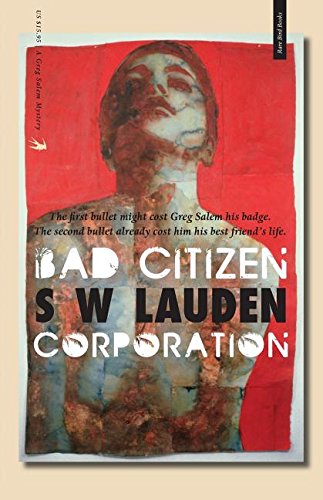
S.W. Lauden: Thanks for having me! Bad Citizen Corporation was always the name of the punk band featured in the novel, but I never considered it for the title until one of my beta readers suggested it. It made sense since the story revolves around the former lead singer of that band, Greg Salem, who goes on to become an East LA cop later in life. He ends up shooting a kid during a pursuit and might lose his badge over the incident—which is bad enough—but then his best friend gets killed by gunmen at a punk show. From there he goes rogue and tries to track down the killer in the beach town where they grew up.

OBAAT: Where did you get this idea, and what made it worth developing for you? (Notice I didn’t ask “Where do you get your ideas?” I was careful to ask where you got this idea.)
SWL: I grew up near the beach in SoCal and spent many years as a musician. I knew I wanted to incorporate those experiences into a crime/mystery novel, but didn’t feel inspired until I came up with the idea for a punk rock cop. I liked the conflict of him surfing and playing shows at the beach on the weekend, but having to be an authority figure at his day job. It’s a nice metaphor for growing up in general, only with more violence and murder.

OBAAT: How long did it take to write Bad Citizen Corporation, start to finish?
SWL: I started it five years ago, writing early in the morning and late at night. Probably had a first draft around three years ago. Made final edits and tweaks on it pretty much up until it got published this October.

OBAAT: Where did Salem come from? In what ways is he like, and unlike, you?
SWL: Greg Salem is all the disparate parts of my life—the good, the bad and the ugly—totally fictionalized, deconstructed, put back together wrong, run through the filter of a faulty memory, and rolled up into one neat little collection of contradictions.

OBAAT: In what time and place is Bad Citizen Corporation set? How important is the setting to the book as a whole?
SWL: The story is primarily set in a fictional SoCal beach town called The Bay Cities. South Bay is where Greg lives now, near the beach and among the wealthy elite. North Bay is the rough-and-tumble, blue-collar neighborhood where Greg grew up. The bulk of the action takes place in the last few years.

The setting was very important to me because, in addition to Greg’s own internal struggles with his past and present, I wanted to explore the juxtaposition between the beach towns I grew up around and what they’ve become over time. Although I have to admit that I rolled other well-known SoCal towns like Santa Barbara and Silverlake into the equation.

OBAAT: How did Bad Citizen Corporation come to be published?
SWL: At first I went the usual route of querying publishers and agents for about a year after I’d gotten to the fourth or fifth draft. Many rejections later, I started going to conferences and joining organizations like MWA and SinC LA. Through all of that, and doing author Q&As on my blog, I got to know the amazing SoCal writer Naomi Hirahara. She introduced me to the team at Prospect Park Books. They read my manuscript and thought it would be a good fit for Tyson Cornell at Rare Bird Books. He agreed. Here we are!

OBAAT: What kinds of stories do you like to read? Who are your favorite authors, in or out of that area?
SWL: I’m pretty immersed in a lot of really great west coast Indie crime and mystery fiction from the likes of Eric Beetner, Anonymous-9, Rob Pierce, Matt Phillips, Will Viharo, Sarah M. Chen, Josh Stallings, Joe Clifford—way too many to name. But, you know what? I’m also a sucker for hooky YA, I enjoy literary fiction, and I will even read the occasional science fiction novel. As for favorite authors, Kurt Vonnegut is the one who really opened my eyes. I also like a lot Umberto Eco’s books, Kem Nunn, Raymond Chandler, Lev Grossman, Don Winslow, Jo Nesbo, Arnaldur Indridason, Neal Stephenson. The list gets longer every day.

OBAAT: What made you decide to be an author?
SWL: I love to read. Not really sure it’s more complicated than that.

OBAAT: How do you think your life experiences have prepared you for writing crime fiction?
SWL: For this book in particular, my life experiences were important. In addition to my music background and where I grew up, a lot of the action is set in bars and clubs. I was a bartender for many years and believe that the people serving your drinks often have the best (and worst) stories to tell about you.

OBAAT: What do you like best about being a writer?
SWL: Coming from bands, it feels like I’ve gone solo. No more organizing rehearsals, gigs or driving around in a beat up old van with three or four other distinct personalities. But I still get to be creative. And I don’t have to worry as much about whether or not my skinny jeans fit (they don’t—deal with it).

OBAAT: Who are your greatest influences? (Not necessarily writers. Filmmakers, other artists, whoever you think has had a major impact on your writing.)
SWL: Hard not to name drop punk heroes like Henry Rollins, Keith Morris, Patti Smith, Iggy Pop and Ian McKay. Dave Grohl and Marc Maron have been great sources of inspiration in recent years, along with Seth Godin. Paul Westerberg always makes me smile. Same with Ryan Adams. James Gunn too. I’ve watched the Grant Hart documentary Every Everything about five times. Everybody should watch the Mike Judge movie Idiocracy.

OBAAT: Do you outline or fly by the seat of you pants? Do you even wear pants when you write?
SWL: I outlined the first draft of BCC, or at least tried to, but Greg Salem wasn’t having any of it. Neither was his sidekick Marco, who wasn’t even in the original concept. Marco was born of long, sleepless nights and a certain kind of computer-fueled punch drunkenness. I’ve come to the conclusion that pants are overrated, unless they’re those sweats that look like jeans.

OBAAT: Give us an idea of your process. Do you edit as you go? Throw anything into a first draft knowing the hard work is in the revisions? Something in between?
SWL: I have to accept that it’s done when I publish it. That’s true of short stories and longer works. Up until that point I will happily tinker and tweak until they come to take me away. So I start at word one and just tap-tap-tappity-tap myself silly. But I do leave extensive notes for myself at the end of every session, making sure to capture whatever stream of consciousness I have managed to get flowing with the plot. Then, when I get to the end, I go back to the beginning and start shredding.

OBAAT: Do you listen to music when you write? Do you have a theme song for this book? What music did you go back to over and over as you wrote it, or as you write, in general?
SWL: It’s hard for me to write with music playing most of the time. Too easily distracted. That said, I had periods during the editing process where I was listening to some of my favorite SoCal punk songs. I made a YouTube playlist that features a lot of that music right HERE. (https://www.youtube.com/playlist?list=PLbNzvRx9lF_Tw6oi-I8iYbhBWNf775kwR)

OBAAT: As a writer, what’s your favorite time management tip?
SWL: Don’t wait for inspiration to strike, the perfect environment, or the right mood. Just sit down and write, whether you’ve got fifteen minutes or a whole day to yourself.

OBAAT: If you could give a novice writer a single piece of advice, what would it be?
SWL: Just do it™

OBAAT: Generally speaking the components of a novel are story/plot, character, setting, narrative, and tone. How would you rank these in order of their importance in your own writing, and can you add a few sentences to tell us more about how you approach each and why you rank them as you do?
SWL: It will probably vary from book to book, but in my case I would say: Character, Narrative, Story/Plot, Tone and Setting. At least that’s my answer at this moment.

I think they’re all important, but as a reader I am most interested in the characters. I’ve put setting last because, although it is crucial in BCC, I’ve found it can be easily fictionalized and manipulated based on character development. If Greg Salem told me he was moving to Bali, I’d follow him there.

Narrative is near the top of the list because it’s closely related to character in my mind, giving shape to the people who drive the action and finding a compelling way to let their stories unfold.

OBAAT: If you could have written any book of the past hundred years, what would it be, and what is it about that book you admire most?
SWL: Too many to choose from. So I’ll go way back and pick Breakfast Of Champions by Kurt Vonnegut. That book hit me in just the right way at just the right time in my life. Ripped my head clean off. I still think of Vonnegut as some kind of surrogate grandpa, although I can’t claim to have inherited any of his amazing talent. Those kinds of personal connections between writers and readers are beautiful things.

OBAAT: Favorite activity when you’re not reading or writing.
SWL: I still like playing drums, although setting them up and breaking them down has lost its luster. Hiking and biking are a constant. Also, long walks on the beach, holding hands and snuggling.

OBAAT: What are you working on now?
SWL: In the middle of final edits for my novella, Crosswise, which comes out from Down & Out Books next March. Just crossed the half way point in the second Greg Salem novel. There will probably be three of those, if everything goes according to plan. Does anything ever go according to plan?

Got your interest piqued? Keep up with Mr. Lauden at these fine Internet locations: